


Top 8 Symptoms of Petrol in Diesel Car: A 2026 UK Driver's Guide
- Misfuelled Car Fixer
- Jan 27
- 17 min read
Updated: Feb 18
24/7 Hotline Nationwide: 0800 999 1182
National Wrong Fuel Rescue: https://www.misfuelledcarfix.co.uk
If you found this page, we cover you in England!
Book Online:
It's a common mistake with potentially costly consequences: putting unleaded petrol into a diesel vehicle. Modern diesel engines are highly sophisticated systems that rely on the specific lubricating properties and combustion characteristics of diesel fuel. Introducing petrol, a solvent, strips this vital lubrication, leading to friction, heat, and severe damage to critical components like the high-pressure fuel pump and injectors. But how do you know for sure if you've made this error? The symptoms of petrol in a diesel car often appear quickly, and recognising them is the first crucial step to preventing thousands of pounds in repairs.
This guide is designed to help you identify the problem instantly. We will walk you through the 8 most common warning signs, explaining what they mean, how serious they are, and exactly what you should (and shouldn't) do next. From rough idling and power loss to unusual smoke from the exhaust, each symptom is a clear signal that your engine is in trouble.
Crucially, if you suspect you've misfuelled, do not start the engine. If you already have, stop driving immediately and call for professional assistance. Taking the right actions now can save your engine and your wallet. This list will give you the clarity needed to act fast and correctly.
1. Petrol in Diesel Car | Engine Misfire and Rough Idling
One of the earliest and most noticeable symptoms of petrol in a diesel car is a sudden change in engine performance, specifically misfiring and rough idling. This happens because petrol disrupts the precise combustion process that diesel engines rely on. Diesel engines use high compression to ignite fuel, whereas petrol is designed to be ignited by a spark plug and has a much lower flash point.
When petrol mixes with diesel, it lowers the cetane rating of the fuel. This causes premature and uncontrolled detonations inside the engine cylinders, rather than the smooth, powerful burn diesel engines are designed for. The result is an engine that stutters, shakes, and sounds uneven, especially when stationary or at low speeds. This symptom often appears within minutes of starting the engine after the misfuelling incident.

Why It Happens So Quickly
A rough idle is an immediate red flag because the contaminated fuel quickly reaches the engine's sensitive injection system. The petrol acts as a solvent, stripping away the lubricating properties of diesel fuel, which can cause friction and damage to the fuel pump and injectors. Even a small amount of petrol in a diesel car can cause these issues.
Real-World Example: A delivery driver fills their van and pulls away from the petrol station. At the first set of traffic lights, they notice the vehicle is vibrating unusually and the engine note is erratic and weak. This is a classic sign that the wrong fuel is circulating.
What You Must Do Immediately
If you suspect you've misfuelled and your engine starts running rough, your immediate actions are critical to prevent catastrophic engine damage.
STOP: Safely pull over as soon as you can and turn off the engine.
DO NOT RESTART: Do not attempt to "drive it out" or hope the problem will fix itself. Every second the engine runs increases the risk of expensive damage.
CALL FOR HELP: Contact a specialist misfuel service immediately. Our team at Misfuelled Car Fix is available 24/7 at 0800 999 1182 for a rapid fuel drain.
PROVIDE DETAILS: Inform the technician how long the engine was running with the wrong fuel, as this helps them assess the potential extent of contamination.
2. Difficulty Starting or Complete No-Start Condition
Another of the most common symptoms of petrol in a diesel car is significant trouble starting the engine, or it failing to start at all. This occurs because petrol fundamentally alters the combustion process. Diesel engines require the high pressure of the compression stroke to auto-ignite the fuel, a process that relies on diesel's high cetane rating. Petrol, with its low cetane number, resists compression ignition and needs a spark plug to ignite.
When petrol contaminates the diesel, it drastically lowers the fuel's ability to ignite under compression. The engine may turn over and over as you crank the ignition, but it won't fire up. In some cases, it might start for a moment before sputtering and stalling immediately. This symptom is a direct result of the engine not being able to combust the incorrect fuel mixture properly.
Why It Happens So Quickly
A no-start condition is a clear indicator because the contaminated fuel has already been drawn from the tank and into the fuel lines and injectors. The fuel pump attempts to pressurise the petrol/diesel mixture, but the engine's cylinders cannot achieve the right conditions for combustion. Each failed attempt to start circulates more of the damaging, non-lubricating petrol through the sensitive high-pressure fuel system.
Real-World Example: A rental car customer fills up their hired diesel vehicle at the airport before returning it. The next person to rent the car cannot get it to start in the car park. They check the fuel receipt and realise the previous driver put petrol in by mistake.
What You Must Do Immediately
If your diesel car won't start after you've just refuelled, it is crucial not to force the issue. Your next steps can prevent thousands of pounds in repairs.
STOP: Cease all attempts to crank the engine. Repeatedly trying to start it can burn out the starter motor and force more petrol into the fuel pump and injectors, causing severe damage.
DO NOT RESTART: Resist the urge to keep trying. The vehicle will not "clear itself".
CALL FOR HELP: Contact a specialist wrong fuel drainage service without delay. Our Misfuelled Car Fix technicians are on call 24/7 at 0800 999 1182 to perform a safe and complete fuel drain.
CONFIRM FUEL: If possible, check your fuel receipt to confirm you used the wrong pump. This information is vital for the technician. A professional can provide guidance on how to drain a fuel tank safely and efficiently.
3. Loss of Power and Poor Acceleration
Another critical symptom of petrol in a diesel car is a significant and sudden loss of power, coupled with sluggish acceleration. This occurs because petrol and diesel have fundamentally different combustion properties. Petrol ignites far too easily under the high-compression conditions of a diesel engine, leading to an inefficient and incomplete burn that fails to generate the required energy.
The contaminated fuel mixture cannot be properly atomised by the injectors, resulting in a dramatic drop in the engine's power output. You will notice the vehicle feels weak and unresponsive, struggling to climb hills or get up to speed. This is one of the most common and dangerous symptoms of petrol in a diesel car, especially if it occurs while driving on a fast-moving road.

Why It Happens So Quickly
The loss of power is an immediate consequence of the fuel's altered chemical makeup. Diesel fuel is an oil, providing lubrication as it powers the engine. Petrol, however, is a solvent and strips this essential lubrication from the high-pressure fuel pump and injectors. This not only causes damage but also prevents the fuel system from delivering the correct pressure needed for effective combustion, leading to the noticeable drop in performance. You can learn more about the damage petrol in a diesel car can cause and why swift action is essential.
Real-World Example: A motorist misfuels their diesel estate car and merges onto a motorway. As they try to accelerate to match the flow of traffic, the car feels incredibly sluggish and cannot get above 40 mph, creating a hazardous situation for them and other road users.
What You Must Do Immediately
Experiencing a sudden loss of power puts you and others at risk. Your priority is to get the vehicle to a safe location without delay.
STOP: Use your hazard lights and safely navigate to the hard shoulder or the nearest safe place to stop. Turn off the engine immediately.
DO NOT RESTART: Continuing to drive with reduced power will force contaminated fuel through the entire system, guaranteeing more extensive and costly damage.
CALL FOR HELP: Contact a specialist misfuelling service like Misfuelled Car Fix at 0800 999 1182. Our technicians can reach you quickly to perform a full fuel drain.
PROVIDE DETAILS: Tell the technician when you refuelled and when the power loss started. This information is vital for them to assess the situation properly.
4. White or Blue Smoke from Exhaust
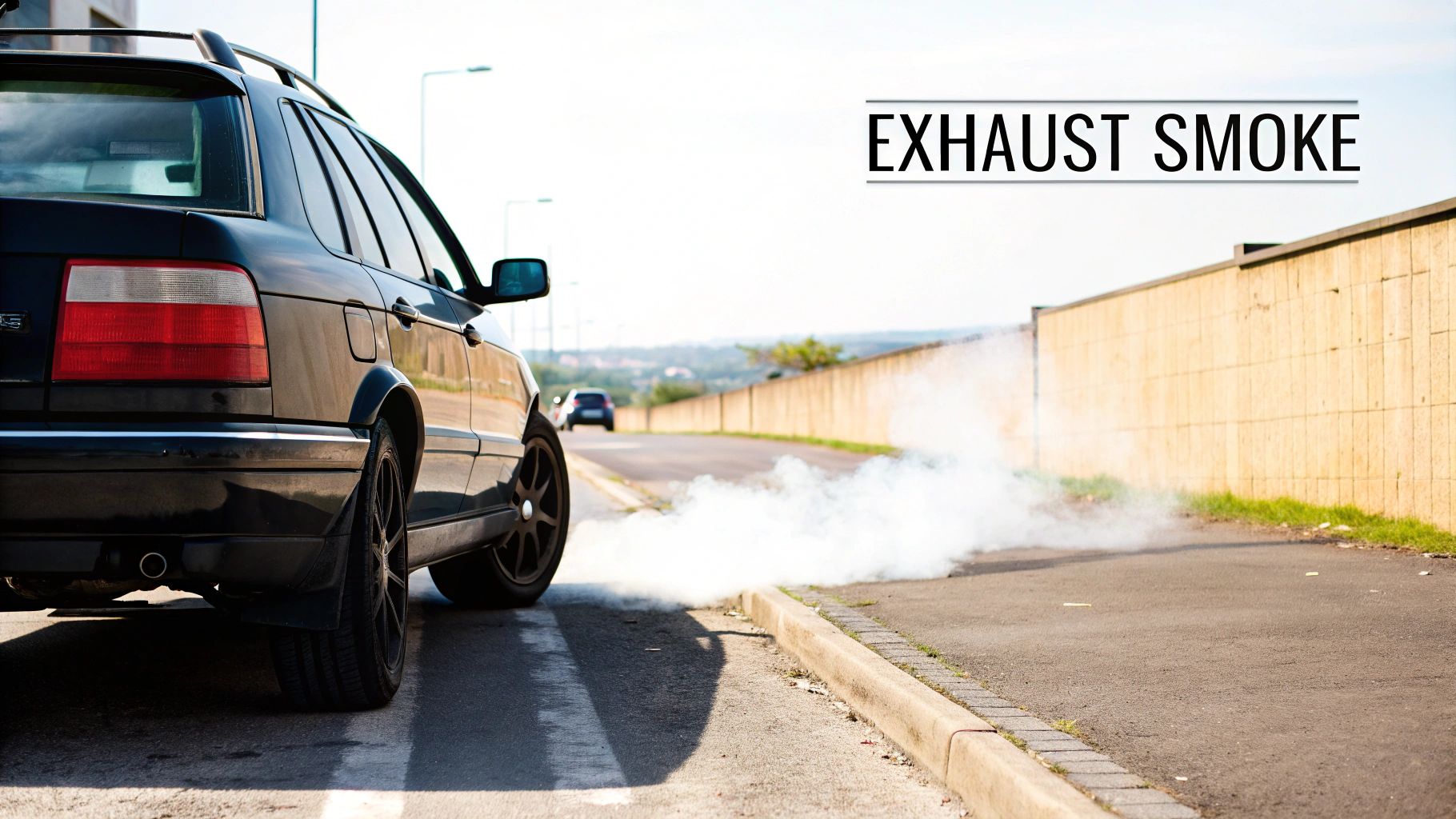
A highly visible and alarming symptom of petrol in a diesel car is the emission of excessive white or blue smoke from the exhaust pipe. This is a direct consequence of the wrong fuel being burned in an engine not designed for it. Petrol's different chemical properties and combustion characteristics lead to incomplete burning in a diesel engine's high-compression environment.
When petrol enters the diesel engine, it doesn't combust cleanly or completely. The white smoke is typically unburnt petrol vapourising due to the engine's heat, while blue-tinged smoke indicates that engine oil is being burnt alongside the fuel. This happens because petrol's solvent nature strips away the essential lubricating film from cylinder walls, allowing oil to seep past the piston rings and into the combustion chamber. This smoke is often most noticeable shortly after starting the engine and will likely worsen under acceleration.
Why It Happens So Quickly
The appearance of smoke is a rapid indicator of a serious problem because it signals that the contaminated fuel has already circulated through the engine and is being improperly combusted. The lack of lubrication caused by the petrol also means critical engine components are already experiencing increased friction and wear. This isn't a symptom that will clear on its own; it's a sign that damage is actively occurring.
Real-World Example: A driver misfuels their diesel car and drives onto a motorway. As they accelerate to merge with traffic, another motorist frantically honks and points towards the rear of their vehicle. The driver checks their mirror and sees clouds of white smoke billowing from the exhaust, a clear sign of severe engine distress from the wrong fuel.
What You Must Do Immediately
Seeing unusual smoke from your exhaust after refuelling is an undeniable warning. Your response must be swift to prevent irreversible and costly damage to your engine and fuel system.
STOP: Find the first safe place to pull over, such as a lay-by or the hard shoulder, and switch off the ignition immediately.
DO NOT RESTART: Continuing to run the engine will only force more of the damaging petrol/diesel mix through the system, exacerbating the problem.
CALL FOR HELP: Contact a specialist wrong fuel recovery service. Our expert technicians at Misfuelled Car Fix are on call 24/7 at 0800 999 1182 to provide an urgent fuel drain and system flush.
AVOID GUESSWORK: Do not attempt to "clear" the engine by revving it or driving at high speed. This will only accelerate the damage.
5. Fuel System Knocking and Diesel Knock Sound
One of the more alarming symptoms of petrol in a diesel car is a loud, metallic knocking or pinging sound coming from the engine. This noise is distinctly different from the usual clatter of a healthy diesel engine and indicates a serious and potentially destructive problem with the combustion process. This is often referred to as "diesel knock" and is a direct result of petrol's very different ignition properties.
Petrol ignites at much lower temperatures and pressures than diesel. When it contaminates the fuel, it causes premature and uncontrolled detonations inside the engine's cylinders. Instead of a smooth, powerful push against the piston, you get a series of violent, poorly timed explosions. This extreme stress on the engine's internal components, such as pistons, connecting rods, and injectors, is what creates the loud, rattling noise.
Why It Happens So Quickly
The knocking sound can begin almost immediately after starting the engine with contaminated fuel. The fuel pump forces the petrol/diesel mix into the high-pressure injectors, which then spray it into the cylinders. The pre-detonation caused by the petrol's presence sends shockwaves through the engine, creating the audible knock. Every revolution of the engine with this contaminated fuel is actively causing damage.
Real-World Example: A fleet driver, familiar with the normal sound of their diesel vehicle, pulls away after refuelling and immediately notices a harsh, metallic clattering sound that gets worse when they accelerate. Recognising this abnormal noise as a critical symptom, they know something is seriously wrong with the fuel.
What You Must Do Immediately
Hearing this sound is an undeniable sign of a major problem. Continuing to drive will almost certainly lead to catastrophic and costly engine failure.
STOP: Pull over to a safe location as quickly and safely as possible and switch off the engine.
DO NOT REV THE ENGINE: Attempting to "clear it out" by revving the engine will only increase the pressure and the force of the detonations, worsening the damage.
CALL FOR HELP: Contact a specialist misfuel recovery service without delay. Our Misfuelled Car Fix team is on call 24/7 at 0800 999 1182 to provide urgent assistance.
PROVIDE DETAILS: When you call, inform the technician that you hear a loud knocking sound and for how long it has been happening. This information is vital for them to assess the severity of the situation.
6. Black Smoke and Excessive Emissions
Another highly visible and alarming symptom of petrol in a diesel car is the emission of thick, black smoke from the exhaust pipe. This is a direct result of incomplete fuel combustion. Diesel engines are calibrated to burn diesel fuel efficiently under high compression, but the introduction of petrol creates a fuel mixture that the engine cannot process correctly.
When petrol enters the diesel engine, its lower flashpoint and different chemical properties lead to a "rich" fuel mixture that doesn't burn completely. This incomplete combustion produces significant amounts of soot and unburnt hydrocarbons, which are expelled as dense, dark smoke. This is often accompanied by a strong, acrid petrol smell, which is different from the usual diesel exhaust odour. This symptom is a clear indication that the fuel contamination is severe.
Why It Happens So Quickly
Black smoke can appear very quickly after starting the engine with contaminated fuel. The incorrectly burning fuel mixture immediately creates excess carbon, which is forced out through the exhaust system. This process not only looks bad but can also cause serious and expensive damage to modern emissions control systems, such as the catalytic converter and the Diesel Particulate Filter (DPF), which can become clogged with soot.
Real-World Example: A fleet van driver misfuels their vehicle and continues on their route. Within a few miles, they notice clouds of black smoke billowing from the exhaust every time they accelerate. This not only poses an environmental concern but also risks a roadside prohibition notice from authorities for excessive emissions.
What You Must Do Immediately
Seeing black smoke from your exhaust after refuelling is a critical warning sign that requires immediate action to prevent long-term damage to your vehicle's engine and emissions system.
STOP: Find the nearest safe place to pull over and switch off the engine completely.
DO NOT RESTART: Continuing to drive will force more unburnt fuel and soot through the exhaust, potentially ruining the DPF, which is very costly to replace.
CALL FOR HELP: Contact a professional misfuelling service without delay. Our rapid response team at Misfuelled Car Fix is on standby 24/7 at 0800 999 1182 to perform an emergency fuel drain.
PROVIDE DETAILS: Let the technician know about the black smoke. This information helps them understand that the emissions system may also need inspection after the fuel system is cleaned.
7. Dashboard Warning Lights and Error Codes
Modern vehicles are equipped with sophisticated onboard computers that monitor engine performance, and one of the most direct symptoms of petrol in a diesel car is the sudden illumination of dashboard warning lights. These lights are your car's primary way of alerting you to a serious internal problem, which includes fuel contamination.
When petrol is introduced into a diesel system, the Engine Control Unit (ECU) detects irregularities almost immediately. Sensors monitoring fuel pressure, oxygen levels in the exhaust, and injection timing will send data that falls outside of normal operating parameters. This triggers a fault and activates warning lights like the Check Engine Light (CEL), Engine Management Light (EML), or a specific fuel system warning.
Why It Happens So Quickly
Warning lights activate because the petrol disrupts the precise, computer-controlled combustion process. The lower lubricity and different burn characteristics of petrol cause fuel pressure sensors to report errors and oxygen sensors to detect incomplete or improper combustion. The ECU interprets these signals as a critical failure and immediately warns the driver to prevent further damage.
Real-World Example: A driver misfuels their new diesel car and starts the engine. Within a couple of miles, the amber Check Engine Light flashes on the dashboard, accompanied by a message on the infotainment screen advising them to seek immediate service. This is the car’s self-diagnostic system identifying the dangerous fuel mix.
What You Must Do Immediately
Dashboard warning lights should never be ignored, especially after refuelling. They are a clear sign that you must stop driving.
STOP: Pull over safely as soon as the warning light appears. Turn off the engine immediately.
DO NOT RESTART: Restarting the engine will continue to circulate the contaminated fuel, worsening the damage to sensitive components.
CALL FOR HELP: Contact a specialist misfuel service right away. Our Misfuelled Car Fix technicians are available 24/7 on 0800 999 1182 to perform a complete fuel drain and system flush.
PROVIDE DETAILS: Note which specific lights are on (e.g., Check Engine, glow plug light flashing) and tell the technician. This information helps them diagnose the issue more efficiently.
8. Fuel Filter Blockage and Fuel Pressure Drop
Another critical symptom that can develop after putting petrol in a diesel car is a significant drop in fuel pressure, often caused by a blocked fuel filter. This issue arises because petrol lacks the viscosity and lubricating qualities of diesel, and its solvent properties can dislodge contaminants or create a gummy residue that clogs the fine mesh of the diesel fuel filter.
When petrol is introduced, it can cause particles within the fuel system to break loose and accumulate in the filter. This restriction reduces the flow of fuel to the high-pressure pump, leading to a noticeable drop in performance. Your vehicle's engine control unit (ECU) monitors fuel pressure constantly, and a sudden drop will often trigger a warning light on the dashboard and may put the car into a reduced power "limp mode".
Why It Happens
The fuel filter is designed specifically for the properties of diesel fuel. Petrol's different chemical makeup can cause the filter's paper or synthetic media to swell or degrade, or it can create a varnish-like substance that blocks the pores. This blockage starves the engine of the fuel it needs to run, preventing the injectors from atomising fuel correctly. This leads to power loss, hard starting, and eventually, a complete engine cut-out as the fuel supply is choked off.
Real-World Example: A fleet driver misfuels their commercial vehicle and continues driving. Over the next hour, they notice the van becoming progressively weaker, especially on inclines. Eventually, the vehicle stalls on a motorway and will not restart. This is a classic sign of the fuel filter becoming completely blocked by the contaminated fuel.
What You Must Do Immediately
A fuel pressure warning or a gradual loss of power after refuelling is a serious indicator of misfuelling.
STOP: Find a safe place to pull over and switch off the ignition immediately.
DO NOT RESTART: Attempting to force the engine to run will only pull more contaminants through the system, increasing the risk of damaging the expensive high-pressure pump and injectors.
CALL FOR HELP: Contact a specialist misfuel drainage service. Our technicians at Misfuelled Car Fix are on call 24/7 at 0800 999 1182 to provide urgent assistance.
REQUEST A FILTER CHANGE: When you call, mention the symptoms. A professional service will recommend and perform a fuel filter replacement as part of the fuel drain process to ensure the system is clear and functions correctly.
Petrol-in-Diesel: 8-Point Symptom Comparison
Symptom | 🔄 Complexity to resolve | ⚡ Resources / Urgency | 📊 Expected impact | ⭐ Diagnostic clarity | 💡 Recommended action |
|---|---|---|---|---|---|
Engine Misfire and Rough Idling | Moderate — fuel drain + injector check; possible injector replacement if run long | High urgency — mobile fuel drain/flush, inspection tools | Irregular idle, stuttering, progressive injector damage if continued | ⭐ High — audible/vibratory symptom often with CEL | Stop immediately, do not restart, call professional fuel drain and document refuelling |
Difficulty Starting or Complete No-Start Condition | Low–Moderate — usually resolved by drain/flushing; may need starter inspection if over-cranked | Immediate critical — avoid repeated cranking; mobile recovery or tow + drain | Extended cranking or no start; starter stress; prevents driving | ⭐ High — clear no-start distinguishes from battery faults | Stop cranking, confirm pump receipt, call 24/7 misfuel service for mobile drain |
Loss of Power and Poor Acceleration | Moderate — drain + possible injector cleaning/replacement | High urgency — unsafe for motorway use; rapid mobile service recommended | Large power drop (30–60%), poor hill/tow performance, potential stalls | ⭐ High — noticeable performance loss | Pull to safety, avoid highways, request specialist fuel drain and injector check |
White or Blue Smoke from Exhaust | Moderate–High — indicates combustion/oil contamination; may need turbo or internal inspection | Immediate — visible emissions; stop driving and call technician | Visible white/blue smoke, strong fuel smell, possible turbo/oil contamination | ⭐ Very high — visually unmistakable | Stop driving, document photos, do not rev or attempt to clear; call fuel drain service |
Fuel System Knocking and Diesel Knock Sound | High — risk of internal damage; may require injector/piston/turbo repair | Immediate critical — shut down engine to avoid catastrophic damage | Loud metallic knock; rapid escalation to internal component failure | ⭐ Very high — distinct and urgent auditory cue | Switch off engine, do not rev, arrange emergency recovery and urgent diagnostics |
Black Smoke and Excessive Emissions | Moderate–High — drain plus DPF/catalyst inspection likely needed | High — emissions system at risk; cease operation promptly | Thick soot, DPF/catalyst damage risk, failed emissions tests | ⭐ Very high — heavy black smoke is obvious | Stop, call for fuel drain and DPF inspection, avoid driving to clear smoke |
Dashboard Warning Lights and Error Codes | Low–Moderate — diagnostic scan pinpoints faults; repair depends on findings | Medium — can sometimes be driven to service but diagnose promptly | Early detection of fuel/injection anomalies; helps scope repairs | ⭐ Medium — informative but not always specific to misfuel | Note lights/codes, do not clear, get professional scan and fuel-system check |
Fuel Filter Blockage and Fuel Pressure Drop | Moderate — requires filter replacement, bleeding, possible injector cleanup | High (may strand vehicle later) — monitor pressure, act before starvation | Gradual power loss, stalling, fuel starvation when filter clogs | ⭐ Medium–High — pressure readings and stalling indicate blockage | Replace fuel filter during misfuel service, bleed system, avoid driving if pressure warning appears |
Spotted a Symptom? Here's Your Next Move
Recognising the symptoms of petrol in a diesel car is the crucial first step, but what you do in the moments that follow can make the difference between a simple inconvenience and a catastrophic engine failure. This guide has detailed the critical warning signs, from the unmistakable clatter of a misfiring engine and rough idling to the alarming sight of white or blue smoke billowing from your exhaust. We've explored how a loss of power, difficulty starting, and specific dashboard warning lights all point towards the same costly mistake: misfuelling.
The common thread linking all these symptoms is the destructive nature of petrol in a diesel engine. Petrol acts as a solvent, stripping away the essential lubrication that diesel fuel provides. This lack of lubrication causes metal components within the high-pressure fuel pump and injectors to grind against each other, generating metal particles that contaminate the entire fuel system. Every second the engine runs, this contaminated mixture is circulated, amplifying the damage exponentially.
Your Immediate Action Plan
If you suspect you've put petrol in your diesel car, your response must be immediate and decisive. The single most important action you can take is to stop the engine immediately and, if you haven't started it yet, do not turn the key in the ignition.
Do Not Drive: Attempting to "drive it out" is the worst possible course of action. It guarantees that the damaging petrol-diesel mix will be forced through every delicate component of your fuel system.
Do Not Restart the Engine: If the car has stalled, resist the instinct to try and start it again. Each attempt to crank the engine primes the fuel pump, pulling more of the wrong fuel from the tank.
Do Not Top Up with Diesel: Diluting the petrol with the correct fuel will not solve the problem. Even a small percentage of petrol is enough to cause significant lubrication failure and damage.
Key Takeaway: The moment you suspect a misfuel, your vehicle becomes a stationary object. Do not attempt any DIY solutions or believe common myths. The only safe and effective solution is a professional fuel drain.
The Professional Solution to Misfuelling
This situation is not a job for a general mechanic and certainly not a task to attempt yourself. Draining a modern fuel system requires specialised, ATEX-approved pumping equipment to handle flammable fuel safely. It also involves flushing the fuel lines, replacing the fuel filter, and ensuring every trace of the contaminated fuel is removed before the system is reprimed with clean diesel.
This is precisely where a dedicated mobile misfuelling service becomes essential. Rather than risking further damage by driving to a garage or paying for expensive recovery trucks and main dealer labour rates, a specialist can resolve the issue right where you are. Whether you're stranded on the forecourt, stuck on the side of a busy road, or have only just realised the mistake at home, a rapid-response mobile service is your most efficient and cost-effective path forward. By understanding the symptoms of petrol in a diesel car and acting fast, you protect your vehicle's engine, save yourself from exorbitant repair bills, and turn a potential disaster into a manageable problem.
If you've noticed any of these symptoms and need immediate, professional help, don't hesitate. Contact Misfuelled Car Fix for a rapid 24/7 mobile fuel drain service across England. Our certified technicians will safely correct the mistake on-site, getting you back on the road quickly and preventing costly engine damage. Visit Misfuelled Car Fix or call our freephone number for immediate assistance.