Wrong Fuel in Car A Practical Misfuel Recovery Guide

Updated: Feb 18
24/7 Hotline Nationwide: 0800 999 1182
National Wrong Fuel Rescue: https://www.misfuelledcarfix.co.uk
If you found this page, we cover you in England!
Book Online:
Misfuel recovery is the process of safely draining the wrong fuel from your car's tank and flushing the entire system to stop engine damage in its tracks. If you've put petrol in a diesel car or vice versa, the single most critical thing to remember is do not start the engine. Not even for a second. Starting the car is what sends the contaminated fuel rushing through the system, and that’s where the expensive damage happens.
The good news? A professional mobile service can usually have the whole mess sorted right where you are in about 60-90 minutes.
That Sinking Feeling: The First Crucial Steps After Misfuelling
It’s a moment of pure dread. You’ve just hung up the fuel nozzle, and a cold realisation washes over you—you’ve used the wrong one. It’s a simple mistake that happens far more often than you’d think, especially when you're tired, distracted, or driving an unfamiliar car.
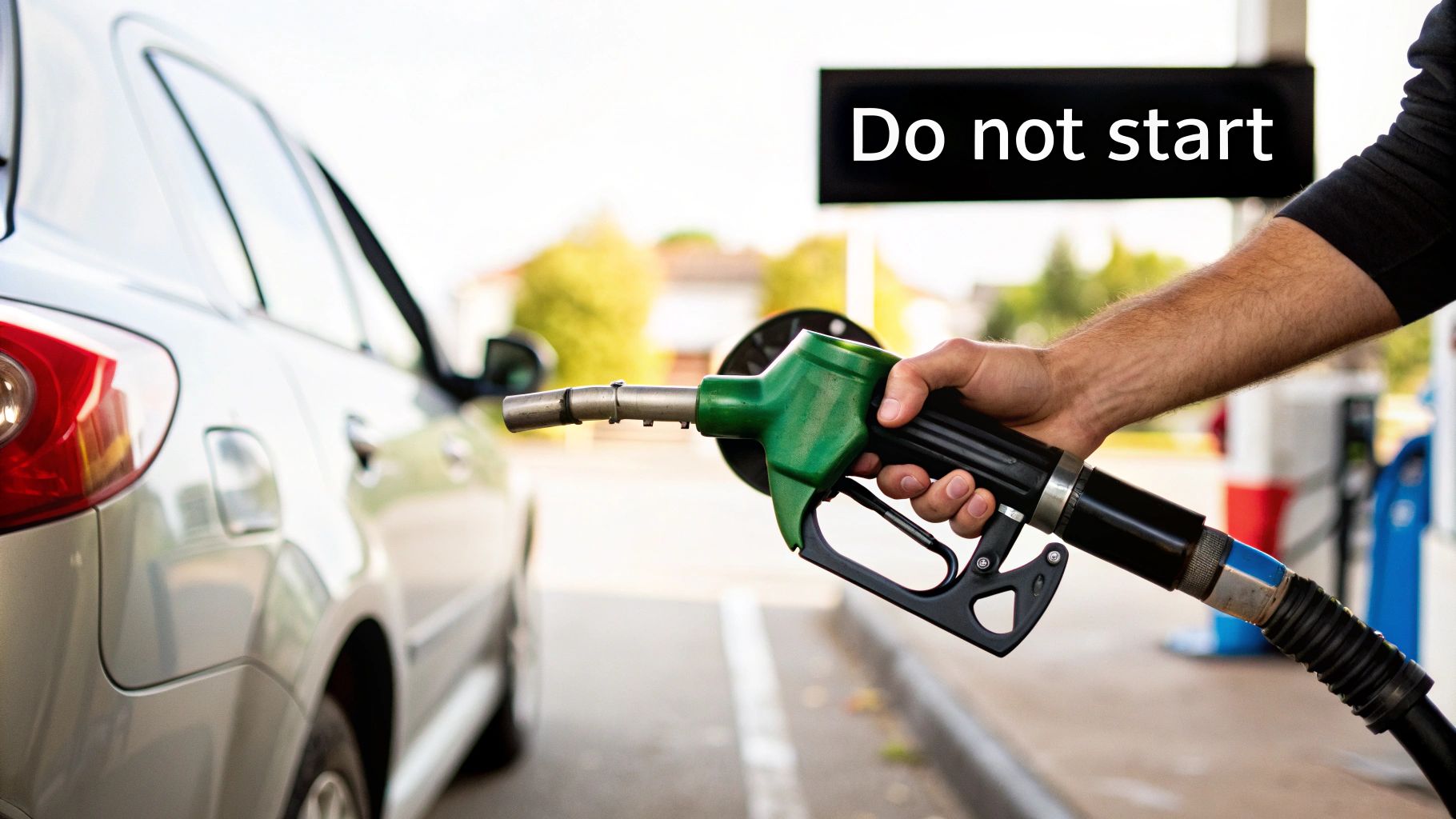
Trust me, you are not alone. In the UK, around 150,000 motorists make this exact mistake every single year. It’s a common slip-up affecting everyone from fleet operators to everyday drivers, and with so many diesel cars still on the road, it’s usually petrol going into a diesel tank that causes the biggest headache.
What you do in the next few minutes is absolutely vital. It can be the difference between a quick, relatively cheap fix and a repair bill that runs into thousands of pounds. The key is to stay calm and follow a clear plan.
Recognising the Symptoms of Misfuelling
If you realise your mistake at the pump, before you’ve even put the keys in the ignition, you’re in the best possible position. But sometimes the penny doesn't drop until you’re already back on the road. The symptoms your car will throw up depend on the type of misfuel and how far you've driven.
Keep an eye (and an ear) out for these common signs:
A spluttering or coughing engine: The car will struggle to run smoothly as the wrong fuel just won't combust correctly.
Excessive smoke from the exhaust: You might see clouds of white or black smoke, which is a clear signal the engine is in distress.
A noticeable loss of power: The car will feel sluggish and weak, with no real acceleration.
Loud knocking or rattling noises: These are alarming sounds that can mean friction and damage are happening inside the engine right now.
Complete engine failure: In many cases, the engine will just cut out and refuse to restart.
If you experience any of these symptoms right after filling up, pull over somewhere safe as soon as you can, switch off the engine, and get your hazard lights on.
Crucial Takeaway: The golden rule of misfuelling is simple: Do Not Start The Engine. Even turning the key to the 'on' position can prime the fuel pump, sending that damaging mixture into the fuel lines. This is where the real trouble begins.
Your Immediate Action Plan
Once you know you've misfuelled, your response needs to be swift and precise. Don't be tempted to try a "quick fix" or just hope for the best. Instead, focus on containing the problem.
This quick table breaks down exactly what you need to do—and what you absolutely must avoid.
Immediate Misfuel Action Plan: What To Do vs. What To Avoid
Action to Take Immediately (DO) | Actions to Avoid at All Costs (DON'T) |
|---|---|
Stay where you are if it's safe. Don’t start the car. | Do NOT start the engine or even turn the ignition on. |
Put the car in neutral. | Do NOT try to drive to a garage, even if it's just down the road. |
Inform the petrol station staff if you're on the forecourt. | Do NOT attempt to drain the fuel yourself. It's dangerous and needs specialist tools. |
Call a professional misfuel recovery service immediately. | Do NOT assume a small amount of wrong fuel won't hurt. Even 5% can cause damage. |
Following these simple 'DOs' prevents the contaminated fuel from circulating, which is the number one cause of serious engine damage. A mobile technician has all the right kit to perform a safe and thorough fuel drain on the spot.
For a deeper dive into the clean-up process, check out our UK driver’s guide to cleaning out a fuel tank after misfuelling. This ensures every last drop of the wrong fuel is removed, protecting your car's most sensitive—and expensive—components.
Petrol in Diesel vs Diesel in Petrol: Understanding the Damage
It’s a common assumption that any fuel mix-up is pretty much the same. But that’s not the case at all. The type of fuel you’ve put in your car, and the kind of engine it has, completely changes the potential for damage. While any wrong fuel situation needs sorting out fast, putting petrol into a modern diesel engine is by far the more destructive—and expensive—mistake.
To get why, you need to understand the basic jobs these fuels do. Diesel isn't just for the 'bang'; it’s also a critical lubricant for many of the high-pressure components inside a diesel engine.
The Critical Damage of Petrol in a Diesel Engine
Modern diesel engines are precision-engineered bits of kit, operating under immense pressure. They rely on the oily nature of diesel to keep parts like the high-pressure fuel pump and injectors moving smoothly against each other. When you pour petrol in, it acts like a powerful solvent.
Think of it like trying to wash engine grease off your hands. Water won't do much, but a bit of solvent strips it away instantly. Petrol does exactly the same thing inside your engine, washing away that essential lubricating film.
This triggers a cascade of serious problems:
Metal-on-Metal Friction: Without that oily film, vital components start grinding against one another. This friction generates tiny metal particles, which we call swarf.
Component Destruction: The high-pressure fuel pump is almost always the first casualty, quickly followed by the injectors. Replacing these parts is a complex and very expensive job.
System-Wide Contamination: That swarf doesn't just stay put. It gets pumped through the entire fuel system, contaminating the tank, fuel lines, and filters, meaning the whole system needs an intensive clean-out.
Even a small amount of petrol can kickstart this destructive chain reaction. The longer the engine runs, the more widespread and catastrophic the damage becomes, often resulting in a repair bill that can easily run into thousands of pounds.
The Less Severe Case of Diesel in a Petrol Engine
Now, while it’s still a serious problem that needs a misfuel recovery professional to sort out, putting diesel into a petrol car is generally less catastrophic. Petrol engines work differently and their fuel systems aren't reliant on the fuel for lubrication in quite the same way.
The main problem here is that diesel is much thicker, oilier, and far less flammable than petrol. It simply won't ignite properly from a spark plug.
Instead of causing destructive wear, the diesel will clog up the works. It can foul the spark plugs, block the fuel filter, and coat the injectors. This will cause the engine to run very poorly, misfire, or simply refuse to start at all. More often than not, the car will just cut out, which actually prevents much more serious damage from occurring.
The Sneaky Problem with AdBlue
There's a third, less common but equally serious mistake modern diesel drivers can make: pouring AdBlue into the main diesel tank. It's an easy mistake to make, but AdBlue is an exhaust fluid, not a fuel additive, and it lives in its own separate, smaller tank.
If it gets mixed with your diesel, the consequences are disastrous:
It is corrosive to many of the metals, plastics, and seals used in a modern fuel system.
When mixed with diesel, it can crystallise, forming solid chunks that block the fuel pump, filters, and injectors.
Repairing a contaminated Selective Catalytic Reduction (SCR) system is often one of the most eye-watering misfuelling repairs you can face.
This kind of complexity is exactly why specialist recovery services are more in demand than ever. In fact, the UK vehicle assistance sector, which includes expert misfuel recovery, is forecast to grow into a £2.2 billion industry by 2025. This reflects the constant need for rapid, expert roadside help for motorists across the country.
Ultimately, it doesn't matter what the specific mix-up is—acting fast is what counts. Understanding the potential damage helps you see why calling for a professional fuel drain is the only truly safe and effective solution. You can learn more about the specific wrong fuel in car symptoms to look out for in our detailed guide.
Inside a Professional Misfuel Recovery Service
When you make that urgent call for help, the calm, professional voice on the other end of the line is just the start. What kicks into gear is a highly organised and efficient process designed to get you back on your journey with minimal fuss and, crucially, zero damage to your vehicle.
Let's pull back the curtain on what our mobile misfuel technicians actually do when they arrive.
From the moment a technician gets to you, their priority is safety. They'll secure the area around your car—an absolutely vital step if you're stranded on a busy roadside. Every part of the process is methodical, not just for your safety but also to comply with strict environmental regulations for handling hazardous materials like contaminated fuel.
The Fuel Drain: The First Technical Step
The heart of the misfuel recovery process is the fuel drain itself. This isn't a simple case of siphoning with a hose and a jerry can. Modern fuel tanks are fitted with anti-siphoning devices that make this impossible, not to mention extremely dangerous to even attempt yourself.
Our technicians use specialised, mobile pumping equipment that is ATEX-approved. This certification is non-negotiable—it means the gear is intrinsically safe and designed specifically for use in potentially explosive atmospheres, which is exactly what you get when dealing with petrol vapour. The pump is connected directly to your fuel tank, and the entire contaminated mixture is drained into a secure, sealed container inside the van.
This step gets the vast majority of the wrong fuel out, but it's really only the beginning of the job.
System Flushing: Removing Every Last Trace
Simply draining the tank is never enough, especially if you turned the ignition on or, worse, started the engine. The moment you do that, contaminated fuel is pulled into the fuel lines, filter housing, and potentially right into the injectors or high-pressure pump.
Leaving even a small residue behind is asking for trouble. It can lead to poor running, long-term performance issues, or even component failure weeks or months down the line. This is where a full system flush becomes absolutely critical.
The technician will:
Introduce a small amount of clean, correct fuel into the now-empty tank.
Circulate this clean fuel through the entire system, from the tank, down the fuel lines, and through the engine components.
Drain this flushing fuel out again, which carries the last remnants of the contaminated mixture with it.
This step ensures that when we finally add the correct fuel, it's going into a completely clean and uncontaminated environment. It’s a meticulous but essential part of a proper, professional misfuel recovery.
The infographic below really brings home the different types of damage that can occur, highlighting why this thorough clean-out is so vital.
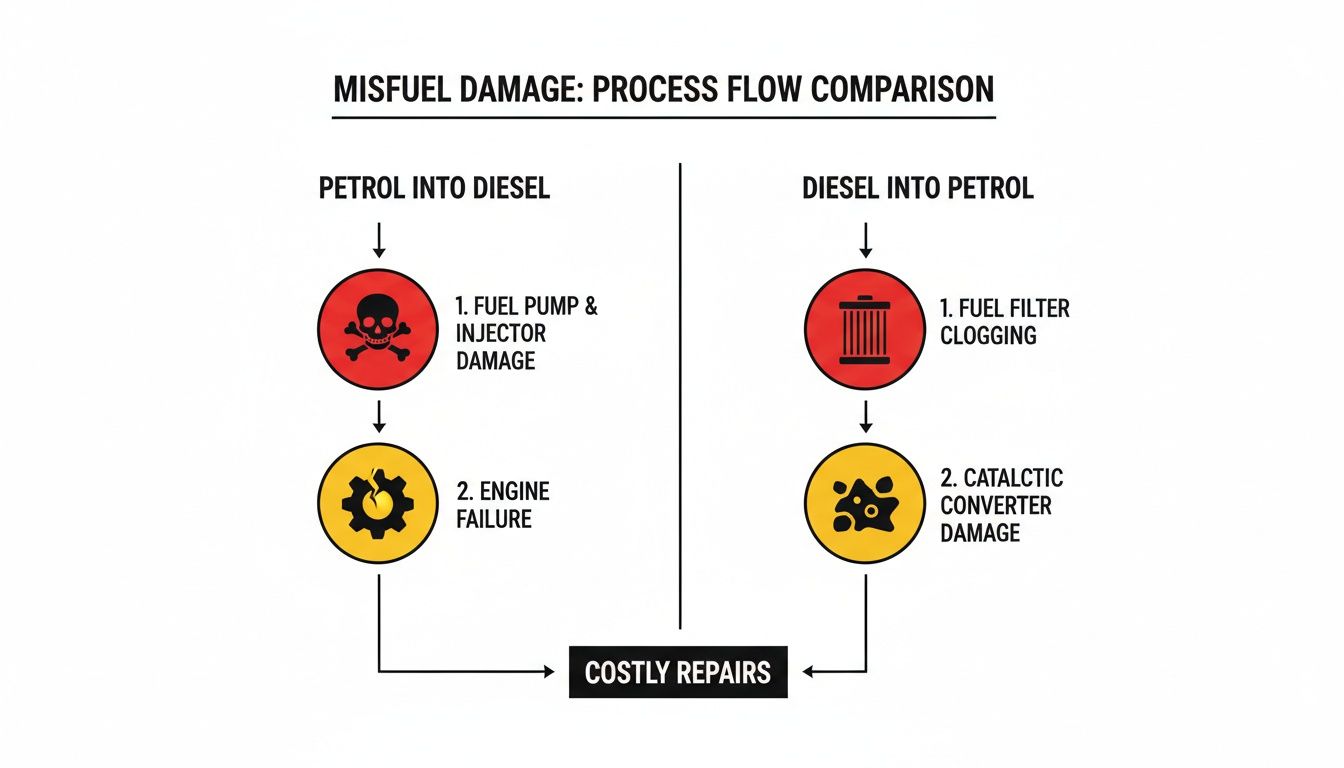
As you can see, petrol in a diesel system causes severe friction and component destruction. Diesel in a petrol engine, on the other hand, primarily clogs the system. Both scenarios need a professional flush to prevent lasting harm.
Refuelling and Final Checks
Once the flush is complete, the final stage begins. The technician will put a small amount of the correct fuel in your tank—usually around 5-10 litres. This is more than enough to get you safely to the nearest petrol station to fill up properly.
With clean fuel back in the system, it's the moment of truth. The technician will start your car. It might take a couple of turns for the new fuel to work its way through, but it should soon fire up and settle into a smooth idle. They'll let the engine run for several minutes, carrying out final checks to make sure everything is operating just as it should be, with no warning lights or funny noises.
What to Expect on Timing and Cost: A typical roadside misfuel recovery, from the moment we arrive to when you're ready to drive away, takes between 60 and 90 minutes. This on-the-spot solution is significantly faster than being towed to a garage, which could leave you without your car for days. Financially, a mobile service is almost always more cost-effective than a main dealer, who may charge for towing, steep labour rates, and potentially unnecessary replacement parts.
Finally, the technician handles one of the most important behind-the-scenes tasks: the safe and environmentally responsible disposal of the contaminated fuel. As licensed waste carriers, they ensure the mixed fuel is taken to a specialised recycling facility, adhering to all Environment Agency regulations. This is a critical part of the service that a DIY attempt can never replicate.
For a complete overview of what's involved, you might be interested in our essential guide to misfuel recovery services nationwide. This expertise ensures a clean, safe, and legally compliant end to a very stressful situation.
Mobile Service vs Main Dealer Recovery Options
When that sinking feeling hits and you realise you’ve used the wrong pump, your next decision is a big one. Who do you call? Broadly speaking, you have two choices: a specialist mobile misfuel service like us, or your main dealer, which usually means going through a standard breakdown provider first.
While both can get the job sorted, they offer wildly different experiences in terms of cost, time, and sheer convenience. One gets you back on the road in about an hour. The other can leave you car-less for days with a much lighter wallet.
The Decisive Factor of Cost
Let's cut to the chase and talk money, as it’s usually the biggest worry. A main dealer’s approach to misfuelling is almost always far more expensive. Their standard procedure involves towing your vehicle to their workshop, which immediately adds a hefty recovery fee to the bill. Once it's there, you’ll be paying main dealer labour rates, which are notoriously higher than any independent specialist.
Worse still, dealers often recommend replacing parts like fuel filters or even pumps as a "precautionary measure," inflating the final cost even further. A mobile service, on the other hand, deals with the problem right where you are.
This approach slashes the bill straight away:
No Towing Fees: The technician drives to you, so there's no need for an expensive recovery truck.
Competitive Labour Rates: Mobile specialists have lower overheads than huge dealerships, and our pricing reflects that.
No Unnecessary Parts: A professional fuel drain and flush is all that's needed in the vast majority of cases. We only replace parts if they're genuinely damaged, which is rare if you haven't run the engine for long.
Honestly, choosing a specialist misfuel recovery service often means you'll pay just a fraction of what a main dealer would charge for the exact same result—a clean fuel system and a car that starts.
Time The Critical Roadside Currency
When you’re stranded—whether at a busy petrol station forecourt or on the hard shoulder of a motorway—time is everything. This is where the difference between the two options becomes crystal clear.
A mobile specialist is built for speed. The entire service is designed to be done and dusted at your location, typically within 60 to 90 minutes of our technician arriving. You make one call, and before you know it, your car is fixed and you're good to go.
The main dealer route, however, is a long, drawn-out process that can easily take days. First, you have to wait for a recovery truck. Then there’s the time it takes to transport your vehicle to the dealership, only for it to join the queue for a slot in their busy workshop schedule. It’s not at all uncommon for a simple fuel drain to leave you without your car for two or three days.
The speed of response is a key performance indicator in the UK breakdown industry. Top providers aim for rapid attendance, with data showing that getting experts on scene quickly is paramount for successful roadside fixes. Discover more insights about breakdown service efficiency on WhatCar.com. A mobile fuel drain service embodies this focus on speed, resolving the specific issue immediately without the delays of a garage visit.
Mobile Fuel Drain vs Dealer Recovery A Head-To-Head Comparison
To make the choice clearer, it helps to see the two options side-by-side. The differences in speed, cost, and overall experience are pretty stark.
Feature | Misfuelled Car Fix (Mobile Specialist) | Main Dealer / Standard Breakdown |
|---|---|---|
Response Time | Typically arrives within an hour | Can be several hours for recovery truck |
Repair Location | On-site (roadside, home, forecourt) | Vehicle must be towed to a workshop |
Total Time to Fix | 60-90 mins from arrival to driving away | 2-3 days (towing, workshop queue, repair) |
Estimated Cost | Lower, fixed fee. No hidden extras. | High. Includes towing, dealer labour, potential unnecessary parts. |
Convenience | Maximum. Problem solved where you are. | Minimum. Involves towing, paperwork, arranging alternative transport. |
Outcome | Fuel system drained, flushed, car running. | Same outcome, but after significant delay and higher cost. |
As you can see, for a misfuelling incident, the specialist mobile route is purpose-built to deliver a faster, more affordable, and less disruptive solution.
Unmatched On-Site Convenience
Finally, let’s talk about convenience, because a misfuel never happens at a good time. You might be rushing to an important meeting, doing the school run, or just trying to get your holiday started. The last thing you need is more hassle.
A mobile technician comes to you, wherever you happen to be.
At the Petrol Station: We can sort the problem right there on the forecourt, causing minimal fuss.
On the Roadside: Our vans are fully equipped workshops on wheels, so the job can be done safely wherever you've pulled over.
At Your Home or Workplace: If you only realise the mistake later, we can come to your house or office car park.
This flexibility saves you the headache of arranging lifts or taxis, taking time off work, and figuring out how to get back to the garage to collect your car days later. The dealer option simply adds more logistical problems to an already stressful situation.
For a fast, cost-effective, and hassle-free fix, a specialist mobile service is undeniably the smarter choice.
Practical Tips To Prevent Misfuelling Your Car
While it’s good to know who to call for a misfuel recovery, avoiding the problem in the first place is obviously the best-case scenario. Let's be clear: misfuelling isn't a sign of being a bad driver. It’s a simple human error, one that usually bites when we're tired, stressed, or just plain distracted by a change in our daily routine.
The good news is that a few smart habits and some surprisingly cheap gadgets can make it almost impossible to slip up.
One of the biggest danger zones is when you're driving a car that isn't yours—think hire cars, a new company van, or even a friend's motor. Before you even think about heading to the forecourt, make a point to confirm the fuel type. A quick check of the paperwork or a glance inside the fuel flap can save you a world of pain later.
Develop a Fuelling Forecourt Routine
Building a simple mental checklist for the petrol station is more effective than you might think. Before you even touch the pump, train yourself to pause and double-check. It only takes a second, but it creates a powerful habit that acts as your last line of defence against a momentary lapse in concentration.
Think of it as your personal pre-flight check for refuelling:
Check the Label: Look at the label on the pump itself – does it say Unleaded or Diesel?
Check the Colour: In the UK, the nozzles are colour-coded. Green is for petrol, black is for diesel. Does it match your car's needs?
Check Your Fuel Cap: Give the sticker or engraving on or inside your fuel flap one final look before the nozzle goes in.
This three-step check might sound blindingly obvious, but deliberately running through it every single time snaps you out of that autopilot mode where mistakes happen. After a while, it becomes second nature.
Don't underestimate the power of a good visual reminder. A brightly coloured, clearly labelled 'DIESEL ONLY' or 'PETROL ONLY' sticker on the inside of the fuel flap is a cheap, simple, and incredibly effective way to give yourself a final, unmissable prompt at the critical moment.
Invest in Misfuelling Prevention Devices
If you want a solution that's almost foolproof, you can get a physical gadget designed specifically to prevent misfuelling. These clever devices replace your existing fuel cap and work as a gatekeeper, physically stopping the wrong-sized nozzle from ever entering your tank.
It works because a standard unleaded petrol nozzle is smaller than a diesel nozzle. This means a prevention device for a diesel car will have a specific opening that only the wider diesel nozzle can fit through. Try to stick a thinner petrol nozzle in, and the mechanism simply won't open.
These devices are a brilliant bit of kit, especially for:
Fleet Managers: Equipping an entire fleet of diesel vans with these caps can prevent costly downtime and repair bills caused by employee errors.
Families with Multiple Cars: If your household has both a petrol and a diesel car on the drive, these gadgets remove the risk of grabbing the wrong keys and making an expensive mistake.
New Drivers: It provides a valuable safety net for those who are still building their driving habits and routines.
Ultimately, preventing a misfuel is all about creating layers of protection. From building simple habits to using smart tech, these practical steps help you stay focused at the pump, saving you the stress, time, and expense of needing an emergency fuel drain.
Your Misfuelling Questions Answered
Even when you know the basics, a misfuelling slip-up leaves you with a dozen urgent questions. We get it. Below, we’ve tackled the most common worries we hear from drivers in your exact situation, giving you clear, straightforward answers to help you figure out what to do next.
I've Already Started My Car After Misfuelling – What Should I Do?
If you've already turned the key, the absolute priority is to minimise the damage. Find a safe spot to pull over as soon as humanly possible, switch off the engine completely, and get your hazard lights on.
The single most important thing now is this: do not try to restart it. Every moment the engine is running, it’s pumping that contaminated fuel further into the most sensitive—and expensive—parts of your system, like the high-pressure pump and injectors. While catastrophic damage isn't always instant, stopping that engine is the best defence you have.
Your next move is to call a professional misfuel recovery service immediately. Make sure you tell them the car has been driven. This lets the technician know they'll need to perform a more intensive system flush to get every last trace of the wrong fuel out of the entire fuel line and engine components.
Will Putting The Wrong Fuel In My Car Void My Warranty Or Insurance?
This is a huge and very understandable worry. Unfortunately, because misfuelling is classed as driver error, any damage that results from it is typically not covered by a standard manufacturer's warranty.
Your car insurance, however, is a different story. Many comprehensive policies do actually cover misfuelling under their 'accidental damage' clause.
But before you rush to make a claim, there are a few things to think about:
You’ll almost certainly have to pay an excess, which can often be pretty steep.
Making a claim is very likely to affect your no-claims bonus when it's time to renew.
The whole claims process can be a lot slower than just getting a direct fix.
For these reasons, many drivers find that paying a specialist mobile fuel drain service directly is often the quickest and most cost-effective solution. It's usually cheaper than the insurance excess, has zero impact on your future premiums, and gets you back on your way in about an hour.
How Long Does A Mobile Fuel Drain Actually Take?
A professional mobile fuel drain is a surprisingly quick and efficient process. We know you’ve got places to be and that you want this sorted with as little fuss as possible.
From the moment our fully-equipped technician arrives at your location, you can expect the entire job to be done and dusted in between 60 and 90 minutes. This window covers everything: securing the area, safely draining the contaminated fuel, flushing the system clean, adding the correct fuel, and making sure your car starts and runs smoothly before we leave. Because our service is completely mobile, we can sort this out wherever you are—stuck on a petrol station forecourt, on the roadside, at home, or in the office car park.
Is It Safe To Try And Drain The Fuel Myself?
In a word: no. We can't stress this enough—please don't ever attempt a DIY fuel drain. It's an incredibly dangerous job for a few key reasons, and it can easily turn a bad situation into a disastrous one.
First off, petrol and diesel are highly flammable, and their fumes are hazardous to breathe in. All it takes is one tiny spark near an open fuel source to cause a fire. Secondly, modern cars are fitted with anti-siphoning devices deep inside the fuel tank, which makes it physically impossible to drain with a simple hose.
Professional technicians use specialised, sealed pumping equipment that is ATEX-certified, meaning it’s been specifically approved for use in explosive atmospheres. They're also licensed to handle and transport the contaminated fuel, ensuring it’s disposed of legally and responsibly according to Environment Agency regulations. This is a job best left to the trained and properly equipped experts.
If you've put the wrong fuel in your car and need immediate, professional help, don't hesitate. Call Misfuelled Car Fix on our 24/7 freephone line for a rapid response across England. We'll get you safely back on the road. Find out more at https://www.misfuelledcarfix.co.uk.