


Wrong fuel in vehicle (wrong fuel in vehicle): What to do, symptoms, and costs
- Misfuelled Car Fixer

- Feb 13
- 16 min read
Updated: Feb 19
24/7 Hotline Nationwide: 0800 999 1182
National Wrong Fuel Rescue: https://www.misfuelledcarfix.co.uk
If you found this page, we cover you in England!
Book Online:
It’s that gut-wrenching moment at the pump you hope never happens: you’ve just filled up with the wrong fuel. Before panic sets in, know this—the single most important rule is to do absolutely nothing. Don't start the engine. Don't even turn the key to listen to the radio. That one simple act is what separates a straightforward fix from a catastrophic engine repair.
What To Do Immediately After Misfuelling
That sinking feeling in the pit of your stomach is more common than you'd think. It's estimated that around 150,000 UK drivers make this mistake every single year. That works out to roughly 410 incidents a day. It’s a surprisingly easy slip-up, with research showing nearly 29% of motorists admit to having done it.
If you've joined the club, staying calm and following the right steps is crucial. Your actions in the next few minutes will decide whether this is a minor inconvenience or a repair bill running into thousands of pounds.
Secure Your Vehicle and The Area
First things first: leave the engine off. Don't be tempted to "just see what happens". If your car is blocking a pump, never drive it to a parking bay. Instead, put the car in neutral and ask the station attendant or a helpful bystander to give you a hand pushing it to a safe spot.
Once the car is out of the way, put the handbrake on and lock the doors. This keeps you safe and stops anyone else from accidentally starting the engine.
The golden rule of misfuelling is simple: an engine that hasn't been started has not been damaged. The problem is contained entirely within the fuel tank, making the solution a simple drain and flush, not a complex and costly engine repair.
This flowchart breaks down the critical decision point and shows just how different the outcome is depending on whether the engine was started.
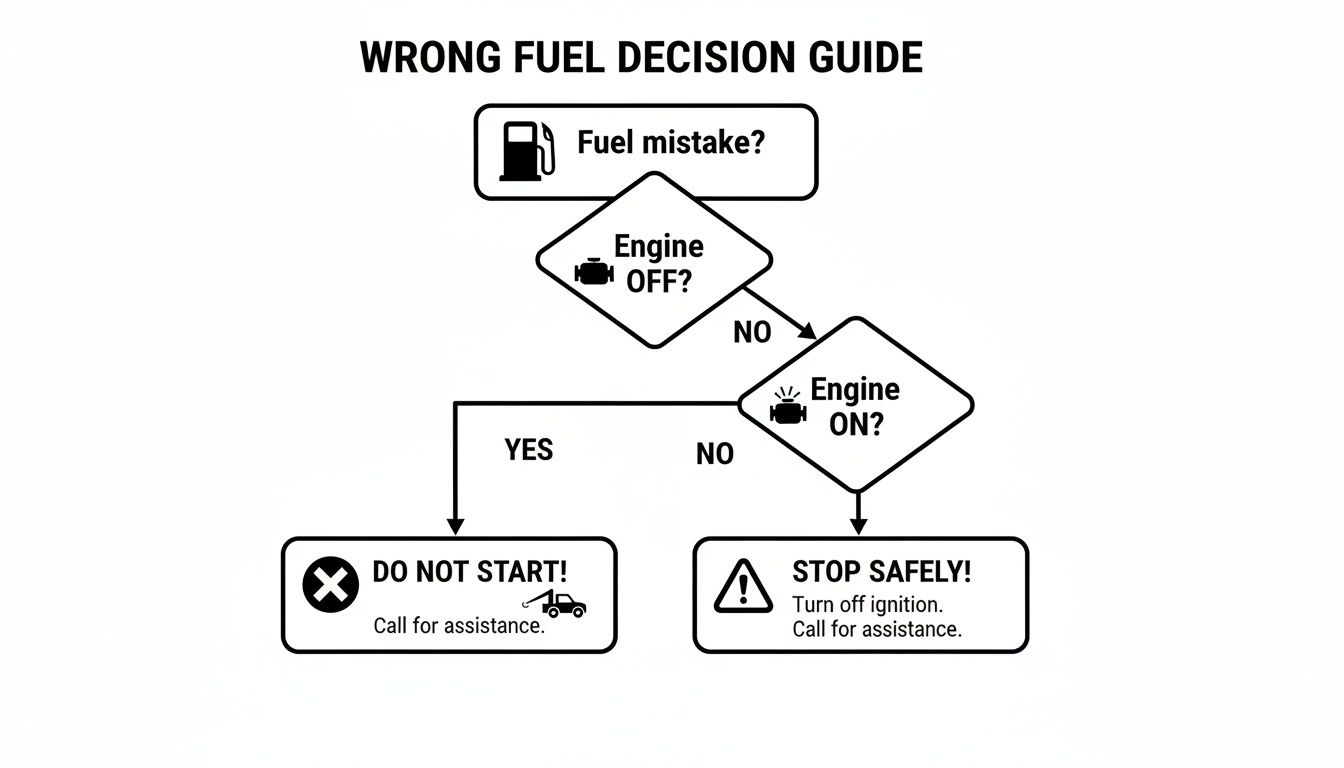
As you can see, keeping that engine switched off is the key to a much simpler, faster, and cheaper resolution.
To make it even clearer, here is a quick-reference table of the absolute must-dos and the critical don'ts.
Immediate Misfuelling Checklist Do's and Don'ts
Action | Why It's Important |
|---|---|
DO NOT Start the Engine | This prevents the contaminated fuel from being circulated through the fuel lines, pump, and injectors. |
DO Put the car in neutral | This allows you to move the vehicle without needing to turn on the ignition. |
DO Push the car to a safe spot | Moving away from the pumps clears the area for other drivers and keeps you out of harm's way. |
DO NOT Turn the key in the ignition | Even turning it to the 'accessory' position can prime the fuel pump, starting the damaging circulation process. |
DO Tell the petrol station staff | They can close the pump, assist with safety, and have likely dealt with this situation many times before. |
DO Call a professional service | Specialist technicians have the correct equipment to drain and flush your system safely and efficiently. |
Following these steps will contain the problem and set you on the right path for a quick fix.
Notify The Petrol Station Staff
It’s always a good idea to let the staff inside the petrol station know what’s happened. They can close off the pump you used, which is especially important if there was some kind of nozzle mix-up. They’re used to seeing this happen and can often point you to a safe place to wait for help.
Call a Professional Misfuelling Service
Your next call is the most important one. You need to contact a specialist wrong fuel service. While your breakdown provider might be able to help, a dedicated company like Misfuelled Car Fix has the precise tools and expertise to sort the problem out on the spot, getting you back on the road far quicker.
When you call, it helps to have this information handy:
Your exact location: The name and address of the petrol station.
Your vehicle details: The make, model, and registration number.
The fuel mix-up: Tell them the correct fuel for your car and the wrong one you put in.
How much went in: A rough estimate of how many litres you added.
Giving the technician these details allows them to prepare and give you a more accurate arrival time. To understand more about the most frequent type of misfuelling, check out our deep-dive guide on what happens when you put petrol in a diesel car. By making that one call, you’ve put the problem in expert hands and are on the fastest route back to a normal day.
Recognising The Warning Signs On The Road

Sometimes, that sinking feeling doesn’t hit you at the petrol station. You might get a few miles down the road before your car starts acting strangely, leaving you confused and worried. Knowing what to look for is your best line of defence against turning a fixable slip-up into catastrophic engine damage.
The symptoms your car will throw up after a misfuel depend entirely on the mix-up. The most frequent scenario—petrol in a diesel engine—gives a completely different set of red flags compared to the other way around. Spotting these signals early means you can pull over safely and call for help before things get a whole lot worse.
Petrol in a Diesel Engine Symptoms
Modern diesel engines are incredibly precise bits of kit. They rely on diesel fuel not just for combustion but also to lubricate high-pressure components like the fuel pump and injectors. When you introduce petrol, which is a solvent, it immediately starts to strip away that vital lubricating film, leading to very noticeable problems, very quickly.
If you’ve driven off after putting petrol in your diesel, you're likely to experience a whole cascade of issues.
A Loud Knocking Sound: This is often the first and most alarming sign. Petrol ignites far too early under the high compression of a diesel engine, creating a sharp, metallic knocking or rattling noise that gets worse as you accelerate.
Significant Power Loss: Your car will suddenly feel sluggish and weak. You’ll press the accelerator, but it will struggle to gain speed, feeling gutless and hesitant.
Excessive Exhaust Smoke: You might see clouds of white or greyish smoke billowing from the exhaust. This is a classic sign of incorrect and incomplete combustion happening inside the engine.
Engine Warning Lights: Your dashboard will probably light up. The engine management light is almost guaranteed to come on, flagging a serious fault.
Complete Engine Cut-Out: Eventually, the engine will likely cough, splutter, and die completely, leaving you stranded. This is the engine's last-ditch attempt to protect itself from terminal damage.
If you notice any of these symptoms, especially right after filling up, your absolute priority is to find a safe spot to pull over. Switch off the engine, put on your hazard lights, and do not try to restart it.
Diesel in a Petrol Engine Symptoms
This is less common, mainly because the wider diesel nozzle won't fit into most modern petrol filler necks, but it does still happen. Diesel is much oilier and less volatile than petrol, so it really struggles to ignite with a spark plug.
The symptoms are quite different, but just as serious.
Engine Misfiring: The engine will struggle to run smoothly. You’ll feel it jerking and juddering as the spark plugs get fouled up with oily diesel residue and fail to ignite the fuel mixture properly.
Plumes of Black Smoke: As the engine fails to burn the thick diesel, it will chuck out dense black smoke from the exhaust. This is essentially unburnt fuel being ejected from the system.
Failure to Start: More often than not, a petrol car with diesel in the tank simply won’t start. If it does manage to fire up, it will run incredibly poorly for a very short time before stalling and refusing to start again.
The Problem With AdBlue in the Diesel Tank
A more modern headache is AdBlue contamination. The AdBlue filler cap is often blue and located right next to the main diesel cap, making it an easy but costly mistake. AdBlue is not a fuel; it’s a urea-based fluid that is highly corrosive to many of the seals, plastics, and metals in a fuel system.
If AdBlue gets into your diesel tank, it can crystallise as it dries, causing severe blockages in the fuel pump, filters, and injectors. The damage can be widespread and eye-wateringly expensive to fix, frequently requiring the replacement of the entire fuel system.
Understanding these distinct signs is vital. For a more detailed breakdown, you can learn more about the specific wrong fuel in car symptoms in our dedicated guide. Acting fast can prevent a moment's distraction from turning into a financial nightmare.
Why Petrol in a Diesel Engine Is So Damaging
Not all misfuelling mistakes are created equal. While putting any fuel in the wrong tank is a problem, filling a modern diesel car with petrol is a recipe for mechanical and financial disaster. The two fuels are worlds apart in their chemical makeup, meaning petrol doesn't just fail to work—it actively starts to destroy critical engine components from the inside out.
It’s also the most common type of misfuelling, and the reason is frustratingly simple. The narrower petrol nozzle slides effortlessly into the wider filler neck of a diesel car, making it an incredibly easy mistake to make when you’re distracted or in a hurry. Understanding exactly what unfolds the moment you turn the key explains why our most urgent advice is always do not start the engine.
Petrol's Destructive Solvent Effect
Think of diesel fuel as being slightly oily. It’s not just for combustion; it acts as an essential lubricant for the incredibly precise moving parts inside the high-pressure fuel system. Components like the fuel pump and injectors are engineered with microscopic tolerances and rely entirely on this lubrication to operate without grinding themselves to pieces.
Petrol is the complete opposite. It's a solvent—much more like a degreaser. When it gets into the diesel system, it immediately begins to wash away that vital, protective oily film. Without lubrication, friction goes through the roof. Tiny metal particles can shear off from the internals of the fuel pump, turning the fuel into something resembling liquid sandpaper.
This abrasive, contaminated mixture is then forced at immense pressure through the fuel lines and into the injectors. The result is rapid, catastrophic wear to some of the most complex and expensive parts of your engine. It’s the mechanical equivalent of running an engine without any oil.
Why Diesel in a Petrol Car Is Less Catastrophic
Now, let's flip the scenario around. Pumping diesel into a petrol car is still a major blunder, but the resulting damage is usually far less destructive, especially if you haven't driven far. Diesel is thicker, heavier, and much less flammable, so it simply won't ignite properly from a spark plug.
Instead of destroying parts through friction, it essentially chokes the engine and clogs the system up.
Fouled Spark Plugs: The oily, heavy diesel residue quickly coats the spark plugs, preventing them from creating the spark needed for combustion.
Clogged Fuel Injectors: The thick fuel struggles to get through the fine nozzles of petrol injectors, starving the engine.
Engine Stalling: The engine will cough, splutter, run incredibly rough, and almost certainly cut out as it just can't burn the diesel effectively.
In short, a petrol engine just can't stomach diesel. It will usually stop running before it gets a chance to cause the kind of terminal internal damage we see when a diesel engine is fed petrol. This often means the fix is a thorough fuel drain and system flush rather than a wallet-emptying component replacement.
To put it into perspective, here’s a direct comparison of how these two common scenarios typically unfold.
Misfuelling Damage Comparison
The potential damage, the symptoms you'll experience, and the likely repair approach differ massively depending on which fuel goes into which car. Petrol in a diesel engine causes a lubrication failure that leads to rapid mechanical destruction. On the other hand, diesel in a petrol engine primarily causes a combustion failure that clogs up the system.
Scenario | Potential Damage | Common Symptoms |
|---|---|---|
Petrol in Diesel | Severe wear on the high-pressure fuel pump, injector damage, metal particle contamination throughout the fuel system. | Loud knocking noise, significant power loss, excessive white exhaust smoke, engine cutting out completely. |
Diesel in Petrol | Fouled spark plugs, clogged fuel filter and injectors, potential damage to the catalytic converter from unburnt fuel. | Engine misfiring and juddering, heavy black exhaust smoke, failure to start or stalling shortly after starting. |
As you can see, while both are serious, the consequences of running a diesel engine on petrol are in a completely different league of severity.
The Financial Reality of the Wrong Fuel
This huge difference in potential damage translates directly to the repair bill. Getting a professional fuel drain for a car that hasn't been started is a straightforward and relatively affordable roadside fix.
However, if a diesel car has been started and driven, even for a few minutes, the costs can escalate into the thousands. Replacing a high-pressure common rail fuel pump and a set of injectors can easily cost £3,000 to £5,000, which can often be more than an older car is even worth. This is precisely why immediate action—or rather, inaction—is so critical. Resisting that instinct to start the car keeps the problem contained in the fuel tank, ensuring the fix is simple and the cost stays manageable.
How a Professional Fuel Drain Service Works
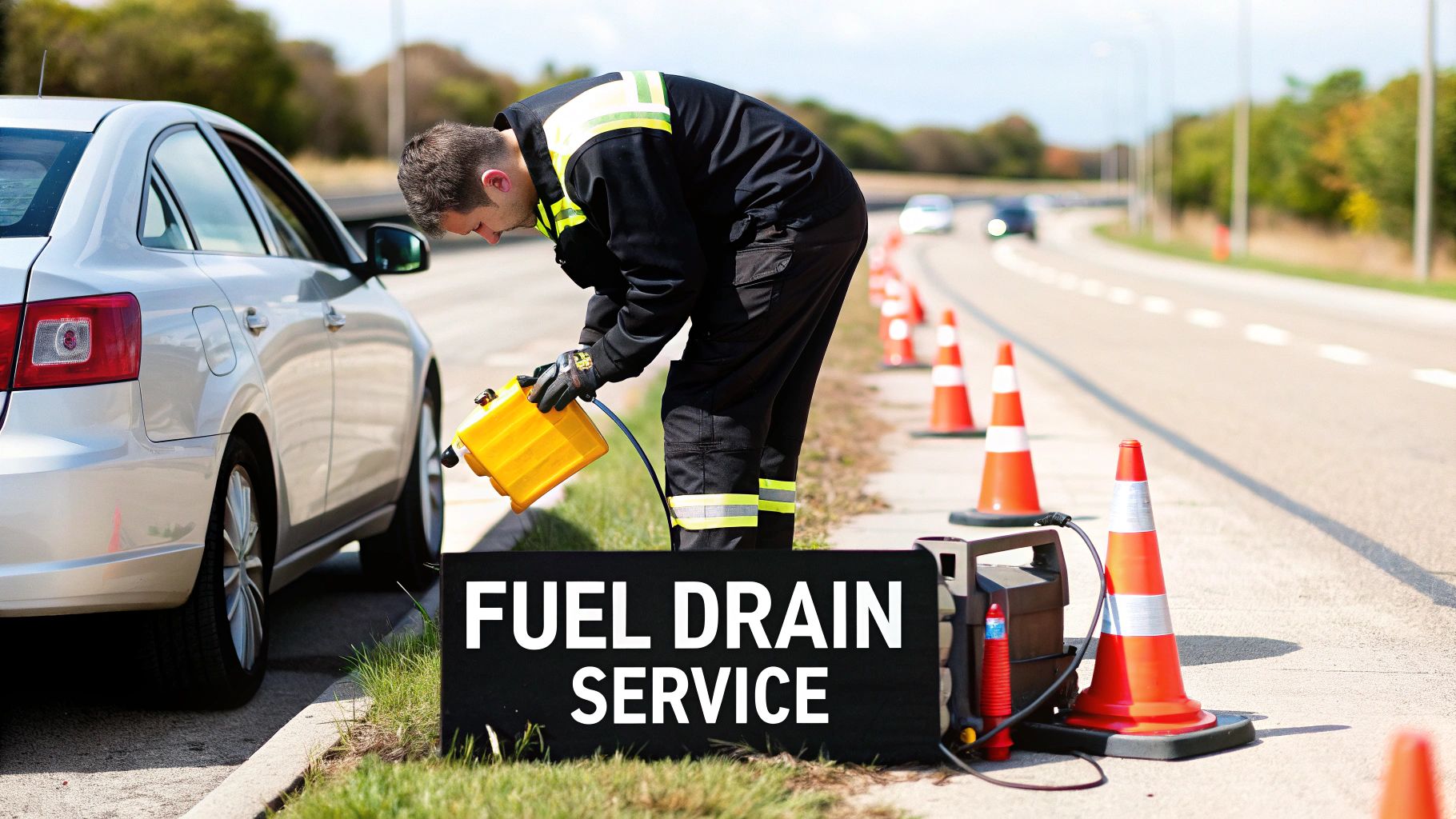
When you've put the wrong fuel in your car, seeing a specialist technician pull up is a massive relief. It’s natural to be curious about what actually happens next. This isn't just a simple case of siphoning fuel with a bit of hose; it’s a precise, multi-stage procedure that has to be done safely and efficiently at the roadside.
Think of our mobile units as a workshop on wheels. They're kitted out with everything we need to fix the problem right there on the spot.
From the second our technician arrives, their first priority is safety. Petrol fumes are incredibly flammable, so managing the risk of a spark is everything. They'll secure the area around your car and use specialised, intrinsically safe equipment designed to prevent ignition. This includes anti-static hosing and ATEX-approved pumps, which are certified for use in potentially explosive environments. This strict approach is what separates a professional job from a risky DIY attempt.
The Fuel Draining Process
The first big job is getting every single drop of that contaminated fuel out of your tank. Our technician will access your vehicle’s fuel tank, usually via the filler neck, and use professional-grade pumping gear to get it all out. This isn't a slow trickle; our pumps are powerful enough to empty an average family car’s tank in just a few minutes.
The whole process is clean and contained. The contaminated fuel is pumped directly from your car into a secure, UN-approved holding tank inside our van. We manage the entire transfer without any spills, making sure no fuel pollutes the ground or the area around your vehicle.
The goal isn't just to empty the tank—it's to remove the problem entirely. Contaminated fuel left in the lines, filter, or pump is enough to cause damage when you restart the engine. A professional service addresses the entire system.
Once the tank is empty, the focus shifts to the rest of the fuel system. This is an absolutely critical step that’s often overlooked.
Flushing The Entire Fuel System
Even with a bone-dry tank, a surprising amount of the wrong fuel can still be lurking in the fuel lines, the filter housing, and even the injectors. To get this out, the technician will perform a system flush. This involves disconnecting key parts of the fuel line to isolate the system properly.
A small amount of clean, correct fuel is then circulated through these components, pushing out any residual contaminants. This flushing process ensures that when we put the right fuel back in, it isn't immediately spoiled by the dregs of the old, damaging stuff. It guarantees a completely clean slate for your engine.
After the system has been thoroughly purged, everything is reconnected. The fuel filter might also be checked or replaced if it looks necessary. Only then is your car ready for the final steps.
Replenishing with Correct Fuel: We'll add a small amount of the correct, fresh fuel to your tank—usually around 5-10 litres. This is plenty to get the engine running and prime the system correctly.
Engine Test Run: With clean fuel in place, the technician will start your car. They'll let the engine idle for several minutes, listening carefully for any signs of hesitation or rough running.
Final Checks: They’ll run a final diagnostic check to make sure no fault codes have been triggered and that the engine is performing smoothly and efficiently, just as it should.
This comprehensive approach means that when our technician gives you the all-clear, you can drive away with total confidence, knowing the problem has been completely solved. We also handle the environmentally responsible disposal of the contaminated fuel, so you don't have to worry about a thing. It’s a complete roadside solution designed to turn a major headache into a minor inconvenience.
Breaking Down the Costs and Insurance Coverage
That sinking feeling in your stomach when you realise you’ve used the wrong pump is often followed by a second, equally unpleasant thought: how much is this going to cost me?
The final bill for a misfuel hinges almost entirely on one crucial factor: whether or not you started the engine. A simple roadside fix can be surprisingly affordable, but if that contaminated fuel has started circulating, the price can climb into the thousands.
A professional mobile fuel drain, like the service we provide, is by far the most cost-effective solution. You’re typically looking at a fixed call-out fee which covers draining the tank, flushing the system, and even adding enough fresh, correct fuel to get you safely on your way. It’s a transparent, all-in-one price for a complete roadside resolution.
In contrast, taking your car to a main dealership often means a much bigger bill for the exact same job. They’ll likely need your vehicle towed to their workshop too, which just adds more cost and delay to an already stressful situation.
Will My Car Insurance Cover This?
This is one of the first questions we get asked, and unfortunately, the answer isn’t always a simple yes or no. Putting the wrong fuel in your car is almost always classed as 'accidental damage', but whether your policy actually covers it depends entirely on the level of cover you have.
Fully Comprehensive Policies: Many fully comp policies will cover misfuelling, but you absolutely have to check the small print. Look specifically for exclusions related to 'contamination' or 'misfuelling' in your policy documents.
Third-Party Policies: It's extremely unlikely that a third-party, fire, and theft policy will offer any cover at all for a misfuelling incident.
Even if you are covered, claiming on your insurance could affect your no-claims bonus and lead to higher premiums when you renew. For this reason, many drivers find that simply paying a specialist fuel drain service directly is often cheaper and a lot less hassle in the long run. We break this down in more detail in our guide to the costs of wrong fuel in a car.
Expert Tip: Always check the 'accidental damage' section of your insurance documents before you decide what to do. Remember that even if you are covered, you'll still have to pay your policy excess, which can sometimes be more than the cost of calling us out for a mobile fuel drain.
The Hidden Costs for Fleet Managers
For any business running a fleet of vehicles, the financial hit from a misfuelling incident goes way beyond the initial repair bill. The real damage is done by vehicle downtime. Every single hour a van or company car is off the road, it's losing you money.
Just think about the knock-on effects:
Missed Appointments: A stranded driver means a cancelled job, a delayed delivery, or a lost sales opportunity.
Damaged Reputation: Unreliability can seriously harm client relationships and your company's professional image.
Logistical Chaos: It creates a huge administrative headache, forcing you to reschedule jobs and reallocate resources on the fly.
A rapid-response fuel drain service is a crucial partner for any fleet manager. By getting to the vehicle and resolving the issue at the roadside within an hour or two, we minimise that business disruption. We stop a simple human error from snowballing into a major financial problem.
This kind of mistake is surprisingly common, but research shows that location and age play a big part. For instance, a staggering 48% of motorists in London admit to having misfuelled a vehicle, while younger drivers aged 18-24 are the highest-risk group nationally. This strongly suggests that distraction and fast-paced environments are major factors—a key insight for anyone managing urban fleets. You can see more details in the full research on UK misfuelling habits.
Your Top Misfuelling Questions Answered
That sinking feeling you get when you realise you've put the wrong fuel in your car is usually followed by a flood of urgent questions. When you're in a stressful spot like this, you need clear, straightforward answers. We’ve been on the roadside helping drivers for years, so let's tackle the most common queries we hear.
What if I Only Put a Small Amount in?
This is easily the question we get asked the most. A driver puts in just a few litres of petrol, realises their mistake, then fills the rest of the tank with diesel, hoping to just dilute the problem away. It sounds logical, but for a modern diesel engine, this is incredibly risky advice.
Even a tiny amount of petrol can cause serious harm. As little as 5% petrol in a diesel tank is enough to completely strip away the lubricating properties that diesel fuel provides. Your high-pressure fuel pump and injectors absolutely rely on that oily film to operate without grinding themselves to pieces. It might not cause an instant breakdown, but you’re starting a process of rapid wear that will almost certainly lead to a very expensive failure down the line.
The only safe amount of the wrong fuel in your car is zero. Never assume diluting it is a viable solution—it’s a gamble with your engine's health that just isn’t worth taking.
The risk is simply too high. No matter how much you put in, the only correct and safe course of action is to have the tank professionally drained and the system flushed.
How Long Does a Professional Fuel Drain Take?
Another big worry is time. You're stranded, you've got places to be, and the idea of being stuck for hours is a nightmare. Thankfully, a mobile fuel drain is a surprisingly fast and efficient job when done by a professional.
From the moment our technician pulls up beside you, the whole process is usually wrapped up in about 45 to 90 minutes. That window covers everything:
Securing the area: First, we make sure the scene is safe before any work begins.
Draining the tank: We use specialised pumps to get every drop of contaminated fuel out.
Flushing the system: All the fuel lines are purged to remove any lingering contaminants.
Adding fresh fuel: We'll put in enough of the correct fuel to get you started again.
Starting the engine: We run the car to make sure everything is working as it should.
Our entire goal is to get you moving again with as little disruption as possible. This kind of rapid roadside assistance is worlds away from getting towed to a garage, which can often leave you without your car for a day or even longer.
Can I Just Siphon the Fuel Out Myself?
It might seem like an easy DIY fix, but trying to siphon fuel yourself is both incredibly dangerous and practically useless. For starters, nearly all modern cars are fitted with anti-siphoning devices deep in the filler neck. They're designed to stop fuel theft, but they'll also stop you from getting a hose into the tank.
More importantly, it's a huge safety risk. Petrol fumes are extremely flammable, and a single spark from static electricity or a dropped metal tool could ignite them. It’s not worth it. Professionals use ATEX-certified, intrinsically safe equipment to completely remove that danger.
Finally, even if you could get a hose in, you'd never get all the contaminated fuel out. The dregs left behind in the tank and fuel lines are more than enough to cause damage. Then you're left with the problem of how to legally and safely dispose of a large container of hazardous waste. It’s a job that should always be left to trained technicians with the right gear.
If you've put the wrong fuel in your vehicle, don't risk it. Contact Misfuelled Car Fix for immediate, professional assistance. Our mobile technicians can be with you quickly to perform a safe and complete fuel drain, getting you back on the road with confidence. Call our 24/7 freephone number or book online now.


