Wrong Fuel in Car Cost a UK Drivers Guide to Misfuelling

Updated: Feb 19
24/7 Hotline Nationwide: 0800 999 1182
National Wrong Fuel Rescue: https://www.misfuelledcarfix.co.uk
If you found this page, we cover you in England!
Book Online:
That sinking feeling at the pump is almost always followed by one urgent question: how much is this going to cost me?
The bill for putting the wrong fuel in your car isn't a single, fixed price. It’s a spectrum of potential expenses dictated almost entirely by what you do in the seconds and minutes after realising your mistake.
Think of it like spilling a cup of tea on your laptop. Act immediately, unplug it, and don't turn it on, and a simple, low-cost cleanup might be all you need. But try to power it up, and you could short-circuit the whole system, leading to a catastrophically expensive repair. Misfuelling works on the exact same principle; keeping the contaminated fuel contained in the tank is your absolute number one priority.
What Will It Really Cost Me?
The single most critical factor that determines the final cost is whether you've started the engine. It's a simple fork in the road with drastically different financial outcomes.
Engine Off: You realised your mistake before turning the key. Brilliant. The solution is relatively simple and affordable. A mobile fuel drain service can come to you, empty the contaminated fuel, flush the system, and get you back on your way. This is the best-case scenario, typically costing between £120 and £300.
Engine On: The moment you start the car, even for a second, you begin pumping the wrong fuel through the entire system. This can cause immediate and severe damage to sensitive components like fuel injectors, pumps, and filters, especially if you’ve put petrol in a diesel car. Costs here can easily spiral into the thousands.
This mistake is far more common than you'd think. Every year, around 150,000 UK drivers find themselves in this exact spot.
It's also worth knowing that many standard insurance policies don't cover this error, often classing it as driver negligence, leaving you to foot the bill yourself.
Right then, let's get into why this all-too-common mistake can catch out absolutely anyone.
If you’ve just pumped the wrong fuel into your car, the first thing to know is you’re in good company. This isn’t some rookie mistake reserved for new drivers. It’s a simple slip-up that can, and does, happen to even the most seasoned motorists.
Think about your daily commute. You’ve driven that route so many times your brain just switches to autopilot. Then one morning there's a diversion, but your muscle memory is so strong you almost sail right past the sign. Misfuelling is often exactly like that.
You pull into a busy petrol station, maybe you're distracted by the kids arguing in the back, thinking about a work call, or just in a tearing hurry. You grab the pump handle your hand automatically goes for, just like it has a thousand times before. Except this time, you’re in an unfamiliar rental car, or you've recently swapped your old petrol motor for a diesel. Your own routine has just betrayed you.
Just How Common is This, Really?
The sheer number of people who make this simple error is genuinely staggering. It paints a very clear picture of just how widespread the problem is on forecourts all over the UK. This isn't a rare event; it's happening every single day.
One in-depth survey found that a massive 29% of UK drivers admit to having misfuelled their car at some point. The stats also show that certain groups are more likely to get caught out; over 54% of younger drivers (aged 18-24) have done it, compared to just 12% of those over 55. This isn't just a number—it’s a stark reminder of how easily this can happen, especially if you're not yet completely in tune with your car. You can see more insights into these driver habits from Go.Compare.
Misfuelling says nothing about your skill as a driver. It's a momentary lapse caused by distraction, routine, or being in an unfamiliar car—things that can affect any of us, at any time. Realising this helps you stop blaming yourself and start focusing on a quick, professional fix.
This mistake happens for perfectly understandable, human reasons. Acknowledging that is the first step to sorting it out calmly and correctly. The key is not to panic, because what you do next has a direct impact on the final wrong fuel in car cost. The triggers are usually simple and completely relatable:
Driving a different car: Whether it's a hire car, a courtesy vehicle from the garage, or your family's new runaround, your muscle memory can easily default to the fuel you're used to.
Distraction at the pump: A packed forecourt, an important phone call, or trying to keep the kids in check can easily steal your attention for the few seconds it takes to grab the wrong nozzle.
A recent change of vehicle: If you've just switched from a petrol car you’ve driven for years to a new diesel (or the other way around), those old habits die hard.
Recognising these common pitfalls helps take the sting out of the mistake. Instead of feeling mortified, you can get straight on with the practical steps needed to sort the problem out with the least amount of damage to your car and your wallet.
How Costs Escalate from a Simple Drain to Engine Damage
Thinking about the cost of putting the wrong fuel in your car is a bit like thinking about a fire. Catch it when it's just a tiny spark in a contained spot, and it's easy to deal with. But let it spread, and you've suddenly got a destructive, expensive disaster on your hands. The exact same logic applies the moment the wrong fuel goes into your tank.
The critical point is when you turn the key in the ignition. That simple twist triggers a chain reaction. The fuel pump whirs to life and immediately starts sending what it thinks is the right fuel from the tank, down the lines, and towards your engine. If you leave the ignition off, the problem stays neatly contained inside the fuel tank, making a straightforward drain the perfect solution.
Petrol in a Diesel Engine: The Costliest Mistake
Of all the misfuelling scenarios, putting petrol into a diesel car is by far the most damaging and expensive. It all comes down to one crucial difference between the two fuels: lubrication.
Diesel is an oily substance. It's not just for combustion; it also lubricates the incredibly precise and vital components of the fuel system, like the high-pressure fuel pump and injectors. Petrol, on the other hand, is the complete opposite – it's a solvent. It cleans and strips oil away.
Imagine trying to run your engine's moving parts with sand instead of oil. That’s what petrol does to a diesel system. It strips away that essential lubricating film, causing delicate metal components to grind directly against each other. This friction isn't just a bit of wear and tear; it instantly creates tiny metal shavings that get pumped through the entire system, causing a catastrophic domino effect. The damage isn’t a slow burn; it’s a rapid, mechanical process that can destroy thousands of pounds worth of parts in minutes.
From Tank to Total Engine Failure
The escalating cost is directly tied to how far that corrosive petrol travels through your diesel system. Every stage of its journey adds another layer of complexity, labour, and expense to the final repair bill.
You can break the journey down into four clear stages:
Fuel Tank Contamination (Engine Off): The problem is localised. It's all contained in the tank. The solution is a mobile fuel drain, a quick flush, and a refill with the correct fuel. This is your best-case, most affordable outcome.
Fuel Lines and Filters (Engine Started): The moment the ignition is turned on, petrol gets sucked into the fuel lines. As well as a full drain, the fuel filter will almost certainly need replacing as it gets clogged with the first wave of debris. Costs start to climb.
Fuel Pump and Injectors (Engine Running): This is where things get serious. With the engine running, the fuel pump is starved of lubrication and can start to destroy itself from the inside out. The injectors can get blocked or permanently damaged by metal fragments. Replacing these parts is labour-intensive and very expensive.
Full Engine Damage (Car Driven): If you manage to drive the car, even for just a minute or two, the contaminated fuel reaches the engine's combustion chambers. This can lead to catastrophic internal failure, potentially requiring a complete engine rebuild or even a replacement—by far the most expensive outcome.
To really understand how a small mistake can spiral, it's helpful to see how each action adds to the potential bill.
Cost Escalation Factors After Misfuelling
The table below shows a simplified breakdown of how turning the key and the type of vehicle can dramatically impact the final cost.
Factor | Low Cost Impact (Engine NOT Started) | High Cost Impact (Engine Started or Driven) |
|---|---|---|
Fuel System | The contaminated fuel is contained entirely within the tank. No sensitive parts are exposed. | Petrol is pumped through lines, filters, the high-pressure pump, and injectors, causing friction and wear. |
Required Fix | A straightforward mobile fuel drain and flush is usually all that's needed. | Requires a full system drain, replacement of filters, pump, and injectors, plus extensive labour. |
Vehicle Type | Cost is consistent across most standard diesel cars. | Modern high-pressure common-rail diesel systems (found in most post-2002 cars) are extremely sensitive and expensive to repair. |
Typical Cost | £200 - £400 | £1,500 - £5,000+ |
As you can see, the difference is stark. Keeping the engine off is the single most effective way to keep your wallet safe.
The final repair bill isn’t just the sum of the broken parts. It also includes diagnostics, hours of specialist labour, and potentially towing fees. What starts as a simple £200 problem can very quickly become a £5,000+ nightmare, all because the key was turned.
Your Step-by-Step Action Plan to Minimise Damage
The moments right after you realise you’ve been holding the wrong fuel nozzle are the most critical. What you choose to do in the next few seconds will directly decide whether the wrong fuel in car cost is a minor hiccup or a full-blown financial disaster.
There's one golden rule here, and it’s absolute.
DO NOT START THE ENGINE.
Think of it this way: right now, the contaminated fuel is contained safely in the fuel tank. Turning the key is like opening the floodgates, sending that damaging mixture surging through your car's delicate veins. Keeping the ignition off contains the problem, making the fix quicker, simpler, and dramatically cheaper.
Your Immediate Four-Step Checklist
The key is to stay calm and follow these steps precisely. Panic leads to costly mistakes, but a clear plan keeps you in control and protects your vehicle (and your wallet).
Stay Put: Don’t put the key in the ignition. Don't even turn on the electrics to listen to the radio. If it’s safe, leave your car exactly where it is at the pump.
Move to Safety: If you're blocking other drivers, pop the car into neutral. Ask the petrol station staff or a helpful bystander to give you a hand pushing it to a safe parking bay.
Call for Specialist Help: This isn’t a job for a general mechanic. Standard breakdown cover often excludes misfuelling, so you need to call a professional mobile fuel drain service right away.
Inform the Petrol Station: Let the staff know what’s happened. Trust me, they’ve seen it all before. They can put out some cones or signs to keep the area safe.
Following this simple checklist stops a basic fuel drain from snowballing into a complex and eye-wateringly expensive repair. The flowchart below paints a clear picture of how quickly those costs can escalate if you get it wrong.
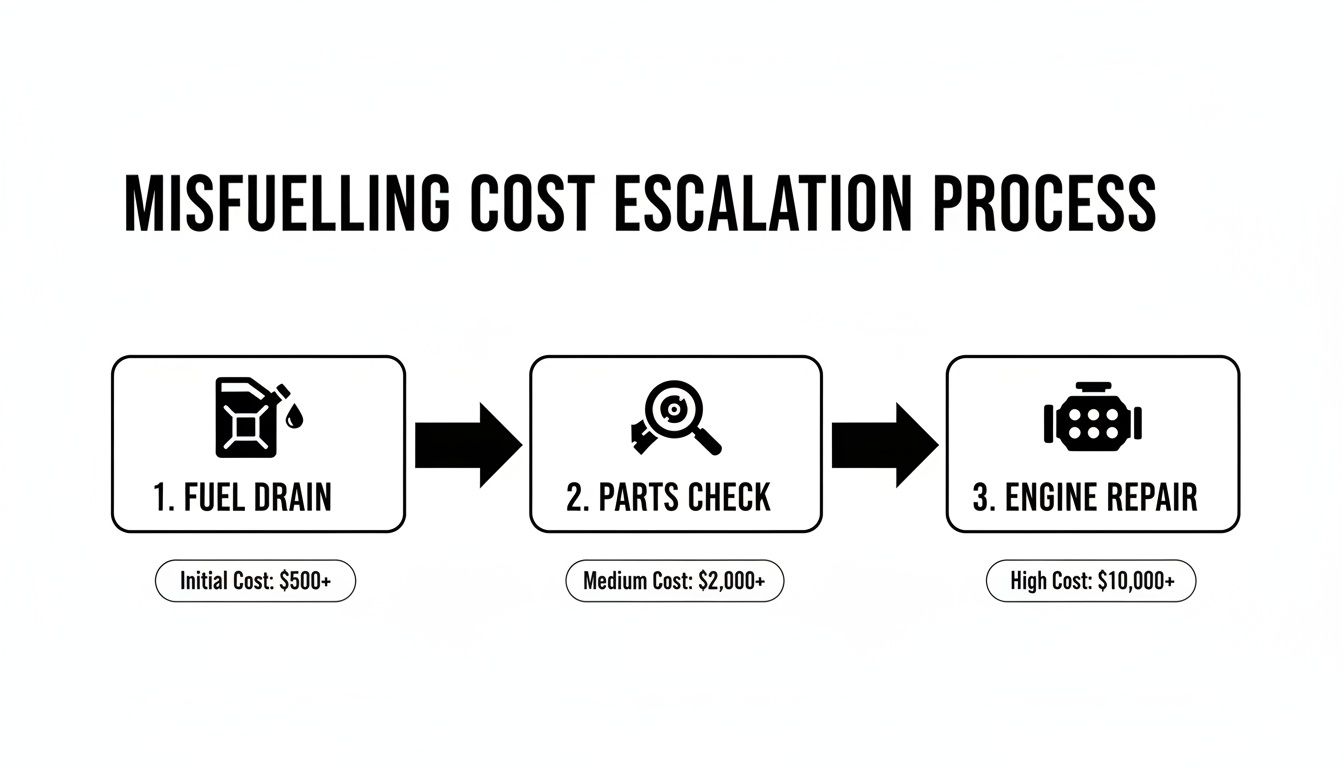
This visual really hammers home the crucial turning point: starting the engine. That one action is what transforms the problem from a simple drain to a potential full-scale engine repair. For a deeper dive into the mechanics of the process, you can learn more about how to drain a fuel tank safely in our dedicated guide.
A mobile fuel drain is your most effective first response. A main dealer will insist on towing your car to their workshop, adding time and expense. A specialist service resolves the issue right there on the spot, often within an hour, saving you a huge amount of time and money.
Choosing the Right Help: Mobile Service vs. Dealership
You’ve dodged the bullet by not starting the engine, but now you need help. In this stressful moment, who you call next will have a huge impact on the final wrong fuel in car cost and, just as importantly, how quickly you get back on the road. Your three main options are a specialist mobile service, your car's main dealership, or your breakdown cover provider.
While it might seem logical to ring the people who sold you the car, a dealership is often the slowest and most expensive route. Their first step is nearly always to get your car towed to their workshop, which immediately adds towing fees and a long delay to your ordeal.
Once it gets there, your car is just another job in a long queue. Dealerships charge premium labour rates, and the whole process—from the tow truck arriving to the final fix—can drag on for hours, if not days. You could easily be left without your car for a while.
The Breakdown Cover Blind Spot
Ringing your breakdown provider seems like a sensible move, but many motorists are surprised to discover that misfuelling often isn't included in standard policies. It’s frequently classed as "driver-induced error" and sits outside their usual scope of cover.
Even if they do help, it usually involves subcontracting the job out or, just like a dealership, towing your car to an approved garage. Again, this just adds delays and the potential for higher garage labour costs. You're left waiting by the roadside for a solution that isn't really built for your specific problem.
Calling a specialist mobile fuel drain service is the single most effective way to minimise cost and hassle. They come to you, solving the problem on-site, often in under an hour. This direct-to-you model bypasses towing fees, workshop queues, and inflated garage labour charges entirely.
Why a Mobile Specialist is the Smartest Choice
A dedicated mobile fuel drain service is designed from the ground up for one thing: fixing misfuelling mistakes efficiently and affordably. Their entire business model is built around speed and sorting the problem out right where you are.
When you call a service like Misfuelled Car Fix, a technician with a fully equipped van is sent straight to you, whether that’s a petrol station forecourt, your driveway, or the side of the road. The advantages are crystal clear.
Speed: They can often be with you in under 60 minutes, ready to get straight to work. The whole job of draining the tank, flushing the system, and adding fresh fuel is typically done and dusted within an hour of them arriving.
Cost-Effectiveness: By cutting out the towing fees and pricey workshop overheads, mobile services offer a much more competitive price. You’re only paying for the specific service you need, right where you are.
Specialist Expertise: Their technicians do this all day, every day. They have the right gear to handle contaminated fuel safely and know exactly how to deal with a huge range of vehicles, making sure the job is done properly.
Making the right call is crucial. For more details on what to expect, check out our essential guide to misfuel recovery services nationwide. This direct approach saves you time, stress, and a significant amount of money.
Your Top Questions About Misfuelling Answered
It's completely normal to have a head full of questions after a misfuelling mishap. Once the initial wave of panic passes, the practical worries start to creep in. Let's tackle some of the most common concerns we hear from motorists in your exact spot, giving you straight answers to clear things up.
Will My Insurance Cover the Wrong Fuel in Car Cost?
This is usually the first question on everyone's mind, and the honest answer is: probably not. Most standard car insurance policies won't cover misfuelling as part of a comprehensive plan. Insurers tend to view it as a preventable, driver-induced mistake rather than an unavoidable accident.
That said, it's not a completely closed door. Some premium policies or specific add-ons do offer "misfuelling cover." It's always worth digging out your policy documents for a read-through, but it’s best to prepare yourself for the likelihood that you'll have to cover the wrong fuel in car cost yourself.
How Long Does a Professional Fuel Drain Take?
One of the biggest reliefs when calling a mobile specialist is just how quickly we can get you sorted. From the moment our technician pulls up, the whole process is surprisingly fast and gets you out of a jam with minimal fuss.
Arrival to Departure: A standard fuel drain, system flush, and a splash of the correct fuel to get you going typically takes between 45 to 90 minutes.
Response Time: We aim to be with you within 60 to 90 minutes of your call, though this can vary a bit depending on where you are and what the traffic is like.
This means that from the second you make that call for help, you can often be back on your journey in under two hours. It’s a world away from the multi-day ordeal you might face if you get towed to a main dealership.
Is My Car Permanently Damaged After Misfuelling?
This all comes down to one critical question: did you start the engine? If you realised the mistake before turning the key, then the answer is a massive, resounding no. A professional fuel drain will leave your vehicle with absolutely no lasting damage. We simply remove the contaminated fuel, clean the system, and your car is back to its old self.
If the engine was started and driven, however, then some level of damage is very likely, especially if you've put petrol into a diesel car. The final repair bill will depend on how bad that damage is. But even in this scenario, a full engine replacement is a worst-case scenario. Often, replacing key parts like the fuel pump and injectors is enough to get things running smoothly again.
The most reassuring fact is this: if the engine was never started, a professional fuel drain is a 100% effective solution. There are zero long-term consequences for your car's health or performance. You can drive away with complete confidence.
What Happens to the Contaminated Fuel?
You might be wondering where that unusable cocktail of fuel ends up. As a professional, licensed fuel drain company, we have a strict duty of care to handle and dispose of contaminated fuel safely and responsibly.
The mixed fuel is pumped out of your car and into a secure, purpose-built tank inside our technician's van. From there, it's transported to a licensed waste management facility that specialises in hazardous materials. It’s then processed and recycled according to strict environmental regulations, ensuring it causes no harm to the environment.
Can I Just Top Up the Tank with the Right Fuel?
This is a common and incredibly dangerous myth. Please, never, ever try to "dilute" the wrong fuel by topping up the tank with the correct one. It won’t solve anything and will almost certainly cause severe, expensive damage when you try to drive the car.
Even a tiny percentage of petrol in a diesel system is enough to strip away its vital lubrication and cause catastrophic friction. Adding more diesel doesn't fix that. The only safe and correct solution is to have 100% of the contaminated fuel professionally drained from the tank and fuel lines.
If you're stuck at the pump with the wrong fuel in your tank, don't panic and definitely don't start the engine. Call the experts at Misfuelled Car Fix for a fast, affordable, and professional 24/7 mobile fuel drain service. We'll get you back on the road safely in no time. Get immediate help now from Misfuelled Car Fix.