Wrong Fuel In Your Car? A Guide On How To Drain Fuel Tank Safely
- Misfuelled Car Fixer

- Jan 19
- 17 min read
Updated: Feb 18
24/7 Hotline Nationwide: 0800 999 1182
National Wrong Fuel Rescue: https://www.misfuelledcarfix.co.uk
If you found this page, we cover you in England!
Book Online:
Putting the wrong fuel in your car can feel like a total nightmare, but the solution starts with one golden rule: do not start the engine. This single action is your lifeline, preventing the contaminated fuel from circulating and saving you from a repair bill that could easily run into thousands of pounds.
Your First Five Minutes After Misfuelling
It’s that sinking feeling every driver dreads. You’ve just clicked the nozzle back into the pump, glanced at the receipt, and your stomach drops. You've put petrol into your diesel car, or the other way around. Panic is a natural reaction, but what you do in the next few minutes is absolutely critical. It’s the difference between a simple fix and catastrophic engine failure.
The most important thing to fight is the instinct to turn the key. Don’t do it. Not even to accessory mode to wind up the windows. The moment you turn that key, most modern fuel systems prime themselves, meaning the fuel pump whirs to life and starts pushing the wrong fuel from the tank straight into your engine's most sensitive—and expensive—components.
The Critical 'Do Not Start' Protocol
Once petrol gets into a diesel engine's fuel lines, it acts like a solvent, not a lubricant. Diesel fuel is oily by nature, and that oiliness is essential for lubricating the high-pressure fuel pump and injectors. Petrol completely strips this protective film away, causing brutal metal-on-metal friction that can generate tiny metal fragments and destroy the entire fuel system. Understanding the real damage petrol can do to a diesel car makes it crystal clear why this first step is so vital.
Diesel in a petrol engine is less immediately destructive, but it’s still bad news. It will clog up the system, foul your spark plugs, and ultimately stop the engine from running properly. Either way, keeping the contaminant isolated in the tank is your number one priority.
This simple diagram breaks down exactly what you need to do to protect your vehicle.
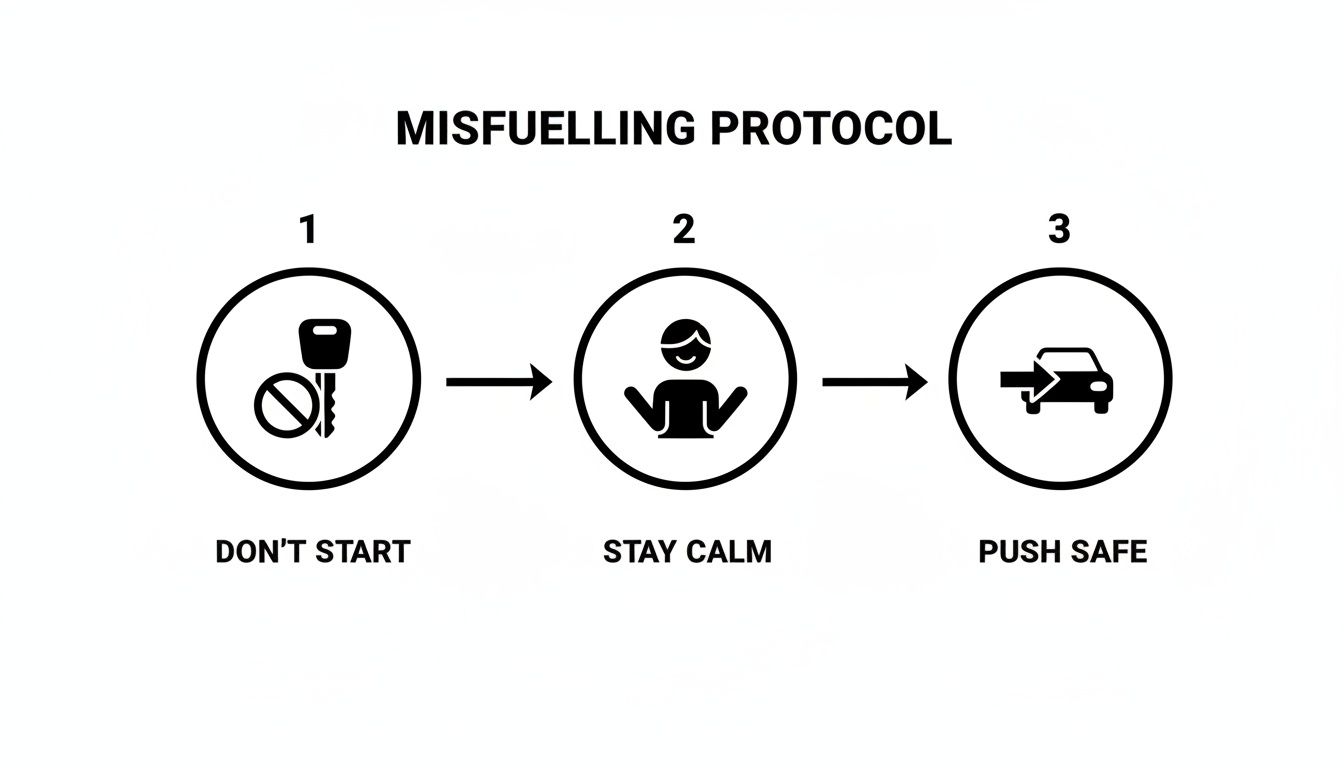
Following these three steps contains the problem, making the solution—a professional fuel drain—far simpler and cheaper.
Immediate Do's and Don'ts After Misfuelling
If you find yourself in this situation, don't beat yourself up. Misfuelling is a surprisingly common mistake, with estimates suggesting over 150,000 cases happen every year in the UK. The key is how you handle it. This table gives you a quick-reference guide for those first critical moments.
Action | What to Do (The Right Way) | What to Avoid (The Wrong Way) | Why It Matters |
|---|---|---|---|
Ignition | Leave the keys out of the ignition completely. | DO NOT turn the key, even to accessory mode. | Turning the key primes the fuel pump, starting the circulation of contaminated fuel. |
Communication | Inform the petrol station staff immediately. | Don't just leave the car at the pump and walk away. | Staff can cone off the area for safety and may be able to help you move the vehicle. |
Movement | Put the car into neutral. | DO NOT start the engine to move it "just a few feet." | Even a few seconds of running the engine can cause thousands of pounds of damage. |
Positioning | With help, push the car to a safe parking bay. | Don't leave the car blocking the pumps. | This clears the forecourt and puts your car in a safe spot for a recovery specialist to work. |
By following the 'Do' column, you successfully prevent any damage to your vehicle's engine. The problem is now contained entirely within the fuel tank, making it a straightforward job for a mobile fuel drain specialist to resolve without any lasting harm to your car.
Your Immediate Action Checklist
Okay, so you’ve realised the mistake. Let’s get this sorted.
Stay Calm: Take a deep breath. Panicking won’t help, and the problem is completely solvable as long as you haven't started the engine.
Inform the Petrol Station Staff: Let them know what's happened. They can cone off the pump and will know what to do.
Put the Car in Neutral: Make sure the handbrake is on, but pop the car into neutral so it can be moved.
Push the Vehicle to a Safe Place: Ask the staff or other motorists for a hand to push your car to a designated parking bay, away from the pumps.
That’s it. You’ve done your part. By taking these initial steps, you have successfully prevented any real damage. The problem is now neatly contained, ready for a specialist to fix without any long-term consequences for your car.
Should You Drain The Fuel Tank Yourself?
After the shock of misfuelling wears off, it's natural to think, "Can I just sort this myself and save a bit of money?" On the surface, draining a fuel tank sounds straightforward enough. But with modern cars, the reality is a world away from siphoning petrol out of an old Escort with a bit of garden hose.
Tackling this yourself is a serious undertaking. The days of simple siphoning are long gone, and attempting it without the right gear and a healthy respect for the risks can turn a simple mistake into a financial disaster.
The DIY Fuel Drain Toolkit
If you were determined to give it a go, you’d need a very specific shopping list. This isn’t a job for household items.
A Proper Siphon Pump: You’ll need a manual pump specifically designed for flammable liquids like petrol and diesel. Anything else could degrade, spark, or just fail.
Certified Fuel Containers: Forget old paint tins or milk jugs. You are legally required to use sealed, compliant containers built for transporting hazardous fuel. With a typical car holding 45-65 litres, you'll need several.
Personal Protective Equipment (PPE): This is non-negotiable. We're talking fuel-resistant gloves, splash-proof safety goggles, and a fire extinguisher right by your side.
Even if you assemble all the correct kit, you’ll immediately hit a wall—one that car manufacturers have built in on purpose.
The biggest obstacle you'll face is the anti-siphon device. Almost every car made in the last two decades has a valve, a mesh screen, or a series of sharp bends in the filler neck. It’s designed specifically to stop fuel theft, and it’s incredibly effective at stopping DIY fuel drains too. Bypassing it without specialist tools often ends with a damaged filler neck.
Why DIY Is A Modern Motoring Gamble
Getting past the anti-siphon device is just the first hurdle. The real minefield is the complexity of a modern fuel system. These aren't simple, gravity-fed setups; they are highly pressurised, computer-controlled networks.
An engine today relies on a system that pushes fuel from the tank through fine lines, filters, and high-pressure pumps before it's atomised by the injectors. Simply draining the tank, even if you could manage it, doesn't get the contaminated fuel out of the system's veins.
The wrong fuel will still be hiding in:
The fuel lines running the entire length of the car.
The main fuel filter.
The expensive high-pressure fuel pump and rail.
The incredibly delicate fuel injectors.
Getting rid of that requires a professional flush, where clean fuel is actively circulated to purge every last drop of contaminant. If you skip this, the remaining bad fuel will mix with the fresh tankful and can still cause catastrophic damage. A new high-pressure pump and set of injectors can easily set you back over £3,000, completely dwarfing the cost of a professional call-out.
The Risks Just Don't Add Up
When you weigh the potential savings against the very real risks, the choice becomes clear. The dangers aren't just financial; they involve your personal safety and the environment.
Risk Category | The DIY Challenge | The Professional Solution |
|---|---|---|
Safety | High risk of fire or explosion from sparks and vapours. Inhaling corrosive fumes is a serious health hazard. | Technicians are highly trained, use certified spark-proof (Atex-approved) pumps, and follow strict safety protocols. |
Effectiveness | It's virtually impossible to remove 100% of the contaminant, leaving your engine vulnerable to long-term damage. | A full system drain and flush purges the tank, lines, filter, and pump, guaranteeing a clean start for your engine. |
Legality | You are legally responsible for the safe and correct disposal of the mixed fuel (a hazardous waste). Fines for illegal dumping are severe. | A professional service is a licensed waste carrier and handles all disposal according to Environment Agency regulations. |
Ultimately, while the instinct to fix it yourself is understandable, the technical barriers and high stakes make it a terrible idea for modern cars. The only safe, effective, and legally sound way to fix a misfuel is to call in the professionals. It protects your car, your wallet, and gives you complete peace of mind.
How Professionals Drain A Fuel Tank
When you make that sinking call for help, a highly organised and rapid process kicks into gear. It’s far more involved than just sticking a hose in the tank; a professional fuel drain is a meticulous procedure performed by a trained technician to get you back on the road safely. Understanding how the pros tackle it really shows why it's the only sensible option for a modern car.
Picture the scene: you've misfuelled at a busy service station, miles from anywhere. Your car's parked safely, but you're stranded. From the moment the technician arrives, their first priority is safety. They'll secure the area around your vehicle with cones and make absolutely certain there are no ignition sources nearby. A quick assessment of the car and the situation is all they need to prepare for a safe, efficient drain.
Accessing The Fuel System Securely
Modern cars are fitted with anti-siphon devices to stop fuel theft, which is great until you need to drain the tank yourself. It makes a DIY job next to impossible. Professionals, however, come equipped with specialist tools designed to bypass these measures without causing a scratch of damage to your filler neck or tank. It's a precise job, not a case of forcing a hose in.
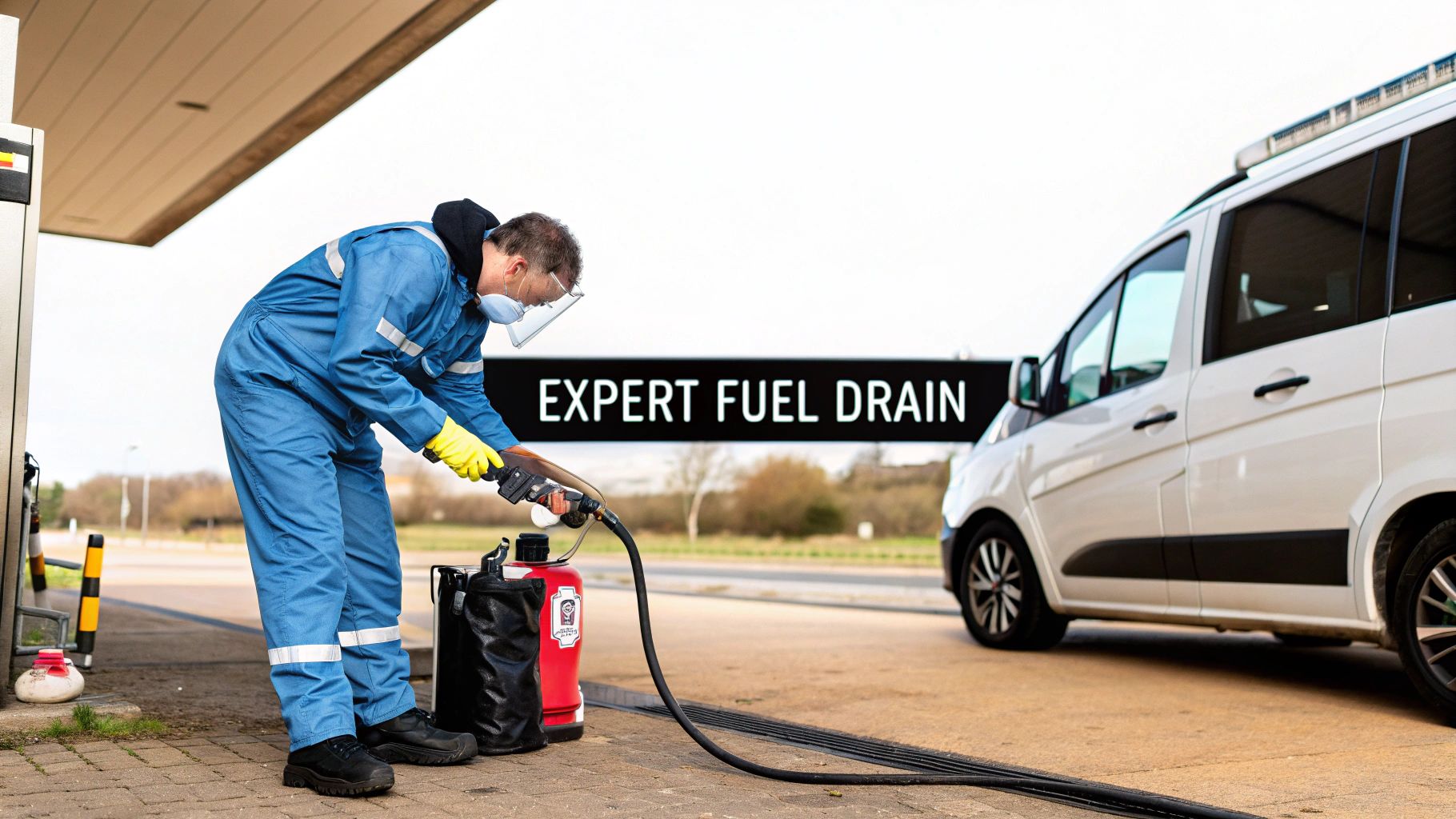
Once they have access, the real work begins. The technician connects an Atex-approved pumping system to your vehicle. "Atex" is the European safety standard for equipment used in explosive atmospheres. In simple terms, it means the pump is intrinsically safe and won't create a spark—an absolute must when you're dealing with flammable fuel vapour.
This isn't just any old pump; it's a self-contained, mobile fuel recovery unit. It's engineered to pull the contaminated fuel out quickly and, crucially, transfer it directly into a sealed, secure tank inside the technician's van.
The pumping itself is incredibly quick. These powerful vacuum extraction systems can remove fuel at rates of up to 100 litres per hour. This speed is vital, particularly for commercial fleets, which accounted for 22% of misfuelling cases in 2025. For a business, vehicle downtime is lost money, so a service that restores 98% of system efficacy is essential to avoid the average £3,200 repair bills that can come from untreated damage.
Flushing The System For A Clean Slate
Just emptying the tank isn't the end of the story. The wrong fuel has already made its way into the fuel lines, filter, and possibly the high-pressure pump. To sort this out properly, the technician will perform a complete system flush.
This involves:
Circulating a small amount of clean, correct fuel through the entire system.
This fresh fuel acts like a cleaning agent, pushing out any lingering droplets of the wrong stuff.
The flushed-out mixture is then safely extracted, leaving the fuel lines and components pristine.
This flushing stage is what truly protects your engine from long-term damage. For a more in-depth look at what these services involve, check out our essential guide to misfuel recovery services nationwide.
Final Steps and Safe Fuel Disposal
With the system clean, the technician adds a small amount—usually 5 to 10 litres—of the correct fuel back into your tank. It's just enough to get you started and drive safely to the nearest petrol station for a full top-up. They'll then ask you to start the engine and will wait to make sure everything is running smoothly before packing up.
The last, crucial step is one you don't see: the legal and environmentally sound disposal of the contaminated fuel. This mixture is officially classed as hazardous waste and must be handled under strict regulations.
A professional fuel drain service is a licensed waste carrier. This means they take full legal responsibility for transporting the contaminated fuel and disposing of it at a certified processing facility. This ensures total compliance with Environment Agency rules and protects you from any potential fines, wrapping up a process that is safe, effective, and legally sound from start to finish.
The Most Common Misfuelling Nightmares (And How to Fix Them)
Putting the wrong fuel in your car isn't a single, straightforward problem. While the golden rule is always the same—don't even think about starting the engine—the specific fuel you've used completely changes the risks and the urgency of the situation. Getting a handle on what’s actually happening inside your fuel system makes it crystal clear why calling a professional is the only sensible move.
Each scenario is its own unique chemical headache for your engine. You’ve got the solvent-like chaos of petrol in a diesel system, the clogging mess of diesel in a petrol car, and the corrosive disaster of AdBlue in the diesel tank. The consequences are worlds apart.
Petrol in a Diesel Car
This is, by a country mile, the most common and destructive misfuelling mistake out there. It’s an incredibly easy slip-up to make, as the smaller unleaded nozzle slides perfectly into the wider filler neck on most diesel cars. Unfortunately, if you turn the key, the results can be catastrophic.
Diesel fuel is naturally oily, and your high-pressure fuel system relies on it for lubrication. The fuel pump and injectors are precision-engineered components that need that oily film to survive. Petrol, on the other hand, is the complete opposite—it’s a solvent. The moment it hits a diesel system, it starts stripping away that essential protective layer.
If you start the engine, here's the grim sequence of events:
Starved of lubrication, the high-pressure fuel pump begins to grind, metal on metal.
This process generates tiny metallic shavings, known as swarf, which are then blasted through the entire fuel system under immense pressure.
These particles travel down the fuel lines, shredding the delicate injectors and contaminating everything from the fuel filter to the tank itself.
The damage can be breathtakingly extensive and wallet-emptyingly expensive to put right, often requiring a full replacement of the entire fuel system. A professional fuel drain is the only way to slam the brakes on this destructive chain reaction.
Diesel in a Petrol Car
Putting diesel in a petrol car is a lot less common, mostly because the chunky diesel nozzle simply won't fit into the narrower filler neck of most modern petrol cars. But it does still happen, especially if someone’s using an old fuel can or driving a classic car.
While it’s not as immediately destructive as the reverse scenario, it will absolutely stop your car in its tracks. Diesel is much thicker and far less flammable than petrol. It’s designed to ignite under compression, whereas a petrol engine relies on spark plugs to get the bang.
When thick, oily diesel enters a petrol engine, it just won't ignite properly. Instead, you'll get:
A clogged fuel filter and injectors as the oily gunk gums up the works.
Fouled spark plugs, coated in a residue that prevents them from creating a spark.
A whole lot of smoke puffing from the exhaust as the engine desperately tries (and fails) to burn the wrong fuel.
Your car will run like a dog, misfiring and smoking heavily before it eventually gives up and cuts out. While you're less likely to face catastrophic engine damage, a complete drain and system flush is still non-negotiable to clean out the mess and get it running smoothly again.
AdBlue in the Diesel Tank
This is a distinctly modern problem, but one we're seeing more and more. AdBlue itself is a non-toxic liquid, but it's incredibly corrosive to many of the metals, plastics, and seals used in a car's fuel system. It’s supposed to be injected into the exhaust, never the fuel tank.
Putting AdBlue in your diesel tank kicks off a chemical reaction that can completely wreck your car’s sophisticated emissions control system.
The real nightmare with AdBlue is that when it mixes with diesel, it crystallises as it dries. These sharp, hard crystals can quickly block the fuel pump, filters, and injectors. Even worse, its corrosive nature can eat away at the sensitive and expensive components of the Selective Catalytic Reduction (SCR) system.
The scale of this issue is ballooning. AdBlue contaminations shot up to 12,000 reported cases in 2024, which isn't surprising when you learn that 70% of modern diesel cars now use it. If you don't get it sorted immediately, repair bills can easily sail past £1,800. It’s a costly mistake in a country where the annual road fuel supply hits 42 billion litres and misfuelling already wastes 2.5 million litres every year. You can get a better sense of the UK's evolving fuel landscape in the government's latest energy analysis.
Before we go any further, it’s worth understanding how these symptoms stack up, as recognising them quickly can save you a fortune.
Misfuelling Mistake Symptom and Severity Guide
The signs your car gives you after being fed the wrong fuel can range from a slight cough to a full-blown mechanical seizure. This table breaks down what to look for and just how serious each mistake can be if you’ve turned the key.
Mistake Type | Common Symptoms | Potential Damage Severity (1-5) | Recommended Action |
|---|---|---|---|
Petrol in Diesel | Engine knocking, loss of power, excessive white smoke, engine warning lights, eventual engine seizure. | 5 (Very High) | Do not start the engine. Call for an immediate professional fuel drain. |
Diesel in Petrol | Engine misfiring, rough idling, excessive black smoke, stalling, failure to start. | 3 (Moderate) | Do not start the engine. Call a professional for a fuel drain and system flush. |
AdBlue in Diesel | Engine won't start, warning lights for AdBlue or emissions system, eventual system-wide corrosion. | 4 (High) | Do not start the engine. This requires a specialist drain to prevent crystallisation and corrosion. |
Recognising these signs and acting fast is your best defence against a four-figure repair bill. No matter which mistake you've made, the solution is always the same: keep the keys out of the ignition and get a professional on the phone. Each type of contamination demands a specific clean-up process, especially with complex Euro 6 diesel engines, and only a trained technician has the right gear and know-how to sort it out safely and completely.
Choosing The Right Misfuel Recovery Service
You’re stranded on a petrol station forecourt, feeling that sinking dread. The last thing you need right now is more stress. Picking the right recovery service is the final, crucial step to turning this major mishap into a minor inconvenience. But not all services are the same, and knowing what to look for will get you a safe, professional fix without any nasty surprises.
Your priority is to find a specialist. This isn't a job for a general breakdown service that’s more likely to just tow you to a garage, adding time and cost to your ordeal. You need a dedicated mobile fuel drain expert who can solve the problem right there on the spot.

Key Factors in Selecting a Service
When you start making those calls, a few key things will instantly separate the real professionals from the cowboys. You’re looking for a service that gives you clear, confident answers about their availability, arrival time, and technical credentials. Speed is great, but competence and safety are everything.
A reputable company will offer 24/7 availability, because these mistakes don’t stick to a 9-to-5 schedule. You need a team that can get to you anytime, day or night. Ask for an estimated response time; most established services can have a technician with you within 60-90 minutes across the main routes in England.
The single most important question you need to ask is about their equipment. A professional service must use an Atex-approved pump. This is the non-negotiable safety standard for equipment used in potentially explosive environments, guaranteeing the pump is spark-proof and safe for handling fuel. If they hesitate or can't confirm this, hang up and call someone else.
The Importance of Certified Technicians
Who actually turns up to do the job is just as important as the gear they use. The technician should be fully trained and certified in handling hazardous materials and roadside safety. They aren’t just mechanics; they are specialists in a very specific, high-risk field.
A qualified technician will:
Arrive in a clearly marked, professional vehicle.
Be wearing the right Personal Protective Equipment (PPE).
Carry out a full safety assessment of the area before they even think about starting work.
Be able to walk you through the process of how to drain a fuel tank clearly and confidently.
This level of professionalism is what gives you peace of mind that the job is being done properly, protecting you, your car, and everyone else around. For a detailed look at what a full service involves, you can learn more about our wrong fuel in car rescue procedures.
Pricing and Environmental Responsibility
Transparent pricing is another sign you’re dealing with a trustworthy company. You should get a clear, fixed quote over the phone before you agree to anything. This quote needs to cover everything: the call-out, the complete fuel drain, a system flush, and a splash of the correct fuel to get you started. Be wary of any company that’s vague about costs or hints that "extras" might be added on later.
Finally, ask them what happens to the contaminated fuel. This isn't just waste; it's legally classified as hazardous. A legitimate service must be a licensed waste carrier, registered with the Environment Agency. They are legally required to transport the mixed fuel in a sealed, secure tank and dispose of it at a licensed facility.
This isn’t just about being green; it ensures total legal compliance and protects you from any potential liability. A true professional handles this from start to finish, providing a completely worry-free solution when you need it most.
Got Questions About Misfuelling? We've Got Answers
Once the initial shock of a misfuelling mistake wears off, it's natural for your mind to start racing with questions. You want to be sure you’re doing the right thing for your car without getting ripped off. We’ve pulled together the most common queries our technicians hear on the roadside, giving you clear, no-nonsense answers from the experts.
Getting your head around the specifics gives you back a bit of control and the confidence that the problem is being handled properly. This isn't just about getting your car started; it's about peace of mind.
Do I Really Need a Drain If I Only Put in a Little Bit?
Yes, without a shadow of a doubt. This is probably the most critical question we get asked, and the answer is always the same. Even a tiny amount of contamination—we're talking as little as 5% of your tank's capacity—can be enough to cause catastrophic damage, especially when you've put petrol into a modern diesel engine.
The moment the wrong fuel hits the tank, it starts to mix. It doesn’t just sit harmlessly on top. A professional fuel drain is about more than just getting the bulk of the bad stuff out; it's about meticulously flushing the entire system to ensure no damaging residue is left behind. Thinking you can just "dilute" the mistake by topping up with the correct fuel is a high-stakes gamble that could easily land you with a repair bill running into the thousands for a new fuel pump and injectors.
The only truly safe option is a complete drain and flush. It's a guaranteed fix that removes the risk of crippling mechanical failure later on. For the relatively small cost of a professional call-out, you’re buying absolute certainty that your engine is safe.
How Long is This Going to Take?
We get it—your time is precious, and you just want this whole ordeal over with as quickly as possible. The good news is, the entire process is designed to be incredibly efficient.
From the moment you pick up the phone, most mobile fuel drain services aim to have a certified technician with you in 60 to 90 minutes, depending on your location in England and what the traffic is doing.
Once the van arrives, the job itself is surprisingly quick:
Making the Area Safe: A couple of minutes to secure the vehicle and set up.
The Drain and Flush: This is the main event and typically takes around 45 minutes.
Final Checks: A few more minutes to add some clean fuel, prime the system, and make sure your engine is running as it should be.
All in, you can expect the on-site work to be wrapped up in about an hour from arrival to departure. We'll have you safely back on your way with minimal fuss.
Has This Just Voided My Car's Warranty?
That's a very real concern, especially if you're driving a newer car. If you start the engine with the wrong fuel and cause damage, then yes, you could definitely jeopardise your manufacturer's warranty. The resulting failure would be classed as user error, not a mechanical fault with the car.
However, by doing the right thing—not starting the engine and calling for a professional fuel drain—you are taking the exact steps needed to prevent any damage from occurring in the first place. A professional drain and flush restores the fuel system to its original state. The invoice from the service is your proof that you took immediate and correct action to fix the mistake, which is a great piece of evidence to have in your car's history.
What Happens to the Drained Fuel?
The cocktail of mixed fuel that comes out of your tank is classified as hazardous waste, and its disposal is governed by strict environmental laws. Any reputable fuel drain service will be fully licensed by the Environment Agency to handle this process from start to finish.
The contaminated fuel is safely pumped into a specially designed, sealed tank inside the technician's van. It's then securely transported to a licensed hazardous waste treatment facility. There, it's processed and disposed of in a way that is legal, safe, and environmentally responsible, ensuring you're fully compliant with all UK regulations.
If you've put the wrong fuel in your car, don't wait and hope for the best. Contact Misfuelled Car Fix right away for a fast, professional, and safe mobile fuel drain service anywhere in England. We're on call 24/7 to get you out of a tight spot. Call us now or book your fuel drain online.