Small Amount of Petrol in Diesel Car: small amount of petrol in diesel car Tips

Updated: 12 hours ago
24/7 Hotline Nationwide: 0800 999 1182
If you found this page, we cover you in England!
That sinking feeling hits you the second you clock the mistake. You’ve just put a small amount of petrol in a diesel car. Right now, what you do next is absolutely critical, and the most important action is non-negotiable: do not start the engine. Don't even turn the key to put the radio on. Keeping that contaminated fuel safely in the tank is your only defence against eye-watering repair bills.
It's an incredibly easy mistake to make, and you're certainly not alone. An estimated 150,000 to 160,000 drivers in the UK do the exact same thing every year. That works out to a misfuelling incident roughly every three minutes, a figure that shows just how common this problem is for motorists nationwide. You can find more details about these shocking figures on misfuelling cases throughout the UK.
The entire problem boils down to the fundamental difference between petrol and diesel. Think of diesel as a fine, lubricating oil. It doesn't just provide the bang for combustion; its oily properties are essential for protecting the incredibly precise, high-pressure components of your fuel system. Parts like the fuel pump and injectors are engineered to microscopic tolerances and rely entirely on diesel to prevent metal grinding against metal.
Small Amount of Petrol in Diesel Car | The Problem With Petrol's Solvent Power
Petrol is the complete opposite. It acts just like a powerful solvent or a degreaser. When you introduce it into a diesel system, it immediately gets to work stripping away that vital lubricating film. Even a tiny amount of petrol in a diesel car is enough to start a destructive chain reaction:
Stripped Lubrication: Without its protective diesel film, the fuel pump starts to grind itself to pieces, creating thousands of tiny metal particles.
Detonation Damage: Petrol ignites at a much lower temperature and pressure than diesel. This causes uncontrolled detonations, often heard as a sharp "knocking," which can damage pistons and cylinder heads.
System-Wide Contamination: Those metal fragments created by the wearing fuel pump get circulated through the entire system, where they can permanently destroy your expensive injectors.
The single most important thing to understand is this: the damage doesn't happen when the petrol goes into the tank. The real damage begins the second you turn the key, engaging the fuel pump and sending that destructive mixture surging towards your engine.
Knowing why this is so bad makes the next step obvious. Calling for a professional fuel drain isn't just a good idea; it's the only guaranteed way to stop a momentary lapse in concentration from turning into a four-figure repair bill.
Here’s a quick-glance table to hammer home what to do—and what not to do—the moment you realise you've misfuelled.
Immediate Actions When You Realize You Have Misfuelled
Action to Take | Why It Is Absolutely Critical |
|---|---|
Do NOT turn the key in the ignition. | Turning the key, even without starting the engine, can prime the fuel pump and circulate the contaminated fuel. |
Put the car in neutral. | This will make it much easier to move the vehicle to a safe spot away from the pumps. |
Inform the petrol station staff. | They’ve seen this happen countless times and can help keep the area safe while you wait for assistance. |
Push the car to a safe parking bay. | Getting away from the pumps is essential for your safety and allows other drivers to refuel. |
Call a professional misfuelling service. | This is not a DIY job. A specialist has the right equipment to drain the tank safely and legally. |
Following these steps contains the problem and prevents that initial mistake from escalating into a mechanical and financial disaster.
How Much Petrol Contamination Is Too Much
It’s the first question on every driver's mind after the horrible realisation dawns: "Was it a small enough amount to get away with?" The hard truth is, for any modern diesel engine, there is no "safe" amount of petrol. Any contamination is too much.
While there’s no official safe limit, the general rule of thumb for what’s considered a small amount of petrol in a diesel car is anything less than 5% of the fuel tank's total capacity. For a standard 60-litre tank, that works out to be under 3 litres.
But even that tiny ratio is a massive gamble. Modern high-pressure common-rail diesel systems are incredibly sophisticated pieces of engineering, built with microscopic tolerances. Their survival depends entirely on the lubricating qualities of diesel fuel. Petrol, being a solvent, immediately starts to strip away this essential protection, no matter how diluted it is. In fact, just a 1% petrol contamination can dramatically lower the flashpoint of diesel, risking uncontrolled combustion known as engine 'knocking' or detonation.
The Escalating Risk of Damage
The danger shoots up exponentially with the amount of petrol you've added. A tiny splash might just cause some accelerated wear over time, but a more significant amount can cause the high-pressure fuel pump to seize up in minutes. When this happens, it sends tiny metal fragments blasting through the injectors and fuel lines, leading to a catastrophic and wallet-emptying failure of the entire system.
The infographic below really brings home just how often this mistake happens, reinforcing why taking immediate, correct action is so important.
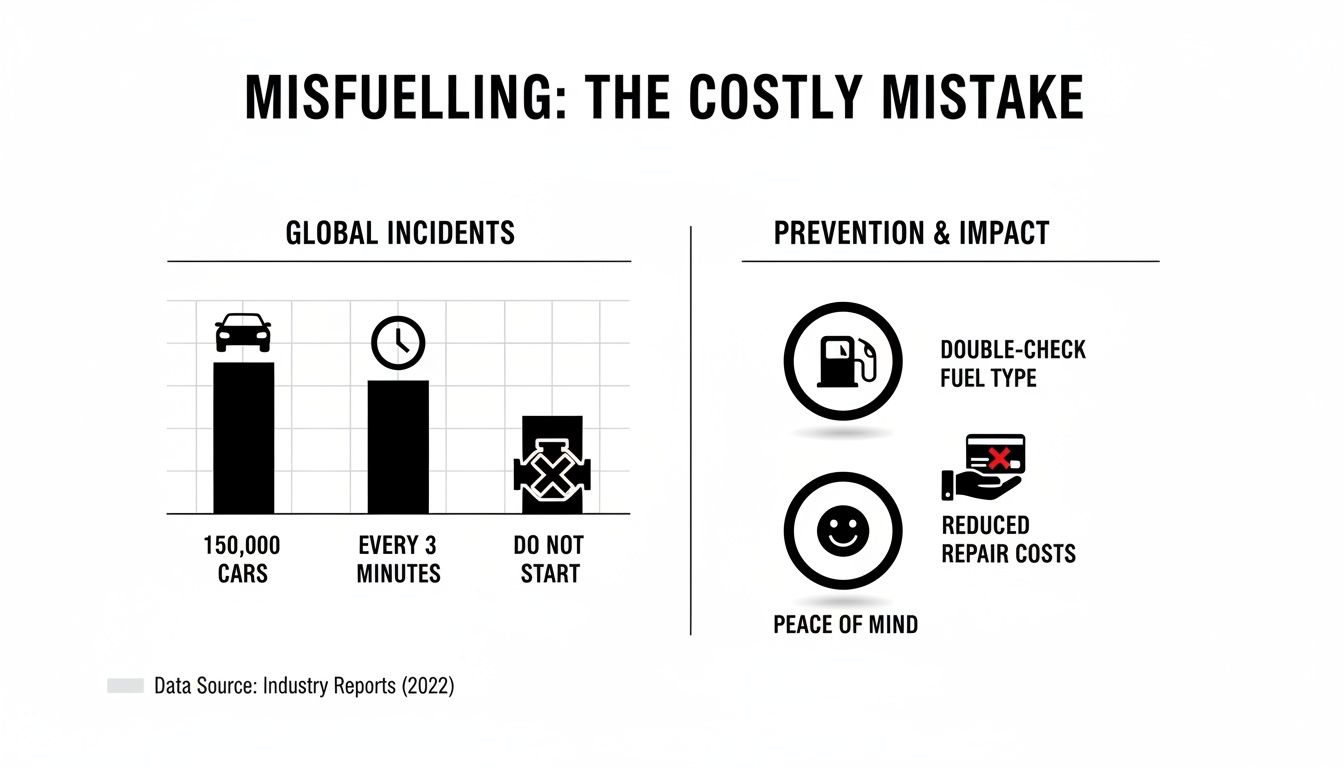
This data shows that misfuelling is a constant problem on UK roads, but the critical lesson is always the same: the damage is completely preventable if you do not start the engine.
The table below breaks down the risk levels, showing how quickly a small mistake can become a major problem.
Petrol Contamination Risk Levels in a 60-Litre Diesel Tank
Contamination Level | Petrol Amount (Litres) | Risk to Engine | Recommended Action |
|---|---|---|---|
Up to 5% | Up to 3 Litres | High. Lubrication is compromised. Risk of pump/injector wear if driven. | Do not start. Call for a professional fuel drain. |
5% to 10% | 3 to 6 Litres | Very High. Severe risk of rapid fuel pump failure and system damage if started. | Do not start. Immediate professional fuel drain is essential. |
Over 10% | 6+ Litres | Critical. Catastrophic failure of the fuel system is almost certain if the engine runs. | Do not start. Call a specialist immediately. |
As you can see, the only safe response, regardless of the amount, is to get the contaminated fuel out.
The bottom line is this: there is no "safe" amount of petrol you can add to a modern diesel car. The potential for severe damage to the fuel pump and injectors is present from the very first drop.
Trying to "dilute" the petrol by topping up the tank with more diesel is a classic false economy. The risk of causing thousands of pounds worth of damage to your engine far outweighs the cost of a professional fuel drain. It's the only guaranteed safe path forward to protect your vehicle.
Recognizing the Warning Signs of Misfuelling
What if you only realised your mistake after pulling away from the pump? It’s a gut-wrenching moment. If you’ve driven off with even a small amount of petrol in your diesel car, the vehicle will quickly start sending out some very clear distress signals.
Knowing what these symptoms are is your best chance to pull over safely and prevent a moment’s mistake from turning into a seriously expensive, long-term problem.

The second that petrol starts circulating where it shouldn't, your engine's performance will fall off a cliff. It's vital to pay close attention to how your car feels and sounds in those first few moments after refuelling.
Common Misfuelling Symptoms
You’re not looking for a subtle change here; the signs are usually quite dramatic. Keep an eye (and an ear) out for any of these tell-tale warnings:
A Spluttering, Hesitant Engine: Your car might start to jerk or stutter, especially when you try to accelerate. It’s a classic sign that the fuel isn’t combusting properly.
A Major Loss of Power: The engine will feel sluggish and weak. Trying to pull away from a junction or climb a hill will become a real struggle as the contaminated fuel fails to ignite as it should.
Clouds of Exhaust Smoke: You might see thick white or even bluish smoke pouring from the exhaust. This isn't just a little puff; it's unburnt fuel being vaporised by the hot exhaust system.
Loud Knocking Noises: This is the one you really can't ignore. A sharp, metallic knocking or rattling sound from the engine is a serious red flag. It’s caused by petrol igniting far too early under the high compression of a diesel engine, literally fighting against the piston’s proper movement.
If you experience any of these symptoms, pull over as soon as it is safe to do so and turn off the engine immediately. Every second you continue to drive massively increases the likelihood of catastrophic damage to your fuel pump and injectors.
Understanding these warnings is absolutely crucial. If you notice these issues shortly after leaving a petrol station, don't try to "limp home" or ignore them. To get a more detailed look at the specifics, you can learn more about the wrong fuel in car symptoms in our other guide.
Acting fast by stopping the car is, without a doubt, the single best thing you can do to protect your engine from a wallet-busting repair bill.
What a Misfuel Technician Actually Does
So, you’ve made the right call and a mobile technician is on their way. It’s always reassuring to watch a real professional at work, as they follow a very precise and safe process to get you sorted without causing any more harm. Believe me, it’s a lot more involved than just sticking a hose in the tank.
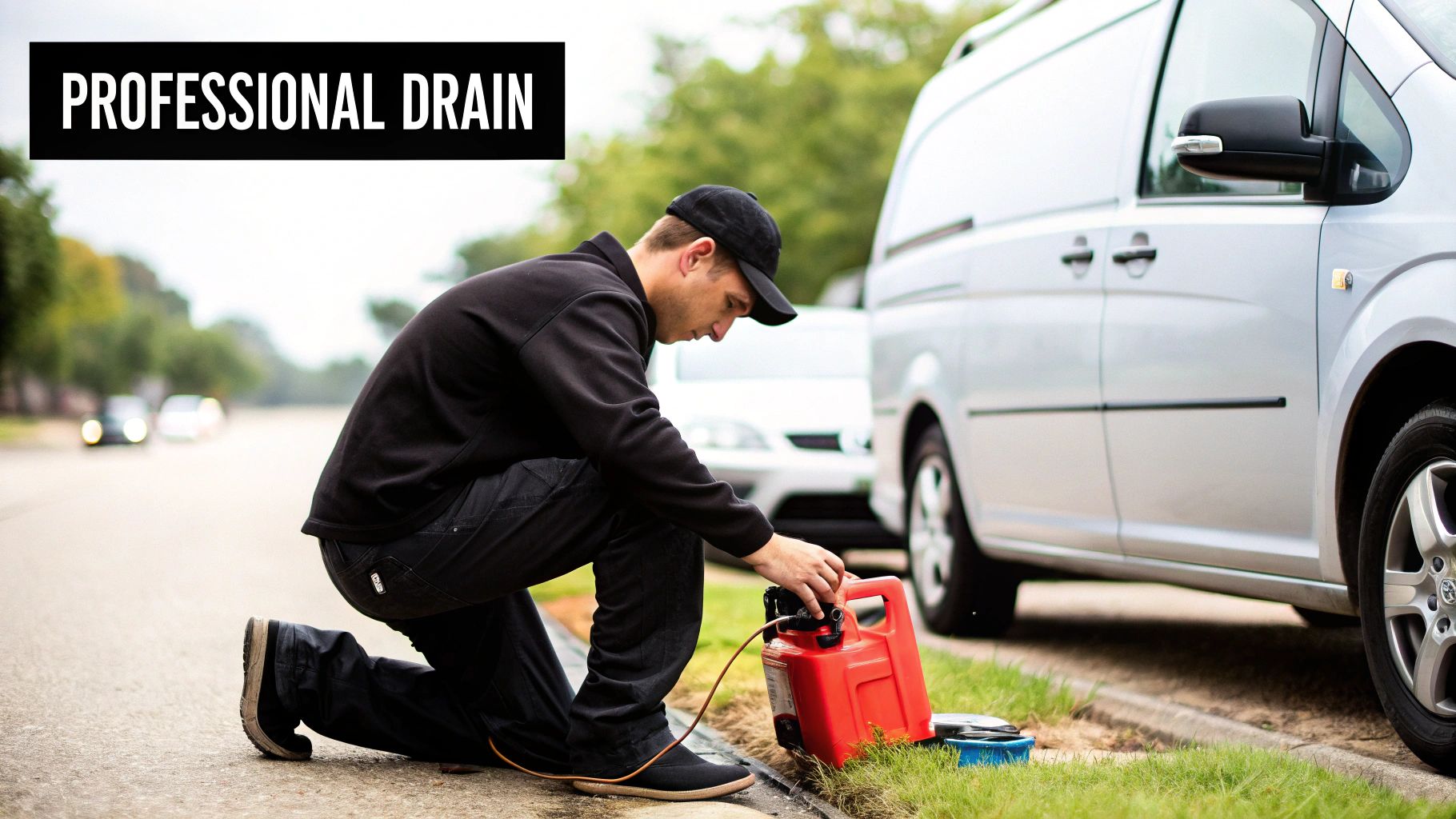
The very first thing they’ll do is make sure the area is safe. This means securing the space around your vehicle and eliminating any potential sources of ignition. Then, they’ll use specialised, ATEX-approved pumping gear to drain the entire contents of your fuel tank. This isn’t just some bit of tubing; it's a fully sealed system designed to handle flammable liquids without any spills.
It’s More Than Just Emptying the Tank
Simply draining the tank is only half the battle, especially if that small amount of petrol in a diesel car has been circulated by the fuel pump even for a moment. The next stage is absolutely critical: flushing the entire system.
The technician will disconnect the fuel lines and use a bit of clean diesel to flush out every last trace of petrol contamination. This clears out the lines, the fuel filter housing, and crucially, the high-pressure pump. It’s this step that ensures when you refill with fresh diesel, it isn’t immediately contaminated by petrol still lurking in the system.
This flushing process is what really separates a proper, professional job from a risky DIY attempt. It gets that damaging solvent away from the components that need diesel’s lubrication the most. If you’re curious about the technical side of things, our guide on how to drain a fuel tank safely goes into more detail.
A key part of the service is also replacing the fuel filter. This filter will have trapped the first wave of contaminated fuel and potentially any tiny metal fragments if the pump has started to wear. A fresh filter is non-negotiable for a clean start.
Once the system is spotless, the technician will add around 5-10 litres of fresh, correct diesel. This is enough to prime the system so the pump can draw fuel properly. They’ll then bleed any air from the lines before carefully starting the engine. All in, the entire process—from arrival to you driving away—usually takes between 45 and 90 minutes. It’s a fast, professional fix that gets you back on the road and prevents the huge cost and hassle of a major garage repair.
How to Make Sure This Never, Ever Happens Again
After the stress and hassle of a misfuelling incident, you’ll want to be absolutely certain it’s a one-time mistake. The good news is that preventing it is far easier—and cheaper—than fixing it. It all comes down to breaking that autopilot mode we all slip into at the petrol station.
The simplest trick in the book? Just pause for a moment. Before you even touch a nozzle, consciously check two things: the colour of the pump handle (green for petrol, black for diesel in the UK) and the label on your car's fuel cap. That tiny, two-second check is usually all it takes to snap you out of a daydream and prevent a costly mistake.
Building Bulletproof Habits at the Pump
The risk of misfuelling is always higher if you regularly switch between cars, like a family runaround and a company van. When you’re jumping from a petrol to a diesel, it’s incredibly easy to slip up. Here are a couple of tried-and-tested tricks to keep you on the right track:
Give Yourself a Visual Nudge: Stick a bright, hard-to-miss "DIESEL" sticker on the inside of your fuel flap or even on the dashboard. It’s a simple, in-your-face reminder.
Say It Out Loud: It might sound a bit daft, but actually saying "This is the diesel pump" as you pick up the nozzle can really help. It forces your brain to register the action instead of just going through the motions.
Honestly, almost every single misfuel happens because of distraction or being in a mad rush. Taking just five extra seconds to double-check is the most effective way to save yourself the money, time, and sheer frustration of a fuel drain.
If you want to make it physically impossible to mess up again, you could look into some of the clever gadgets on the market. There are several aftermarket fuel caps designed to replace your standard one. They are engineered so that the smaller unleaded petrol nozzle simply won't fit into your car's diesel filler neck, stopping the mistake before it can even start.
Your Top Questions About Misfuelling Answered
It's completely normal to have a head full of questions after putting the wrong fuel in your car. Once the initial panic subsides, the practical worries start to creep in. Let's tackle some of the most common concerns we hear from drivers every single day.
Can’t I Just Top Up the Tank with Diesel to Dilute the Petrol?
It's a tempting thought, isn't it? The idea that you can just water down the problem and hope for the best. But in a modern diesel, this is a recipe for a mechanical nightmare.
The old advice to “just top it up” is a dangerous myth. Petrol acts as a powerful solvent, stripping the vital lubricating film from your fuel pump and injectors. Adding more diesel won't magically restore that lubrication; it just guarantees the damaging mixture gets forced into every corner of your fuel system. The only safe solution is to have it all drained out professionally.
Will My Car Insurance Cover a Misfuelling Incident?
This one’s a real grey area, and the honest answer is, it all comes down to the small print in your policy. Some comprehensive plans do include accidental damage cover that can help, but many standard policies specifically exclude misfuelling. You’ll need to check your documents.
Even if you are covered, it's worth thinking about a couple of things first:
Your Policy Excess: You might find the excess you have to pay is actually more than the cost of calling out a specialist mobile fuel drain service.
Your No-Claims Bonus: Making a claim will almost certainly hit your no-claims bonus, which could mean paying higher premiums for years.
How Long Does a Mobile Fuel Drain Service Take?
You’ll probably be surprised at how quick and efficient a professional fuel drain is. Once a qualified technician arrives on-site, the whole job is typically done and dusted in 30 to 60 minutes.
That time includes draining the tank, flushing the entire fuel system, adding a splash of fresh diesel, and making sure the engine starts up and runs smoothly.
The whole point of a mobile service is to get you out of a jam with minimal fuss. Instead of waiting for a recovery truck and then a garage slot, you can be safely on your way in about an hour. It’s a huge benefit we explore in our guide to nationwide misfuel recovery services.
Is It True That Older Diesel Cars Can Handle a Little Petrol?
You might hear this from an old-school mechanic or your grandad, and back in the day, they weren’t entirely wrong. Older, mechanically simple diesels were a lot tougher and could sometimes shrug off a bit of contamination.
But that advice is completely useless for any modern diesel. Today’s common-rail systems are precision-engineered machines, built to microscopic tolerances. They are incredibly sensitive, and even a small amount of petrol is enough to risk catastrophic—and seriously expensive—engine damage. It’s a gamble you really don’t want to take.
If you've put a small amount of petrol in your diesel car, don't panic and don't start the engine. The expert team at Misfuelled Car Fix offers a 24/7 mobile service to safely drain the wrong fuel and get you back on the road quickly. Visit https://www.misfuelledcarfix.co.uk or call our freephone number for immediate assistance.