


Petrol in a diesel car what to do: Quick guide to prevent engine damage
- Misfuelled Car Fixer

- Jan 25
- 13 min read
Updated: Jan 26
That horrible, sinking feeling you get the moment you realise you’ve grabbed the wrong nozzle at the pump. If you've just put petrol in your diesel car, what you do in the next few seconds is absolutely crucial.
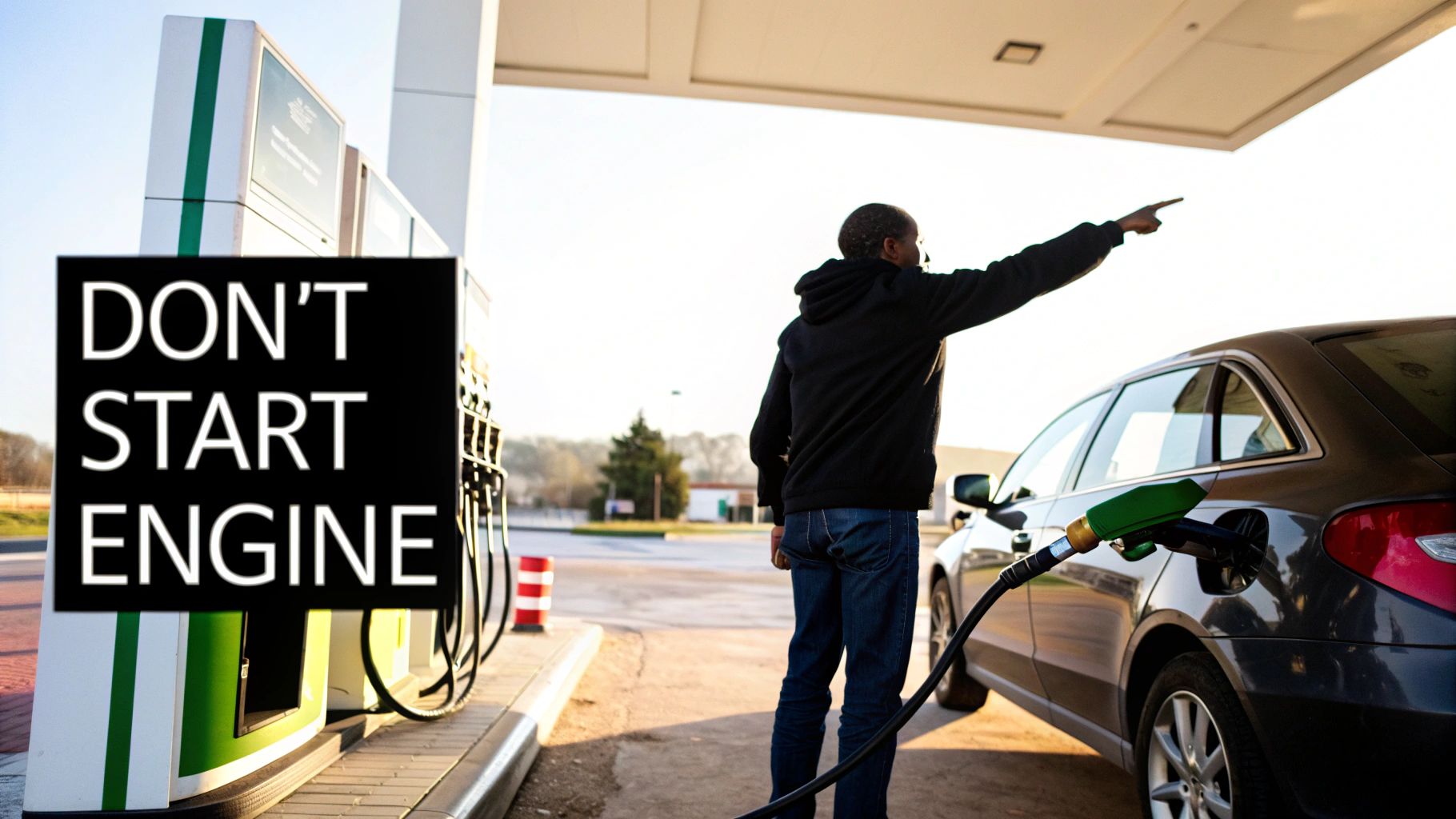
The golden rule, the one non-negotiable action, is this: do not start the engine. Don’t even be tempted to turn the key to put the radio on. Just activating the car's electronics can be enough to prime the fuel pump, which will start circulating that damaging petrol through the system. Keeping the engine completely off is the single best thing you can do to avoid a massive repair bill.
What To Do the Moment You Realise the Petrol in a Diesel Car Mistake
First, take a deep breath. You are far from the first person to do this, and you won't be the last. In fact, a 2023 survey by Go.Compare revealed that a staggering 29% of UK motorists have misfuelled their car at least once. With around 150,000 incidents happening across the UK every year, it’s clear this is a very easy mistake to make. You can read more on the findings at MotorTradeNews.com.
The moments right after you realise are pivotal. Your one and only goal right now is to keep that contaminated fuel safely contained inside the tank and stop it from ever reaching your engine.
Your Immediate Action Plan
Okay, let's get practical. Resist every instinct you have to turn that key. Leaving the car completely switched off prevents the fuel pump from kicking in and sending the solvent-like petrol into the delicate, high-precision parts of your diesel engine.
Next, you need to make sure your car is safe and not blocking the forecourt. Here’s exactly what to do:
Keys Out, Pocket In: Take the keys completely out of the ignition. This removes any chance of accidentally starting the car.
Pop it in Neutral: This will make it much easier to push the vehicle if needed.
Tell the Staff: Let an attendant at the petrol station know what’s happened. They’ve seen this countless times before and can help by closing off the pump and helping you move the car out of the way.
By keeping that engine off, you’ve already done the most important thing to minimise the damage. The problem is still entirely contained within the fuel tank, making the fix much, much simpler and cheaper.
Once your car is parked in a safe spot, it's time to call for professional help. Trust me, this isn't a DIY job. Our guide on how to drain a fuel tank safely details the specialist equipment needed for the task. A mobile fuel drain service is designed for this exact situation and is your fastest, safest, and most cost-effective route back on the road.
Why Petrol Is So Damaging to a Diesel Engine
To really get why starting the engine is the worst thing you can possibly do, it helps to understand what's actually happening on a mechanical level. A modern diesel engine is a seriously complex piece of kit, and its fuel system relies on properties that are the polar opposite of petrol.
It all boils down to one fundamental difference: lubrication versus solvency.
Think of diesel fuel as a light, protective oil. It has a greasy quality that lubricates all the high-pressure components it flows through, especially the fuel pump and injectors. These parts are engineered with incredibly tight tolerances, measured in microns, and they absolutely depend on this constant film of lubrication to operate without grinding themselves to pieces.
Petrol, on the other hand, is a solvent. In its own engine, its job is to clean and combust in a flash. But when you introduce this solvent into a diesel system, it immediately gets to work stripping away that protective oily film, leaving critical metal components grinding directly against each other.
To see the stark differences side-by-side, this table breaks it down.
Petrol vs Diesel Why They Can't Mix in Your Engine
Property | Diesel Fuel | Unleaded Petrol |
|---|---|---|
Primary Function | Burns under high compression, lubricates parts. | Burns with a spark, cleans components. |
Viscosity | Higher (oily, greasy texture). | Lower (thin, watery texture). |
Ignition Method | Compression ignition (squeezed until it explodes). | Spark ignition (ignited by a spark plug). |
Key Characteristic | Lubricant. | Solvent. |
As you can see, their roles are completely incompatible within the same engine. One protects, the other strips.
The Chain Reaction of Destruction
The damage isn't instantaneous, but it follows a brutally quick and destructive sequence. The moment you turn that key, the low-pressure fuel pump in the tank kicks in, sending the contaminated mixture on its way.
This mix then slams into the high-pressure fuel pump, which is often the first—and most expensive—casualty. Without lubrication, its internal metal parts tear themselves apart, creating tiny metallic particles we call swarf. This swarf is then forced through the rest of the system under immense pressure.
This gritty, abrasive fuel then travels through:
Fuel Lines: The metal particles begin their destructive journey toward the engine.
Fuel Filter: The filter will catch some of this debris, but it's quickly overwhelmed and clogged, which can starve the engine of fuel.
Common Rail and Injectors: Finally, the swarf reaches the high-precision injectors, either blocking them solid or destroying their delicate nozzles.
This entire process can happen in just a few minutes of the engine running. A simple mistake at the pump has now escalated into a full-system contamination that is eye-wateringly expensive to fix. If you want to know the first signs of this happening, have a read of our guide on wrong fuel in car symptoms.
Detonation and Combustion Chaos
On top of the catastrophic lubrication failure, petrol also wreaks havoc on the combustion process itself. Diesel engines use immense pressure to ignite fuel. Petrol engines use a spark plug. Critically, petrol ignites at a much lower temperature than diesel.
When petrol vapour gets into a diesel engine's high-compression chamber, it doesn't burn in a controlled manner—it detonates uncontrollably. This creates violent shockwaves inside the engine, causing that loud, metallic knocking sound you might hear.
This uncontrolled detonation places enormous stress on pistons, gaskets, and cylinder heads. It's the engine's way of screaming that it’s being fed the wrong diet, and continuing to run it can lead to catastrophic internal failure.
In short, every single component from the fuel tank to the engine cylinders is put at immediate risk. The solvent action destroys lubrication, the resulting metal fragments contaminate the entire system, and the incorrect combustion process threatens the engine's core. This is precisely why a professional fuel drain isn't just a good idea—it's an absolute necessity to prevent a simple error from turning into a four-figure repair bill.
What If You've Already Driven the Car?

Realising your mistake at the petrol station is one thing. But what happens if you didn't notice, started the engine, and drove away? This is a much more serious situation, but the absolute worst thing you can do is panic. Acting fast is your best shot at limiting what could otherwise become a very expensive repair bill.
Once you're on the road, your car will quickly start to protest. The petrol’s lack of lubrication and incorrect combustion properties will make the engine very unhappy, and it won't be quiet about it.
The Telltale Warning Signs
The moment that contaminated fuel hits the engine, you'll start to notice some classic symptoms. You don't need to be a mechanic to know something is badly wrong. Keep an ear and an eye out for any of these distress signals:
A Loud Knocking Noise: Petrol detonates uncontrollably under the high compression of a diesel engine. This creates a sharp, metallic knocking or rattling sound that is impossible to ignore. It’s the sound of an engine fighting itself.
A Serious Lack of Power: Your car will feel sluggish and weak. It might jerk, splutter, or struggle to accelerate as the engine fails to burn the fuel correctly.
Clouds of White Smoke: This is a big one. Unburnt fuel is getting vaporised in the hot exhaust system, emerging as thick, white smoke billowing from the tailpipe.
Flashing Dashboard Lights: Your engine management light will almost certainly light up or flash, signalling a critical fault with the engine or fuel system.
The second you notice any of these signs, your only priority is to pull over safely and turn the engine off. Find a lay-by, the hard shoulder, or a quiet side road and kill the ignition. Every second the engine continues to run, the risk of permanent damage climbs higher and higher.
Crucial Takeaway: Continuing to drive, even for another 60 seconds, could be the difference between needing a simple fuel drain and facing a full replacement of your fuel pump and injectors—a repair that can easily run into thousands of pounds.
What to Tell the Technician
Once you're safely stopped, your next step is to call a specialist misfuelling service. To give them the best chance of saving your engine and to speed up the process, you need to have some key details ready.
When you call, be prepared to tell them:
How much fuel went in: Was it just a quick splash of £10, or did you fill the tank to the brim? This tells the technician the concentration of petrol in the system.
How far you managed to drive: Did you just get out of the forecourt, or have you driven several miles down the motorway?
The symptoms you noticed: Describe everything you heard and felt—the knocking, the smoke, the loss of power—before you shut it down.
While driving after misfuelling is never good news, it doesn’t automatically mean your engine is a write-off. Quick thinking is everything. By pulling over at the first sign of trouble, you stop the damaging fuel from circulating further, giving the professionals a much, much better chance of fixing the problem at the roadside.
Getting Professional Roadside Help From a Specialist

Whether you're stuck at a bustling petrol station forecourt or have pulled over on a quiet country lane, the next move is the same: call in the professionals.
Trying to drain the tank yourself is a seriously bad idea. You're dealing with highly flammable fuel, toxic fumes, and the huge risk of causing an environmental spill. This is exactly why specialist misfuelling services exist – they're the emergency service for this precise situation.
Making that call is your lifeline. A dedicated mobile service like Misfuelled Car Fix operates 24/7, because we know these mistakes don’t keep office hours. Unlike a standard recovery truck that can only tow you to a garage, a mobile fuel drain technician is dispatched straight to you, with everything needed to fix the problem right there and then. It cuts the waiting, the stress, and the cost.
What Happens When the Technician Arrives
When the specialist van pulls up, you'll see a slick and professional operation get underway. Their first job is always to make the area safe, for you and for other road users. The technician will then quickly talk you through the process, giving you the reassurance that your car is in expert hands.
The heart of the job involves using specialist, ATEX-approved pumping gear to safely extract every last drop of contaminated fuel from your tank. This isn't just a simple siphon; it's a controlled, spark-free extraction process designed specifically for flammable liquids.
Here's a breakdown of what they'll do:
Complete Fuel Drain: First, they'll access your fuel tank and systematically pump out the entire petrol-and-diesel mixture.
System Flush: With the tank empty, they'll flush the fuel lines, filter, and pump with clean diesel. This is a crucial step to purge any lingering petrol residue that could still cause damage.
Responsible Disposal: All the contaminated fuel is safely stored in secure containers on the van. It's then taken for environmentally compliant disposal at a licensed waste facility.
By calling a specialist, you’re not just getting a fuel drain. You're getting a full system cleanse carried out by a trained and insured expert. It’s the only way to be absolutely certain no destructive petrol is left behind to cause problems later on.
The Benefits of a Specialist Service
This mistake is far more common than you'd think; petrol in a diesel car is one of the most frequent roadside callouts in the UK. The real sting in the tail is that 62% of car insurance policies explicitly state they do not cover misfuelling.
This leaves you to foot the bill, which can vary wildly from a few hundred quid for a roadside drain to over £5,000 for major engine repairs. For more context, you can explore the government's latest road fuel statistics in this UK government report.
Using a specialist mobile service is a faster, safer, and much more cost-effective fix than getting towed to a main dealer. After the flush, the technician will add a bit of fresh, correct diesel to the tank, prime the system, and make sure the engine starts and runs smoothly. In most cases, you'll be ready to drive away in about an hour, turning a potential disaster into a minor inconvenience.
You can find out more about our complete wrong fuel in car rescue service and how we can help.
Breaking Down the Potential Repair Costs
The financial fallout of putting petrol in a diesel car can swing wildly, and it all comes down to one critical moment: did you start the engine? Looking at the potential costs isn't about scare tactics; it’s about understanding why a quick call to a specialist is an investment that can save you from a truly eye-watering bill.
Let’s start with the best-case scenario. You realised your mistake right there at the pump, and the car has stayed completely switched off. If that's you, you've successfully contained the problem.
The fix is a straightforward professional fuel drain. A technician comes out to you, safely pumps out the contaminated fuel, flushes the system to clear any residue, and gets you back on your way. The cost for this kind of mobile service typically falls between £300 and £500. It's an unexpected hit, for sure, but compared to the alternative, it’s a relatively small price to pay.
When the Engine Has Been Started
The financial picture changes dramatically the moment that key is turned. Even if you only drove down the road before realising something was wrong, the costs immediately start to climb. At this stage, you're likely looking at the fuel drain plus a replacement fuel filter, which will have been saturated with the damaging petrol mixture. That could easily add another £100-£200 to your bill.
The real danger zone, financially speaking, is when the car has been driven until it grinds to a halt. This means the petrol has fully circulated, stripping away lubrication from critical components and almost certainly causing severe damage.
The worst-case scenario isn't just a possibility; it's a common outcome for drivers who ignore the warning signs. The metal-on-metal friction inside the high-pressure fuel pump and injectors can destroy them in a matter of minutes.
In this situation, the repair bill can skyrocket. Costs can quickly spiral into the thousands, with some repairs hitting £2,000 to £6,000 for new pumps and injectors. A major worry here is that misfuelling is often not covered by standard insurance policies, with reports suggesting around 62% of policies explicitly exclude it. You can find out more about these potential costs and how UK drivers are affected in this report from GB News.
Just to give you a real-world example, a driver in London back in 2023 saved nearly £4,000 by calling a mobile specialist as soon as they pulled over. The quote they received after being towed to a main dealership was astronomical in comparison. It just goes to show that acting fast truly puts the power—and the savings—back in your hands.
Simple Habits to Prevent Misfuelling in the Future
Right, the immediate crisis is over, your car is running smoothly again, and you're safely back on the road. The first thought that usually pops into your head is: "How on earth do I make sure that never, ever happens again?"
Let's be clear: misfuelling almost always comes down to a brief moment of distraction. You're stressed, you're on the phone, you're driving a hire car, or you're just on autopilot after a long day. The good news is that you don't need some complex system to avoid a repeat performance. A few simple, conscious habits built into your refuelling routine will all but eliminate the risk.
The single most effective thing you can do is to force a mental pause before you even touch the pump. Just take one second. Look at the handle. In the UK, diesel pumps are consistently coloured black, and unleaded petrol is green. This simple colour-check is your best line of defence.
Building Your Prevention Checklist
To make this foolproof, create a quick mental checklist that you run through every single time you pull up to the pump. It takes less than five seconds and can honestly save you thousands of pounds.
Check the Colour: Black is diesel. Green is petrol. Say it in your head.
Read the Labels: Glance at the text on the pump trigger, then look at the label inside your car's fuel flap. Make sure they match before the nozzle goes anywhere near the car.
Kill Distractions: Phone away. End the conversation with your passenger for a moment. Just for those 30 seconds, give the task your full attention.
Think of it like a pilot's pre-flight check. It might feel a bit silly and repetitive at first, but that repetition is exactly what makes it work. It embeds the right actions into your muscle memory, stopping your brain from switching to autopilot and making a costly mistake.
Tools That Make it Almost Impossible to Get Wrong
If you're someone who often swaps between petrol and diesel cars – maybe you have a company van, or your partner's car is different – it's incredibly easy to get mixed up. In these cases, a physical reminder can be a game-changer.
You can pick up a brightly coloured, unmissable sticker for the inside of your fuel flap that screams "DIESEL ONLY". Even better, you can buy a specialised misfuelling prevention device to replace your fuel cap. These clever gadgets are designed to physically block a narrow petrol nozzle from ever being inserted into your car's wider diesel filler neck, making it practically impossible to choose the wrong fuel.
Your Top Questions About Misfuelling Answered
It's completely normal to have a head full of questions after making this mistake. Once the initial panic subsides, the practical worries start to creep in. Let's tackle some of the most common concerns we hear from drivers every day to help you get a clearer picture of what's next.
For many, the first thought that pops into their head is about the cost and whether their insurance will step in to help.
Will My Insurance Cover a Fuel Drain?
This is a real grey area, and the honest answer is probably not. A Go.Compare survey found that a massive 62% of standard policies won't cover misfuelling mistakes, often classing it as a self-inflicted issue.
It's always worth digging out your policy documents just in case, but it’s best to assume you’ll be paying for the drain out of your own pocket.
How Long Does a Professional Fuel Drain Take?
Once one of our specialists gets to you, the whole process is surprisingly quick. You can expect the job to take somewhere between 60 and 90 minutes.
That time covers draining the entire tank, flushing the fuel lines to get rid of any residue, and giving the engine a quick check over to make sure you’re good to go.
What If I Only Put a Little Bit In?
This is a question we get all the time. People hope that if they only put a splash of petrol in, they can just top up with diesel and drive on. Unfortunately, even a small amount is enough to cause damage.
The petrol immediately starts stripping the vital lubricating properties from the diesel, putting your fuel pump and injectors at risk. It absolutely needs a full drain, no matter how little you put in.


