Diesel Engine vs Petrol Engine - diesel engine vs petrol engine
- Misfuelled Car Fixer

- Feb 5
- 16 min read
Deciding between a diesel and a petrol car really boils down to one simple question: what kind of driving do you actually do? It’s probably the biggest choice you'll make when buying a car in the UK, and it hits everything from your daily fuel budget to long-term ownership costs.
If you’re a high-mileage driver, constantly cruising up and down the country's motorways, a diesel engine is almost certainly your best bet. They are built for those long, steady runs, offering fantastic fuel economy and the low-down torque that makes towing feel effortless.
On the other hand, if your life is mostly short hops around town, school runs, and nipping to the shops, a petrol engine makes far more sense. They’re generally better suited to urban driving, cheaper to buy upfront, and often have simpler, less costly maintenance down the line.
Choosing Your Engine: A Quick Comparison for UK Drivers
The fundamental differences in how these engines work create very distinct pros and cons depending on your lifestyle. A diesel's brilliant efficiency only really kicks in on long, steady journeys where it can get up to its optimal running temperature. It’s not happy doing repeated short trips from a cold start, which is the bread and butter of city life.
Petrol engines, in contrast, are often cheaper to buy and their maintenance is usually more straightforward. They also have a massive advantage when it comes to the growing number of Ultra Low Emission Zones (ULEZ) popping up in UK cities. Newer petrol cars are far more likely to be compliant, saving you from the daily charges that many older diesel models now face.
Diesel vs Petrol At a Glance
To cut through the noise, here’s a straightforward table breaking down the key characteristics of each engine. Just think about how each point lines up with your own driving needs and what you’re prepared to spend.
Characteristic | Diesel Engine | Petrol Engine |
|---|---|---|
Best For | Motorway driving, high mileage, towing | City driving, short trips, lower mileage |
Fuel Economy | Typically 20-30% better than petrol | Generally lower, especially on motorways |
Purchase Price | Usually higher upfront cost | Generally lower upfront cost |
Running Costs | Higher fuel cost per litre, potential DPF/AdBlue expenses | Lower fuel cost per litre, simpler maintenance |
Performance Feel | High torque at low RPMs (strong pulling power) | More responsive at high RPMs (quicker feel) |
ULEZ/CAZ | Older models (pre-Euro 6) may face charges | Generally more compliant, especially newer models |
At the end of the day, it's a practical decision. The right engine for your neighbour might be completely wrong for you.
This simple flowchart helps visualise the choice based on where you spend most of your time behind the wheel.
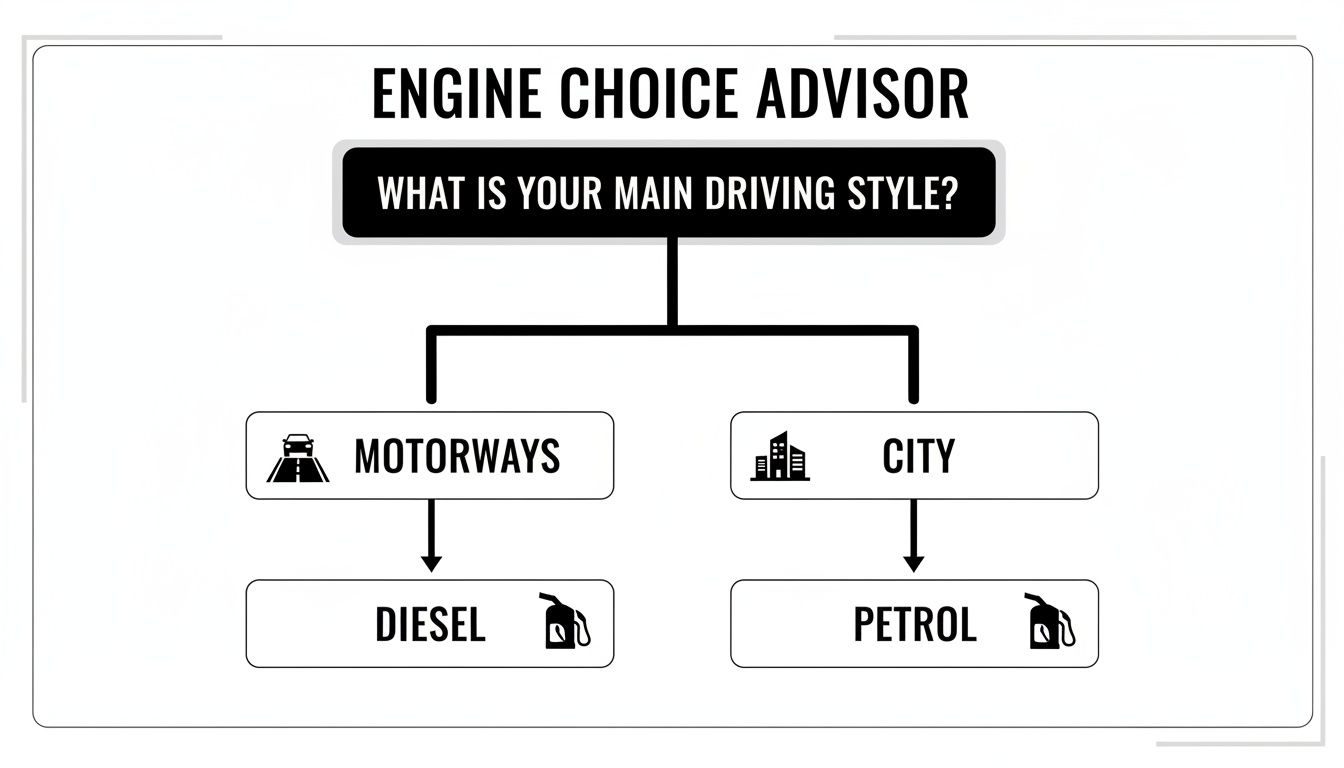
As the guide shows, your daily commute is the best indicator of which engine will serve you better. Let your real-world driving habits be the core of your decision.
How Diesel and Petrol Engines Actually Work
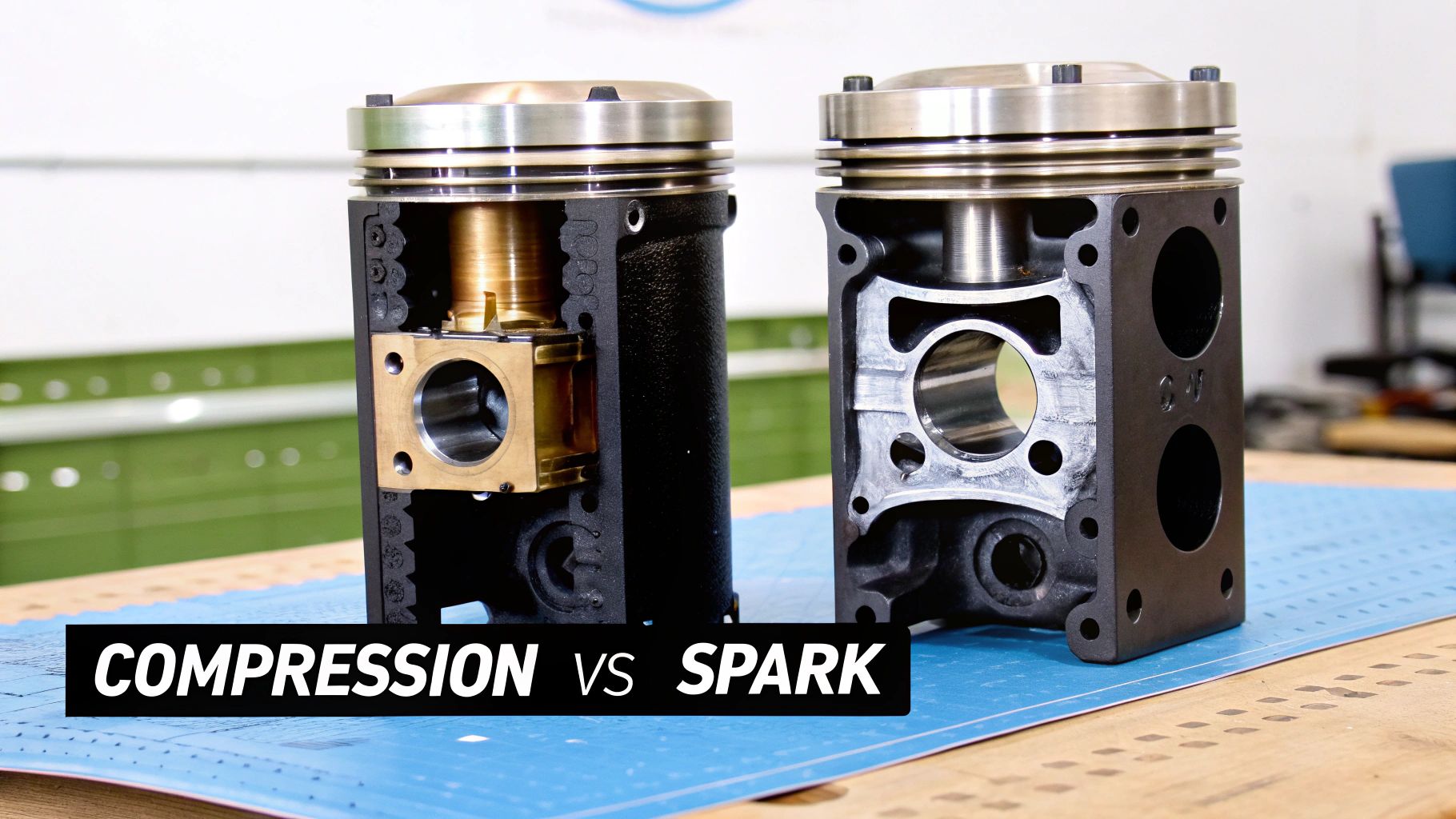
On the surface, both petrol and diesel engines seem to do the same thing. They’re clever bits of metal that turn fuel into forward motion using a series of tiny, controlled explosions. But the way they make those explosions happen is completely different, and that single distinction is the key to understanding every contrast you feel from behind the wheel in the diesel engine vs petrol engine debate.
It all boils down to one simple concept: spark versus squeeze.
A petrol engine relies on what’s called spark ignition. A fine mist of petrol is mixed with air, sucked into the engine’s cylinder, and then squeezed by a piston. Just as the squeeze is at its tightest, a spark plug zaps the mixture, forcing the piston down and creating power. It’s a quick, fiery process, which is exactly why petrol cars often feel so responsive and eager to rev.
Diesel engines, on the other hand, take a much more forceful approach. They use a method known as compression ignition, which does away with spark plugs entirely.
The Power of Compression
Instead of mixing fuel and air from the get-go, a diesel engine first draws in nothing but air and compresses it to an incredible degree. This intense squeeze—often at a compression ratio double that of a petrol engine—heats the air to blistering temperatures, typically well over 540°C.
It’s only at this exact moment of maximum heat and pressure that a precisely measured shot of diesel is injected directly into the cylinder. The superheated air instantly ignites the fuel, creating a powerful and sustained shove that pushes the piston down with immense force.
This compression-ignition process is the secret to a diesel engine’s personality. The slower, more muscular burn generates a huge amount of torque at low revs, which is why diesel vehicles are so brilliant at towing and feel so effortless on the motorway.
Why The Fuels Are Not Interchangeable
Because the engines work in opposite ways, the fuels themselves are engineered to have opposite properties. Petrol is light, volatile, and designed to ignite instantly with a spark. Diesel fuel is denser, oilier, and much harder to light—it needs the intense heat from compression to combust.
Understanding this core difference makes it crystal clear why misfuelling is such a disaster:
Petrol in a Diesel Engine: Petrol ignites far too easily under high compression and has none of the lubricating qualities of diesel. This causes destructive knocking and strips the protective oily film from high-precision parts like the fuel pump and injectors, leading to rapid, catastrophic wear.
Diesel in a Petrol Engine: Diesel is too heavy and oily to turn into a vapour properly and simply won't ignite from a spark plug. The result? A non-starting engine, fouled-up spark plugs, and a fuel system clogged with a thick, greasy fuel it was never designed to handle.
This fundamental incompatibility is precisely why putting the wrong nozzle in your tank can lead to such eye-watering repair bills. Each fuel system is a highly specialised environment, and introducing the wrong fuel is like trying to run a human on seawater—it just can’t process it and will quickly shut down.
Comparing Total Ownership and Running Costs
When you’re weighing up a diesel vs a petrol engine, the price you see at the pump is just one small piece of a much bigger puzzle. The true cost of owning a car goes way beyond fuel, covering everything from the day you buy it to long-term maintenance, tax, and insurance. To make the smart choice, you have to look at the whole journey, not just the cost of a single tank.
Let's start with the sticker price. Diesels have traditionally cost a few thousand pounds more than their petrol equivalents for the same spec. That higher initial price tag means you’re starting in the red, and it can take tens of thousands of miles of driving before any fuel savings start to pay that back.
This initial cost also nudges up your insurance premiums. Insurers tend to place diesel cars in slightly higher insurance groups, partly because they cost more to buy and partly because their complex engine and exhaust systems can be pricier to fix.
Analysing Fuel Efficiency and Pump Prices
The classic argument for diesel has always been its fantastic fuel efficiency. A modern diesel can easily give you 20-3'0% more miles per gallon (MPG) than a similar petrol car, a huge advantage that really comes into its own on long, steady motorway runs. This is where a diesel truly shines.
But, there's a catch. That MPG advantage is often cancelled out by the higher price of diesel fuel here in the UK. While the gap can shrink and grow, diesel is almost always the more expensive option at the pump. So, while you'll be visiting the filling station less often, each visit will hit your wallet harder. The real savings, therefore, come down to how many miles you actually drive.
For a high-mileage driver, like a sales rep clocking up 25,000 miles a year mostly on motorways, the superior MPG of a diesel will almost certainly outweigh the higher fuel cost, leading to serious annual savings. For someone in the city doing short school runs, that initial diesel premium might never be recouped.
Servicing and Long-Term Maintenance Bills
For the first few years, the routine servicing costs for diesel and petrol cars are pretty much neck and neck. An oil change is an oil change, after all. The real financial split happens as the cars get older and their specialist parts come into focus. Modern diesel engines are packed with sophisticated emissions control systems that you just don't find on petrol cars.
These systems include:
Diesel Particulate Filter (DPF): This clever bit of kit traps soot from the exhaust. It needs regular, long drives at high speed to "regenerate" or burn off all the soot it's collected. If you only ever do short town trips, the DPF can clog up, triggering a warning light and a potentially massive garage bill for a forced regeneration or even a full replacement.
AdBlue System (Selective Catalytic Reduction): Many newer diesels need a urea-based fluid called AdBlue, which you have to top up periodically. It’s not a massive expense, but it's another running cost that petrol car owners simply don't have to worry about.
Injectors and High-Pressure Fuel Pumps: These components are engineered to incredibly fine tolerances and operate under immense pressure. They're extremely sensitive to fuel quality and contamination, and replacing them can easily run into thousands of pounds. Understanding these high repair costs is vital, especially when you consider how a simple mistake like misfuelling can go wrong. You can learn more about the potential wrong fuel in car cost from our UK driver's guide to see just how quickly those bills can spiral.
Taxes and The Bigger Financial Picture
Vehicle Excise Duty (VED), or road tax, is another area where things have changed. While older diesels often enjoyed lower tax thanks to their CO2 emissions, the current system can penalise the higher list price of many new diesel cars. On top of that, the spread of Clean Air Zones (CAZ) and London's ULEZ means older, non-Euro 6 diesel cars now face daily charges, making them a financial nightmare for anyone driving in the city.
Let’s put this into practice with two very different drivers:
Scenario 1: The Motorway Commuter
Driver: A consultant covering 30,000 miles a year, mostly up and down the M1.
Engine Choice: Diesel.
Financial Breakdown: The higher purchase price is paid back within about two years thanks to massive fuel savings. Their driving style keeps the DPF healthy and clear, and AdBlue is just a minor, predictable cost. For them, diesel is the undisputed economic winner.
Scenario 2: The Urban Parent
Driver: A parent doing 6,000 miles a year on school runs and local shopping trips.
Engine Choice: Petrol.
Financial Breakdown: The lower purchase price and cheaper insurance provide savings right from day one. The short, stop-start journeys would risk cripplingly expensive DPF problems in a diesel. The simpler petrol engine is cheaper to maintain and avoids any worry about city-centre emission charges.
Understanding Performance, Power and Driving Feel
When you're comparing a diesel and a petrol engine, the numbers on a spec sheet only ever tell you half the story. The real difference is felt from behind the wheel – it’s all about how the engine delivers its power, and what that actually feels like on the road. This all comes down to two key ideas: torque and horsepower.
Think of torque as the engine's brute strength, its initial shove. It's the twisting force that gets you moving from a standstill and makes light work of pulling a heavy load. Horsepower, on the other hand, is about how quickly the engine can work. It’s what gives a car its top-end speed and its ability to keep accelerating at higher revs.
The Low-End Power of a Diesel
A diesel engine is the undisputed champion of low-end torque. Thanks to its high-compression design and the energy packed into its fuel, it produces a massive wave of pulling power very low down in the rev range – often from just 1,500 RPM. This is what gives you that effortless, muscular surge you feel when you gently press the accelerator on the motorway.
This abundance of low-RPM torque is why diesel cars and vans feel so right in certain situations. They feel relaxed and incredibly capable in everyday driving, needing fewer gear changes and less effort to pick up speed.
A diesel’s performance really comes into its own here:
Motorway Cruising: Pulling out to overtake a lorry or climbing a long, steady incline is completely drama-free. You rarely need to thrash the engine; a gentle squeeze of the accelerator is all it takes to tap into that deep well of torque.
Towing and Hauling: Whether you’re hitching up a caravan for a family holiday or loading a van to the roof, a diesel’s muscular pull makes the job feel significantly easier and more stable.
Effortless Merging: Getting up to speed on a motorway slip road feels smooth and confident. That instant shove of torque allows for brisk acceleration without having to redline the engine.
For drivers who spend their time on long, relaxed cruises or need practical pulling power, the strong, low-rev performance of a diesel is hard to beat. The car feels unstressed and capable right where it counts.
The Responsive Nature of a Petrol
A petrol engine, in contrast, serves up its performance in a totally different way. While it doesn’t have the same low-rev grunt as a diesel, it comes alive as you let the engine spin faster, delivering its peak power much higher up the rev range. This creates a more dynamic, responsive, and often more involving driving experience.
Petrol engines are generally lighter and love to rev more freely than their diesel counterparts. This translates into a feeling of nimbleness and agility, especially in smaller cars. They are also typically quieter and smoother, particularly at idle and around town, which makes for a more refined drive in urban settings.
This high-revving personality makes petrol engines a perfect fit for certain driving styles:
City Driving: In stop-start traffic, a petrol engine’s zippy response and smooth power delivery make it easy to manage. That willingness to rev gives you the punchy acceleration needed to navigate busy junctions and roundabouts.
Spirited A-Road Journeys: On a winding country road, many drivers love the engagement of working the gearbox to keep a petrol engine fizzing in its power band, rewarding them with lively performance out of the corners.
Seeking a Quieter Ride: For those who value refinement, the reduced noise and vibration of a petrol engine, especially in modern hybrid models, create a more serene cabin environment.
Ultimately, the choice comes down to your personal driving habits. A diesel gives you effortless, muscular performance that’s ideal for long hauls and heavy work. A petrol, on the other hand, offers a livelier, more responsive feel that many find better suited to shorter journeys and more dynamic driving.
Navigating UK Emissions Regulations and The Future of Fuel
The diesel vs petrol debate is no longer just about performance or how much you spend at the pump. It’s now dominated by environmental rules and what the public thinks. For UK drivers, the ground has shifted under our feet, especially for diesel cars, making emissions a deal-breaker in any car-buying decision.
Not so long ago, diesel was the government-backed choice for the eco-conscious driver, praised for its lower CO2 output. But that reputation was shattered. The big turning point was the 2015 'Dieselgate' scandal, where major car brands were caught cheating on emissions tests. That single event destroyed public trust and sent shockwaves through the UK car market.
The decline has been nothing short of staggering. Over the last decade, diesel's slice of the market has collapsed by an incredible 87 percent. Back in 2015, diesels made up nearly half of all new cars sold; by 2024, that number had cratered to just six percent. This was a direct result of that broken trust, with studies revealing that 43 percent of UK drivers pointed to Dieselgate as the main reason they'd never buy a diesel again. Motoring Research has a great piece on the factors behind diesel's sharp market decline.
What's Actually Coming Out of Your Exhaust?
To make a smart choice, you need to know what you’re dealing with. The whole conversation boils down to three main culprits, and petrol and diesel engines handle them very differently.
Carbon Dioxide (CO2): This is the big one for climate change. Because diesel fuel is more energy-dense, diesel engines are simply more efficient. That means they typically produce 20-25% less CO2 per mile than a comparable petrol engine.
Nitrogen Oxides (NOx): These are nasty pollutants that cause smog and contribute to breathing problems. This has always been diesel's Achilles' heel, as the high-temperature combustion process naturally churns out more NOx than a petrol engine does.
Particulate Matter (PM): Think of this as the fine soot you used to see. These tiny particles are a major health risk because they can get deep into our lungs. Older diesels produced a lot more of this, which is where their "dirty" reputation came from.
How Modern Diesels Cleaned Up Their Act
That old image of a diesel car puffing out clouds of black smoke is, thankfully, a thing of the past. To meet the incredibly strict Euro 6 emissions standards, modern diesel engines are packed with clever tech designed specifically to zap NOx and particulates. These systems have made today's diesels worlds cleaner than their predecessors.
You’ll find two core technologies doing the heavy lifting:
Diesel Particulate Filter (DPF): This is essentially a soot trap in the exhaust, and it’s brilliant at its job, capturing over 99% of harmful particulate matter. The catch is it needs to get hot enough on longer drives to burn off this trapped soot in a process called regeneration.
Selective Catalytic Reduction (SCR): This system injects a urea-based fluid, widely known as AdBlue, into the exhaust. This sets off a chemical reaction that converts harmful NOx into harmless nitrogen and water. We've put together a detailed guide explaining what AdBlue is and how it works.
While this tech is highly effective, it does add complexity and potential costs. A DPF, for instance, can get clogged if the car only ever does short city trips, leading to some wallet-lightening repair bills. It’s a huge reason why diesels are a poor choice for city-only drivers.
The ULEZ Challenge and Clean Air Zones
For UK drivers today, perhaps the biggest headache is the spread of Clean Air Zones (CAZ) and, of course, London’s Ultra Low Emission Zone (ULEZ). These zones are designed to tackle air pollution by charging older, dirtier vehicles a daily fee just to drive in.
The magic number here is the Euro emissions standard. For diesel cars, this means you generally need a Euro 6 model (typically sold from September 2015 onwards) to avoid the daily charge. Petrol cars get an easier ride, with most Euro 4 models (sold from 2006) being compliant.
This creates a clear line in the sand. A brand-new diesel is perfectly fine, but an older, pre-2015 model could become a massive financial drain if you live in or regularly travel into a major city. This pressure from regulations is a powerful force pushing many urban drivers away from diesel and towards petrol, hybrid, or fully electric cars.
What to Do If You Misfuel Your Car
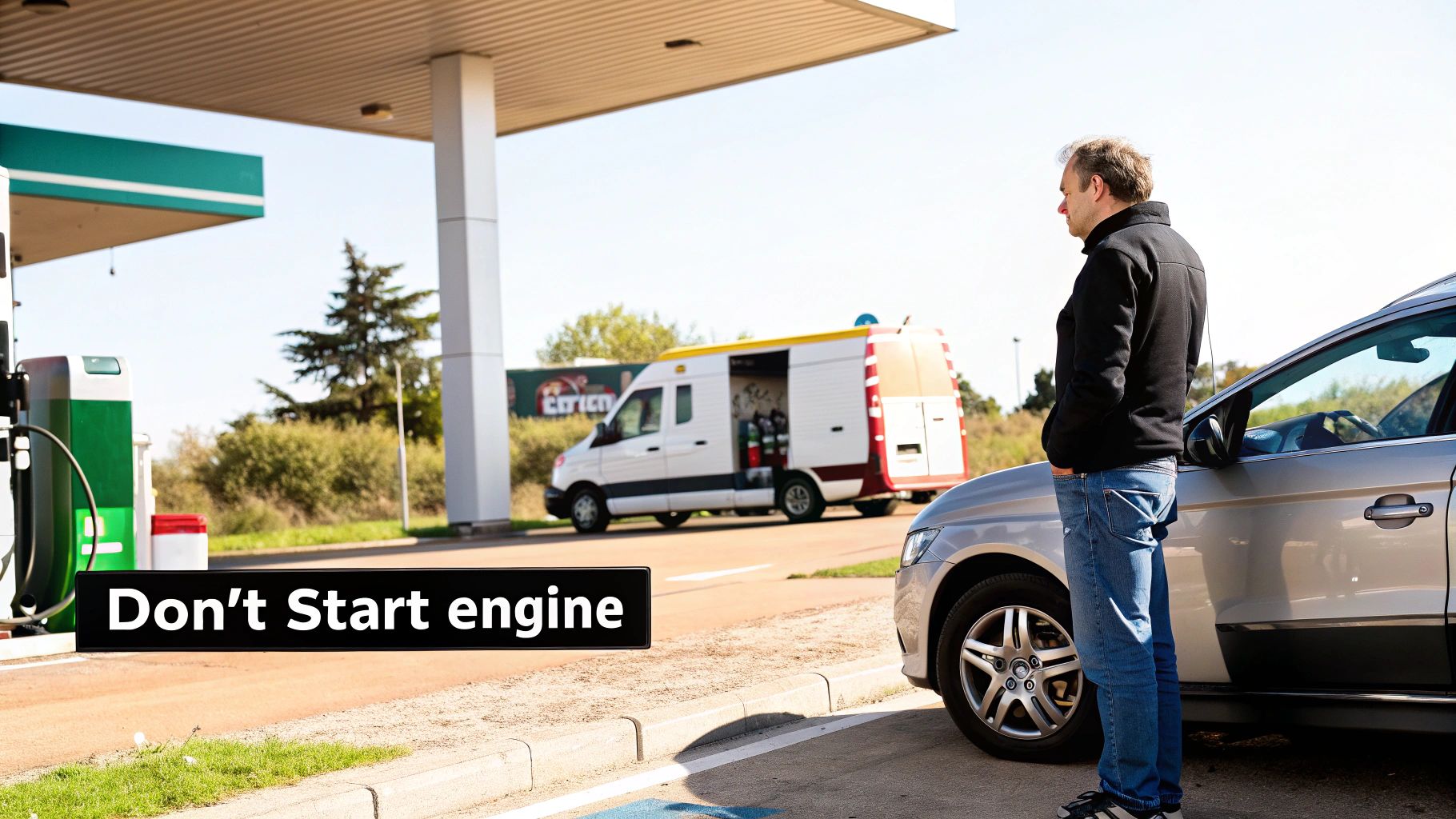
It’s a heart-sinking moment every driver dreads. You're in the middle of a busy day, your mind wanders at the pump, and you grab the wrong nozzle. Misfuelling is an incredibly common slip-up across the UK, but what happens next can be the difference between a simple inconvenience and catastrophic engine failure. It all hangs on your next move.
The most frequent—and by far the most damaging—mistake is putting petrol into a diesel engine. As we’ve covered, the way a diesel engine works is worlds apart from a petrol one. Diesel fuel is oily, acting as a critical lubricant for high-precision parts like the fuel pump and injectors. Petrol, in stark contrast, is a solvent. It immediately strips this vital lubrication away, causing metal components to grind against each other.
If you’ve made this mistake and turned the key, your car will very quickly tell you that something is seriously wrong.
Symptoms of Misfuelling
The warning signs of putting petrol in your diesel tank can show up almost instantly, especially if you’ve started the engine. Be on high alert for any of these tell-tale symptoms:
Loud Knocking or Pinging: A very distinct, metallic clattering from the engine. This is the sound of volatile petrol igniting incorrectly under high compression.
Excessive Smoke: Plumes of white or grey smoke billowing from the exhaust as unburnt fuel is vaporised.
Loss of Power: The car will feel sluggish and weak, struggling to accelerate or even cutting out completely.
Failure to Start: If you only realise your error after filling up, the engine might turn over but simply refuse to fire up at all.
The single most important piece of advice is this: Do NOT start the engine. Don't even turn the ignition to listen to the radio. The moment you turn that key, the fuel pump primes, instantly circulating the damaging petrol throughout the entire fuel system.
Keeping the engine off contains the problem within the fuel tank, which makes for a relatively straightforward fix. Starting it, even for a moment, transforms a fixable mistake into a potential four-figure repair bill. To get a better sense of the damage, read our detailed guide on what happens when you put petrol in a diesel car.
If you’ve misfuelled, the first thing to do is stay calm. The solution is professional, and help is available 24/7. Your next step should be to call a mobile fuel drain service like us at Misfuelled Car Fix. A qualified technician will come directly to you, whether you’re at a petrol station, stranded on the roadside, or sitting on your driveway.
They use specialised equipment to safely drain the contaminated fuel from your tank, flush the entire system to clear out any residue, and give you enough correct fuel to get you safely on your way. This is, without a doubt, the fastest, safest, and most cost-effective way to sort the situation out and prevent any lasting damage to your vehicle.
Answering Your Top Diesel vs Petrol Questions
When you're weighing up diesel vs petrol, a few key questions always seem to pop up for UK drivers. Getting straight answers can make the final choice a lot less stressful, especially with one eye on long-term costs and future driving rules. Let's tackle the big ones.
Are Diesel Cars Going to Be Banned in The UK?
The short answer is no, not your current one. While the sale of brand-new petrol and diesel cars is set to stop in 2035, there are no plans to ban existing vehicles from UK roads. You’ll still be able to own, drive, and sell a used diesel car long after that date.
The real headache for diesel owners, though, is the ever-expanding network of Clean Air Zones (CAZ) and London's Ultra Low Emission Zone (ULEZ). Older diesels, typically those registered before September 2015 (pre-Euro 6 models), already face daily charges in many city centres. This makes them a pretty impractical choice if you do a lot of urban driving.
Is It More Expensive to Maintain a Diesel Car?
In the long run, yes, it often is. The higher maintenance costs for a diesel are almost always down to the complex emissions control systems that petrol cars simply don’t have.
The biggest potential wallet-drainers are the Diesel Particulate Filter (DPF) and the AdBlue system. The DPF, in particular, is notorious for clogging up if the car is only ever used for short, low-speed trips. This can lead to expensive "forced regenerations" at a garage or, in the worst cases, a complete and very costly replacement.
I Just Put Petrol in My Diesel Car What Should I Do?
This is easily the most common and damaging misfuelling mistake, but it's absolutely fixable if you act fast and do the right thing. The single most important rule is DO NOT start the engine. Don't even turn the key to put the ignition on.
Starting the car kicks the fuel pump into life, circulating the petrol through the entire system. Petrol acts like a solvent, stripping away the essential lubrication that diesel fuel provides. This causes catastrophic, metal-on-metal damage to the high-pressure fuel pump and injectors. Your first and only move should be to call a professional mobile fuel drain service for help.
If you've found yourself in this exact situation, the expert technicians at Misfuelled Car Fix can help. We run a 24/7 mobile fuel drain service across England to safely get the wrong fuel out, flush your system, and get you back on your way, avoiding those terrifying dealership repair bills. Contact us immediately at https://www.misfuelledcarfix.co.uk.