Understanding petrol in a diesel car small amount: What to do next

It’s that gut-wrenching moment every driver dreads. You’ve just put petrol in your diesel car. Before the panic fully kicks in, let me tell you this: if you haven't started the engine, you've almost certainly avoided any serious damage. The absolute golden rule is do not turn the key. Don't even switch on the ignition to check the radio.
The Sinking Feeling at the Pump What to Do Right Now
That horrible, sinking feeling at the petrol station is a nightmare shared by over 150,000 UK motorists every year. It’s an incredibly common slip-up, usually happening when we're tired, distracted, or driving an unfamiliar car.
Interestingly, our callout data shows that a huge chunk of these incidents—somewhere between 40% and 50%—involve drivers who catch the mistake mid-fill and only add a small amount of petrol. You can read more about this common mistake and its financial impact on UK drivers.
Just turning the key to the 'accessory' position is enough to prime the fuel pump. That single action starts circulating the damaging petrol-diesel cocktail from the tank right into your car’s sensitive fuel system.
Your Immediate Action Plan
What you do in the next sixty seconds is absolutely critical. Staying calm and following a few simple steps can turn a potential disaster into a manageable hiccup. The entire goal is to keep that contaminated fuel safely isolated in the tank.
Here’s a quick decision tree to help you figure out what to do next.
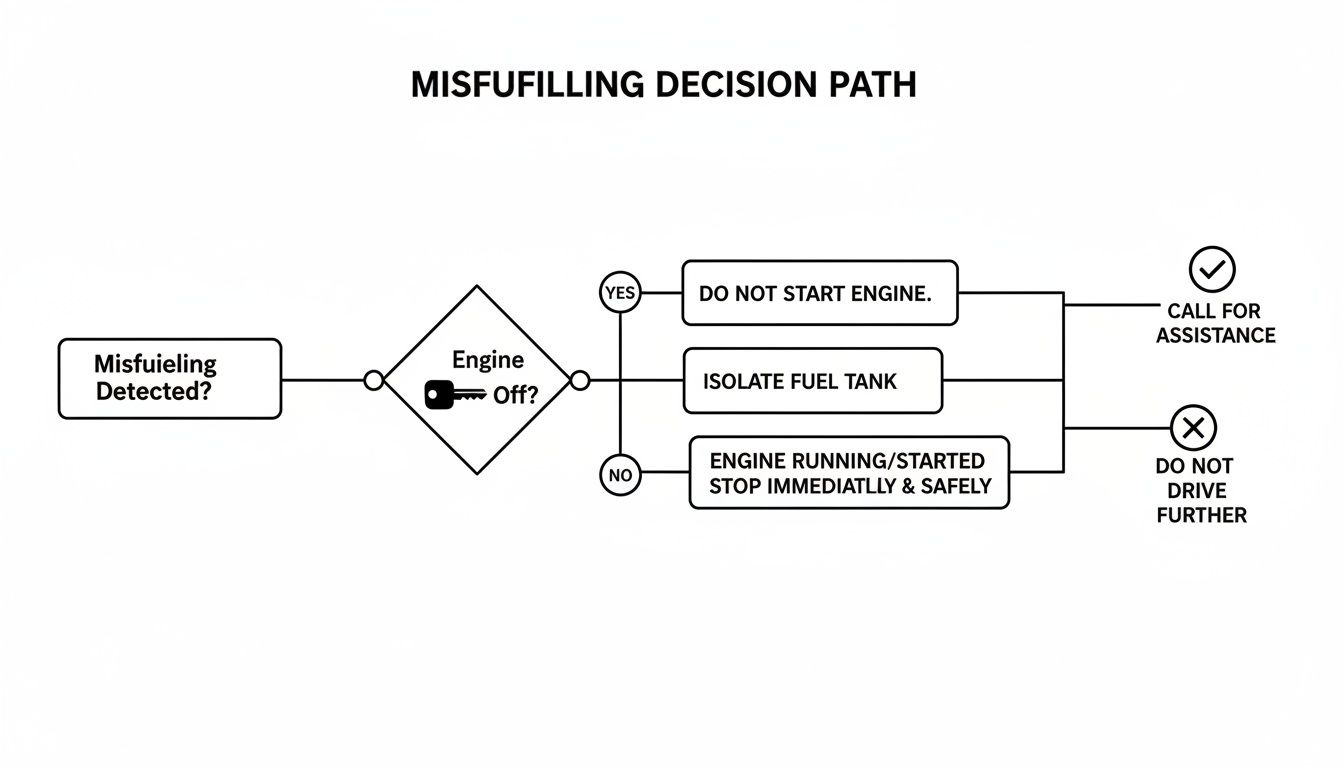
This flowchart really highlights the crucial fork in the road. Whether you started the engine or not completely changes the severity of the problem and how we fix it.
If the engine is off, the problem is contained and a professional fuel drain will sort it. If you've started it, the risk of eye-watering repair bills shoots up, making an immediate call to a specialist like us even more urgent.
Next Steps at the Petrol Station
Okay, you’ve confirmed the engine is off and the keys are safely in your pocket. Here are the next practical steps to take right there on the forecourt:
Inform the Staff: Let an attendant know what’s happened. They’ve seen it all before and can help put some cones out and assist with moving your vehicle.
Do Not Move the Car Yourself: Don’t be tempted to just start the engine to move it a few feet. Put the car in neutral and ask for help to push it to a safe parking bay, away from the pumps.
Make the Call: Now is the time to get on the phone to a mobile fuel drain specialist. A service like Misfuelled Car Fix can get a technician out to you, wherever you are, and solve the problem on the spot. This saves you the extra cost and hassle of getting towed to a garage.
Key Takeaway: The single most important thing you can do is not start the engine. This keeps the contaminated fuel inside the tank, making the fix cheaper, faster, and much less stressful. Every decision you make from this point should be about keeping that fuel from circulating.
For a more detailed look at what to do in those first few minutes, check out our guide on quick steps to avoid damage after misfuelling.
So, Just How Much Petrol Is a Real Problem?
Right, you’ve put a bit of petrol in your diesel. The first question that flashes through your mind is, "How bad is this, really?" The honest answer isn't a simple yes or no. It all boils down to the contamination ratio – how much petrol you’ve added compared to the amount of diesel already sloshing around in the tank.
Guessing isn't going to cut it here, so let's get practical. Putting five litres of petrol into a nearly full 60-litre diesel tank is a completely different ball game to adding that same amount when the warning light was on. The more concentrated the petrol, the bigger the threat to your engine.
Understanding the Solvent Effect
To get why this is such a big deal, you need to understand why petrol is pure poison to a diesel engine. Picture diesel fuel: it's oily, it's slippery, it's a lubricant. Your car’s high-pressure fuel pump and injectors are miracles of engineering, built to incredibly fine tolerances, and they rely on that oiliness to run smoothly and prevent metal parts from grinding themselves into dust.
Petrol is the complete opposite. It's a solvent. Instead of lubricating, it cleans and strips oils away. When it mixes with your diesel, it instantly starts to slash the fuel's ability to protect those vital, and very expensive, parts. Even a tiny amount of petrol in a diesel car begins this destructive process the moment the engine is turned on.
The heart of the problem is a total loss of lubrication. Petrol acts like a degreaser, washing away the protective oily film your diesel fuel pump and injectors need to survive. Without it, friction and heat build up fast, leading to rapid wear and, ultimately, catastrophic failure.
Gauging Your Contamination Risk Level
The amount of petrol you've put in is only half the story. The other crucial part of the equation is how much diesel was already there to dilute it. A contamination level below 5% is often thought of as lower risk (as long as you don't start the engine!), but anything over 10% puts you squarely in the high-risk zone, where serious damage becomes almost inevitable if you turn that key.
To give you a clearer picture, it helps to look at some real-world scenarios. This table breaks down how the risk escalates based on the petrol-to-diesel ratio in a typical 50-litre family car tank.
Petrol Contamination Risk Levels in a Diesel Tank
This table helps you assess the potential risk based on the percentage of petrol in your diesel tank. Do not start the engine regardless of the level.
Contamination Level (Petrol %) | Common Scenario (in a 50L Tank) | Primary Risk (If Engine is Started) | Recommended Action |
|---|---|---|---|
Below 5% (Low Risk) | Adding up to 2.5 litres of petrol to an almost full tank. | Minor reduction in lubrication. Still poses a risk to sensitive components. | Do not start the engine. A professional fuel drain is the only safe option. |
5-10% (Medium Risk) | Adding 5 litres of petrol to a tank that was half full (25L diesel). | Significant loss of lubrication. Increased risk of fuel pump wear and injector damage. | Do not start the engine. An immediate fuel drain is essential to prevent costly repairs. |
Above 10% (High Risk) | Adding 5 litres of petrol to a nearly empty tank (e.g., 10L diesel). | Severe lubrication failure is almost guaranteed. High probability of catastrophic damage to the fuel pump and injectors. | Do not start the engine. This is a critical situation requiring an urgent professional fuel drain. |
Just remember, these are guidelines. The age and type of your car also play a part. Modern common-rail diesel systems are far, far more sensitive to fuel contamination than the old-school diesel engines of yesteryear.
Ultimately, it doesn't matter how much it was. Putting petrol in a diesel car, even a small amount, demands the exact same response: don't touch the ignition, and get on the phone to a professional.
The Real Cost of Driving on the Wrong Fuel
It’s tempting, isn't it? That little voice in your head might say, "It was only a small amount, maybe I can just drive it off and hope for the best." Resisting that urge is the single best financial decision you can make in this situation. Driving away with even a small amount of petrol in a diesel car is the most expensive gamble you can take.
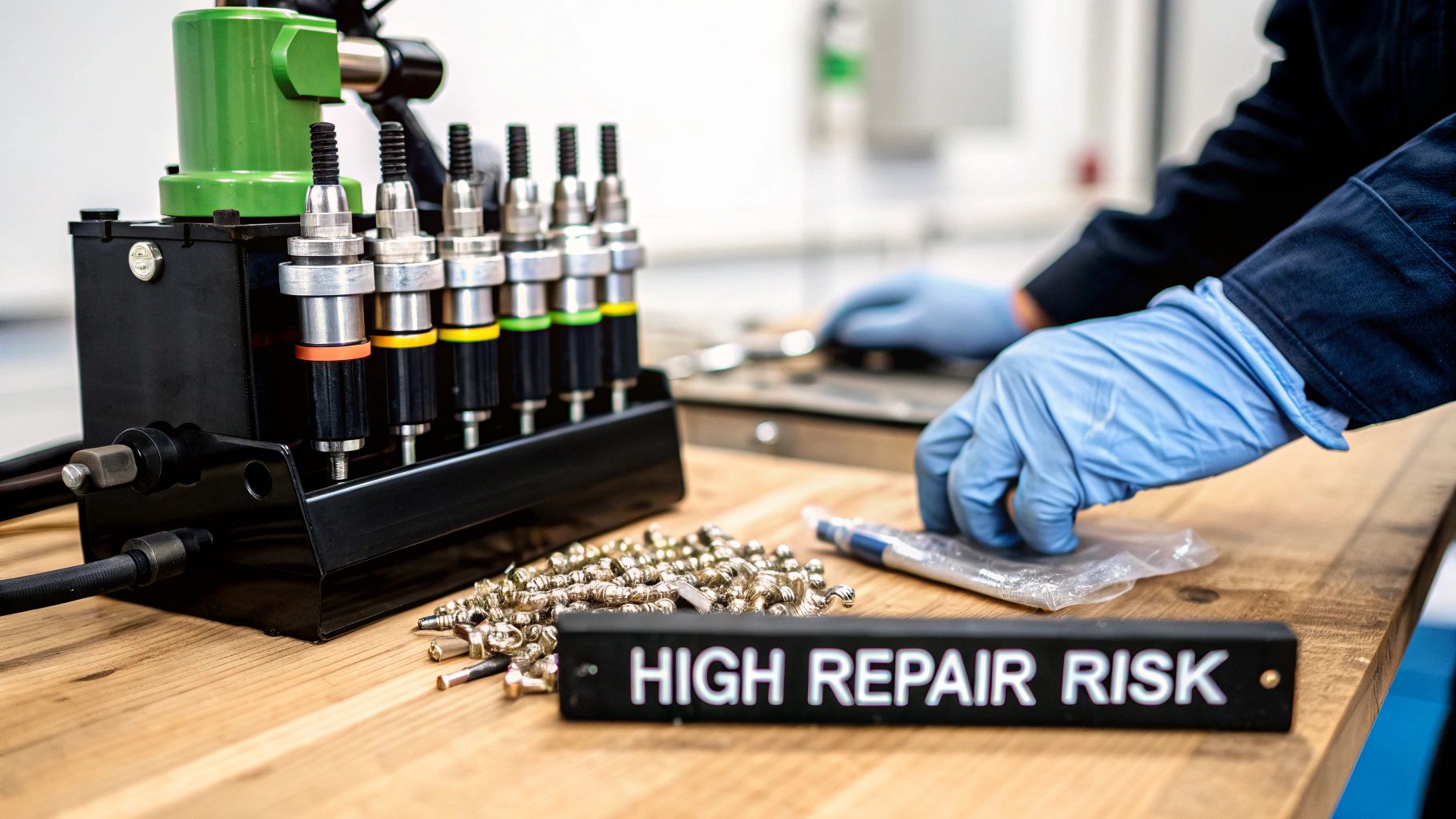
Starting the engine kicks off a devastating chain reaction. The first casualty is the high-pressure fuel pump, a meticulously engineered component that relies entirely on diesel's oily properties for lubrication. Petrol, being a solvent, strips this protection away almost instantly, causing metal parts to grind against each other.
This grinding creates tiny metal particles—shrapnel, essentially—that are then forced through the rest of your fuel system. They travel down the fuel lines, quickly overwhelm and clog the fuel filter, and head directly for the most sensitive and expensive parts of your engine: the fuel injectors.
From Minor Mistake to Major Mechanical Failure
If you did drive away without realising, the symptoms would be hard to ignore. Your car would quickly let you know something is seriously wrong. The initial signs often include:
A Distinctive Rattling Noise: Often described as "pinking" or knocking, this is the sound of uncontrolled combustion as the volatile petrol ignites at the wrong time in the engine cycle.
Significant Power Loss: The engine will feel sluggish and unresponsive as it struggles to burn the incorrect fuel mixture.
Excessive Smoke from the Exhaust: You might see clouds of white or grey smoke, a clear sign of incomplete combustion and potential engine distress.
These aren't just minor inconveniences; they are the audible and visible signs of your engine destroying itself from the inside out. Even if you only added a small dose of petrol, the consequences can be severe if the car is driven.
According to reports, even small amounts of petrol—say, 3-15 litres in a 50-litre tank—can cause havoc. The petrol’s lower viscosity allows it to seep into delicate injectors, potentially leading to repairs costing between £500 and £5,000. However, if the car remains stationary, recovery is a simple fix. Discover more about how UK drivers are affected by misfuelling.
Comparing the Costs: A Simple Drain vs a Full Repair
This is where the financial reality truly hits home. The cost of inaction, or incorrect action, is staggering when compared to the straightforward solution. Let's break it down.
The Smart Choice (Professional Fuel Drain): Calling a mobile service like Misfuelled Car Fix typically costs between £150 and £300. A technician comes to you, drains the contaminated fuel, flushes the system, and gets you back on the road safely.
The Expensive Gamble (Driving On): If the fuel pump fails and sends metal particles through the system, you're looking at replacing the pump, all the injectors, the fuel filter, and flushing the entire system. This bill can easily soar into the thousands of pounds, often exceeding £3,000-£5,000 for modern diesel vehicles.
Ultimately, the choice is between a manageable inconvenience and a financially crippling repair bill. For a detailed breakdown of what's involved, explore our comprehensive guide on handling petrol in a diesel car.
Why Calling a Professional Is Your Best Option
In that heart-sinking moment at the pump, it’s only natural to scramble for a quick fix. A quick search online will throw up all sorts of well-meaning but frankly dangerous advice, and the temptation to try and sort it yourself can be huge. But trust me on this: when you’ve put even a small amount of petrol in a diesel car, this is one situation where professional help is absolutely non-negotiable.

Let’s quickly bust a few of the common myths that could turn this simple slip-up into an absolute financial catastrophe.
Debunking Dangerous DIY Misfuelling Myths
The idea of siphoning the fuel out yourself is often the first thing people think of. The problem is, it's not just impractical, it's incredibly dangerous. Modern cars are almost all fitted with anti-siphon devices deep in the fuel neck, making it physically impossible to get a hose into the tank anyway. More importantly, you’re dealing with petrol – it’s highly flammable, and the risk of creating a spark or static electricity near open fuel is a serious fire hazard you don't want to take.
Another popular but flawed bit of 'wisdom' is to just "top up" the tank with diesel to dilute the petrol. It might sound logical on the surface, but it completely fails to solve the core problem. Petrol doesn't just mix with diesel; it fundamentally alters its chemical properties. Even a tiny contamination ratio strips away the essential lubricating qualities your fuel pump and injectors rely on, meaning the damage will still happen.
Crucial Insight: Topping up with more diesel is a false economy. It doesn't get rid of the contaminant; it just circulates it through your entire system. The only truly safe and effective solution is a complete drain and flush.
What a Mobile Fuel Drain Service Actually Does
Calling a specialist like Misfuelled Car Fix is far simpler and more efficient than you might imagine. It’s a slick, well-practised process designed to get you back on the road with the minimum of fuss and the maximum of safety. A trained technician doesn’t just empty the tank; they perform a full system recovery right where you are.
The process usually breaks down like this:
Safe Arrival and Setup: The technician will find you—whether you're on a petrol station forecourt, at home, or stuck on the roadside—with a fully equipped, specialised van.
Complete Fuel Drain: Using approved pumping equipment, they will safely drain every last drop of contaminated fuel from your car's tank. This fuel is then stored securely for environmentally responsible disposal.
System Flush: This is the most critical step. The technician flushes the fuel lines, filter housing, and other key parts of the system with clean diesel. This ensures that every last trace of petrol is gone.
Fresh Fuel and Restart: A small amount of fresh, correct diesel is added to the tank. The engine is then started safely and left to run for a few minutes to circulate the clean fuel and double-check that everything is running perfectly.
Why a Mobile Service Beats the Main Dealer
Your first instinct might be to ring your breakdown provider or main dealership. More often than not, a dedicated mobile service is a much faster and more cost-effective choice. A main dealer will insist on your car being recovered to their workshop, which immediately adds towing fees to your bill before any work has even started. On top of that, their workshop labour rates are typically much, much higher.
A mobile fuel drain service comes directly to you, cutting out the towing costs and getting the job done on the spot, usually in under an hour. It’s a direct-to-you approach that saves you a significant amount of time, money, and a whole load of stress.
Simple Habits to Prevent Misfuelling Again
Once the stress of dealing with petrol in your diesel car is over, the last thing you want is a repeat performance. This isn't about blaming yourself for a common mistake; it's about building a few simple, foolproof habits to make sure it never, ever happens again.
Let's be honest, distractions are the number one culprit here. You’re in a rush, your phone buzzes, the kids are arguing in the back… and suddenly you're holding the wrong nozzle. The key is to create a small, consistent routine that forces you to pause and focus for just a few seconds every time you pull up to the pump.
Building Your Misfuelling Prevention Routine
Making a few tiny tweaks to how you fill up can make all the difference. Think of it as a mental checklist that will quickly become second nature, saving you from a world of hassle.
Mindful Fuelling: The pump is a no-phone zone. Avoid getting dragged into conversations or scrolling through your phone while you’re fuelling. A few seconds of focused attention is your absolute best defence.
Know Your Colours: It's a simple visual trick that works. In the UK, diesel nozzles are typically black, while unleaded petrol nozzles are green. Get into the habit of consciously associating the black nozzle with your diesel car.
The "Double-Check" Habit: This might feel a bit silly at first, but it works. As you lift the nozzle, actually say the word "diesel" to yourself. This simple action breaks that autopilot mode we all slip into and reinforces the correct choice.
Adopting these habits will massively reduce the risk of another incident. For a deeper dive into what can go wrong if the mistake isn't caught, you can explore our guide on the symptoms of petrol in a diesel car and how to prevent engine damage.
A Practical Tip: If you frequently switch between cars (maybe a petrol family car and a diesel work van), stick a small, brightly coloured "DIESEL ONLY" sticker on the inside of your fuel flap. It's a cheap, simple, and incredibly effective reminder right when you need it most.
If you want some extra peace of mind, you could even invest in a misfuelling prevention device. These clever gadgets replace your standard fuel cap and are designed to physically block the smaller unleaded petrol nozzle from fitting into your diesel filler neck, making it almost impossible to make the same mistake again.
Your Top Misfuelling Questions Answered
That sinking feeling on the forecourt, staring at the wrong nozzle, always brings a rush of urgent questions. It’s a common mistake, but a stressful one. Getting clear, straightforward answers is the first step to sorting it out without letting the panic take over.
We've pulled together the most frequent queries we hear from drivers in your exact situation. Let's cut through the noise and get you the facts, right now.
Will Just 5 Litres of Petrol Really Damage a Diesel Engine?
Absolutely, yes. It’s a question we get all the time, but the answer never changes. Even a seemingly tiny amount like 5 litres can cause severe, wallet-busting damage if you start the engine.
The whole problem boils down to lubrication. Diesel fuel is oily by nature; it’s designed to protect the incredibly precise components of your high-pressure fuel pump and injectors. Petrol, on the other hand, is a solvent. It acts like a degreaser, stripping that vital oily film away in an instant.
Running the engine on this contaminated mix forces sensitive metal parts to grind directly against each other. This friction can quickly lead to catastrophic failure of the entire fuel system, leaving you with repair bills that can easily spiral into thousands of pounds. The only safe move is to leave the engine off and call a professional to drain the tank.
Does Car Insurance Cover Putting Petrol in a Diesel Car?
This is a real grey area, and honestly, it all depends on the fine print of your policy. Many standard car insurance plans do not cover misfuelling, classing it as driver error rather than an accident. Some fully comprehensive policies might offer cover, but you’ll almost certainly have to fork out for an excess.
Beyond that, making a claim could torpedo your no-claims bonus, pushing up your premiums for years. In the vast majority of cases, calling a dedicated, independent fuel drain service is significantly cheaper, much faster, and has zero impact on your insurance record.
Expert Insight: Before you even think about calling your insurer, dig out your policy documents and search for 'misfuelling cover'. If it’s not explicitly mentioned, it's safest to assume you aren't covered. A professional mobile service is nearly always the most economical and hassle-free solution.
How Much Does It Cost to Drain Petrol from a Diesel Car?
The cost of a professional mobile fuel drain is far less than most people fear. Typically, you can expect to pay somewhere between £150 and £300. This isn't just for the drain; that price usually covers the technician coming to you, safely removing the contaminated fuel, flushing the system, and giving you enough fresh diesel to get on your way.
When you stack that up against the costs at a main dealership—which often involve expensive towing fees and inflated labour rates—a mobile service offers incredible value. It’s a small, fixed cost that prevents a potential repair bill of £5,000 or more.
How Long Does a Professional Fuel Drain Take?
The whole process is remarkably quick and efficient, designed to get you out of a jam with minimal disruption. From the moment a qualified technician pulls up—whether you're at the roadside, on a petrol forecourt, or parked on your driveway—the entire job usually takes about 45 to 60 minutes.
They arrive with all the specialised, certified equipment needed to drain the tank, flush the fuel lines, and ensure your vehicle is completely safe to drive. It means you can be back on your way in about an hour, turning a potential disaster into a minor delay.
If you've put the wrong fuel in your car, don't panic and definitely don't start the engine. The expert team at Misfuelled Car Fix is available 24/7 to provide a fast, affordable, and professional mobile fuel drain service across England. Call our freephone number immediately for assistance and get back on the road safely. Find out how we can help at https://www.misfuelledcarfix.co.uk.