How to Drain a Gas Tank: how to drain gas tank safely

That gut-wrenching moment at the pump when you realise you've used the wrong nozzle is often followed by a frantic search for a DIY solution. "How hard can it be to drain a fuel tank?" you might wonder. But for most cars on the road today, this is absolutely not a simple DIY job. Trying to fix it yourself without the right gear and knowledge can turn a manageable mistake into a catastrophically expensive one.
Should You Drain Your Fuel Tank Yourself?
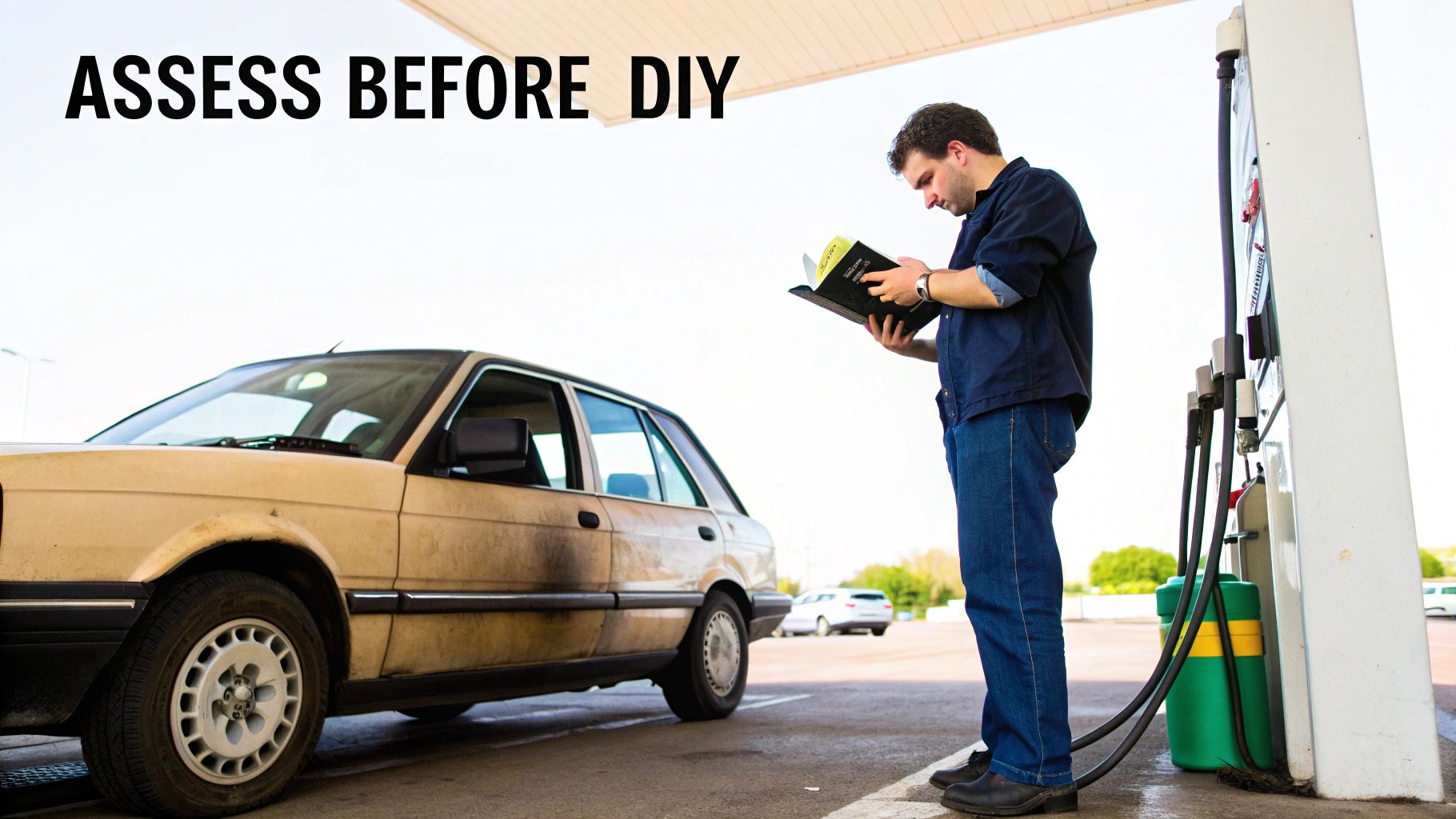
So, can you fix this yourself? While it's tempting to roll up your sleeves and save a few quid, the answer almost always comes down to the age of your vehicle.
If you’re driving a classic car from the 1990s or earlier, you might be in luck. Those older models often had pretty straightforward fuel systems where a simple siphon pump could, in theory, do the trick. But let's be honest, the world of car technology has moved on in a big way since then.
The Modern Car Dilemma
Today’s cars are a different beast altogether. Manufacturers have built in features that make a DIY drain not just tricky, but downright dangerous. Knowing what you're up against is the first step to making the right call.
Key modern features that will stop you in your tracks include:
Anti-Siphon Devices: Most cars built since the early 2000s have a mesh screen or a rollover valve in the fuel filler neck. It’s put there specifically to stop fuel from being siphoned out. Your hose-and-pump idea is dead on arrival.
In-Tank Fuel Pumps: Your fuel pump isn't a simple part you can just get to anymore. It’s usually inside the fuel tank, bundled with the sending unit. Getting to it often means ripping out the back seats and using specialised tools, all while trying not to fry sensitive electronics.
Pressurised Fuel Systems: Many fuel systems are kept under pressure. If you try to disconnect a fuel line without depressurising it properly first, you’ll get a high-pressure spray of incredibly flammable fuel right in your face.
These complex systems are all managed by the car’s brain—the Engine Control Unit (ECU). Messing with them without the right diagnostic tools is a sure-fire way to create even more problems.
The hard truth is that for almost every driver on UK roads today, a DIY fuel drain is simply not an option. The risk of wrecking a modern fuel system massively outweighs any money you might think you're saving.
Safety and Damage Prevention First
Even if you could get past the technical hurdles, the safety risks are huge. Petrol fumes are unbelievably volatile. A single spark from static electricity or a dropped spanner is all it takes to ignite them. Handling litres of fuel without professional, sealed equipment is just asking for trouble.
Worse still, getting it mostly right is just as bad as not doing it at all. Leaving even a little bit of the wrong fuel behind can still lead to engine knocking, damaged injectors, and a hefty repair bill later on. A professional service doesn't just get the fuel out; they flush the entire system to make sure no residue is left to cause mischief.
To help you weigh your options, here's a quick comparison of trying it yourself versus calling in the experts.
DIY Fuel Drain vs Professional Misfuel Service
This table breaks down the key differences to help you make the safest decision for you and your vehicle.
Consideration | DIY Fuel Drain | Professional Service (Misfuelled Car Fix) |
|---|---|---|
Safety Risk | High. Risk of fire, explosion from fumes, and direct contact with harmful chemicals. | Very Low. Technicians are trained and use certified, sealed equipment to handle fuel safely. |
Vehicle Damage Risk | High. Easy to damage anti-siphon devices, fuel pumps, sensors, and the ECU. | Minimal. Professionals have the correct tools and knowledge to work on modern, complex fuel systems without causing harm. |
Effectiveness | Often incomplete. DIY methods frequently leave contaminated fuel residue behind. | Thorough. The entire fuel system is drained and flushed to remove all contaminants, preventing future damage. |
Tools Required | Specialised pumps, containers, and tools that most people don't own. | Fully Equipped. Mobile units arrive with everything needed for the job, including diagnostic tools. |
Time & Effort | Hours of work. Can be a messy, frustrating, and time-consuming process. | Fast & Efficient. Typically completed in about 60-90 minutes by the roadside. |
Legal Disposal | Difficult. You are legally responsible for disposing of hazardous mixed fuel. | Handled. Professionals are licensed to transport and dispose of contaminated fuel legally and safely. |
Cost | Low initial outlay, but potentially thousands in repair costs if things go wrong. | A fixed, upfront cost (typically £200-£400) with no risk of additional repair bills caused by the procedure. |
Ultimately, while the DIY spirit is admirable, this is one of those times where calling a professional is the smarter, safer, and often cheaper choice in the long run. Before you even think about reaching for a siphon hose, take a moment to honestly assess your car's complexity and your own expertise.
What Really Happens When You Put the Wrong Fuel In?
That sinking feeling at the pump is a universal one. You’ve just grabbed the wrong nozzle. Before your mind jumps straight to draining the tank, it’s crucial to understand what's actually going on inside your engine. The most important decision you'll make happens right now, before you even think about touching the car keys.
The golden rule is dead simple: do not start the engine. Don’t even turn the key to the 'on' position to listen to the radio. Modern cars prime the fuel pump the second the ignition gets power, which immediately starts circulating the wrong fuel through the lines.
Petrol in a Diesel Car: The Most Common—and Damaging—Mistake
Putting petrol in a diesel is the number one misfuelling error here in the UK. A big reason for this is that the smaller unleaded nozzle slips easily into the wider diesel filler neck. It’s also by far the most destructive scenario for your engine.
You see, diesel isn’t just fuel; it’s also a lubricant. It’s a slightly oily liquid that keeps critical, high-precision components like your fuel pump and injectors running smoothly. Petrol does the exact opposite – it acts as a solvent, like a degreaser. When it mixes with diesel, it strips away all those protective lubricating properties.
If you start the engine, this corrosive cocktail gets forced through the entire fuel system. The result is instant metal-on-metal friction that grinds away at components, creating tiny metallic particles we call ‘swarf’. This swarf contaminates everything:
The Fuel Pump: Can quickly overheat, seize up, and fail completely.
Fuel Injectors: The incredibly fine nozzles get clogged or permanently scored.
Fuel Lines and Filters: Become contaminated with swarf, demanding a complete system flush.
Circulating this mixture turns a simple tank drain into a potentially catastrophic and wallet-busting repair. To get a better idea of the specific signs this mistake causes, you can read more about wrong fuel in car symptoms in our detailed guide.
Diesel in a Petrol Car: A Different Kind of Problem
Putting diesel into a petrol car is much less common, mainly because the larger diesel nozzle won't physically fit into most modern petrol filler necks. If it does happen, though, the consequences are different but still serious.
Diesel is much thicker, oilier, and far less flammable than petrol. It simply won’t ignite properly in a petrol engine, which uses spark plugs to create combustion. Instead of burning, the diesel will coat the spark plugs in a greasy film and clog up the fuel system, stopping the engine from starting or causing it to run incredibly poorly.
Key Takeaway: If you start the engine, the wrong fuel will immediately begin to circulate. A simple, affordable roadside drain becomes a complex, costly mechanical repair involving the replacement of major engine components.
The financial hit from this mistake can be huge. For misfuelled vehicles, starting the engine can lead to repair costs anywhere from £500 to over £5,000, according to CMA-informed estimates. This is where a specialist service makes all the difference, providing an on-site drain and flush that can save you a fortune compared to main dealer repair costs.
What Symptoms Should You Watch For?
If you’ve already driven off, you’ll start to notice problems almost immediately. Recognising these signs and pulling over quickly is your best defence against causing even more severe damage.
If you’ve put petrol in a diesel engine:
You’ll hear a loud, knocking or 'pinking' sound from the engine as it struggles with uncontrolled detonation.
There will be a very noticeable loss of power and the car will feel sluggish.
The engine management light will almost certainly pop up on your dashboard.
You might see excessive smoke coming from the exhaust.
Eventually, the engine will cut out completely and refuse to restart.
If you’ve put diesel in a petrol engine:
The engine will start to misfire and run very roughly, juddering and shaking.
Noticeable smoke will start billowing from the exhaust pipe.
The car will feel gutless, lacking power and struggling to accelerate.
Ultimately, the engine will stall and won't start again.
In either case, the second you realise your mistake or notice these symptoms, find a safe place to pull over, switch the engine off, and call for professional help. That one action can be the difference between a minor inconvenience and a major financial headache.
A Practical Guide to the DIY Fuel Drain Method
So, you've assessed the situation and think a DIY fuel drain might be on the cards. Perhaps you've got an older car without a modern anti-siphon valve, and you're pretty handy with a set of tools. If you're confident, it's a route you can consider, but let's be crystal clear: this isn't like changing a tyre.
Petrol and its vapours are exceptionally flammable. Getting this wrong can have catastrophic consequences. The process demands meticulous preparation, the right kit, and an absolute focus on safety from the moment you start to the moment you finish. This guide will walk you through it, but remember, once you pick up that wrench, the risk is all yours.
Setting the Stage for a Safe Operation
Before you even think about touching the car, your number one job is to create a safe workspace. This is the most important step, period. You need to be working outdoors on a flat, level surface, miles away from any potential ignition source. That means no smoking, no nearby pilot lights from a boiler or water heater, and definitely no sparks.
Fuel vapours are heavier than air and can creep along the ground for a surprising distance, just looking for something to ignite them. A stray spark from a dropped spanner or even static from your clothes could be all it takes.
This flowchart breaks down the absolute first things you must do to prevent any damage.
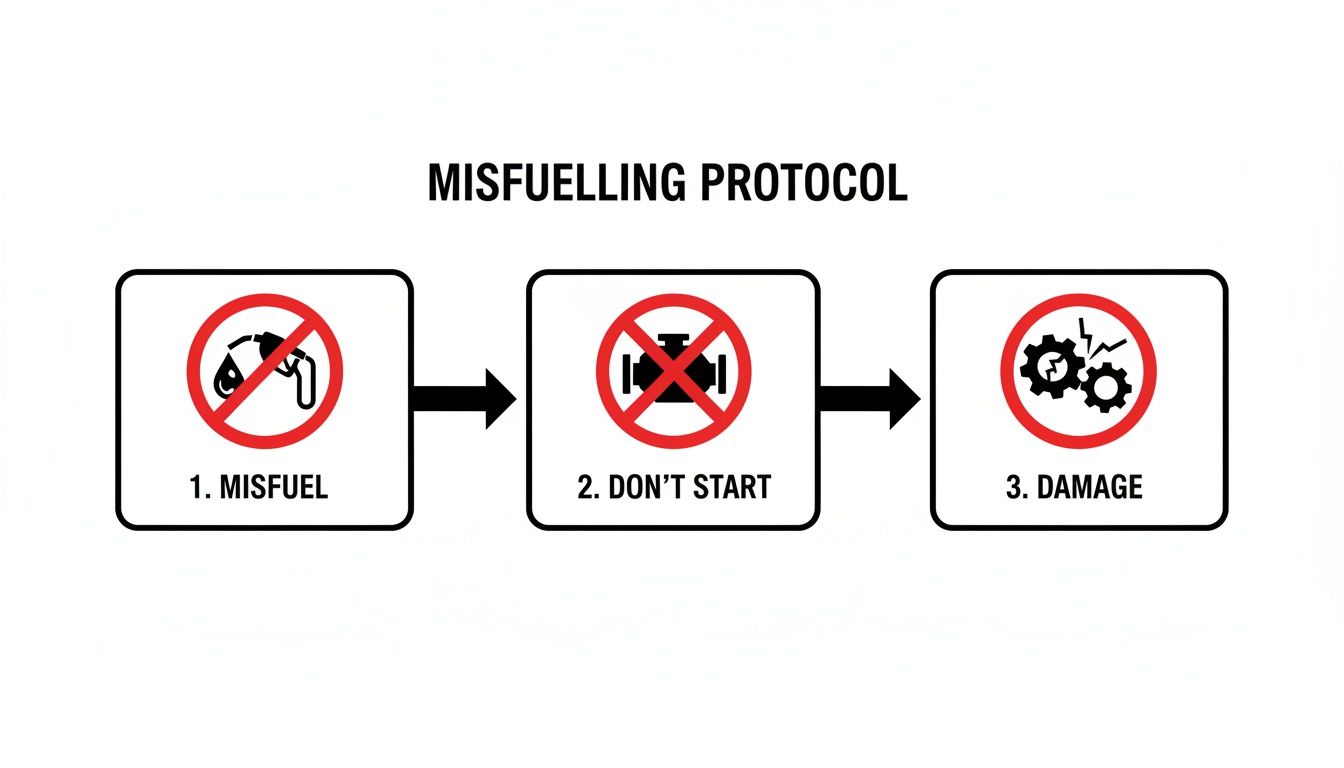
As you can see, the protocol is simple but non-negotiable: realise the mistake, leave the engine off, and you sidestep the really expensive damage.
With a safe spot sorted, it's time to prep the vehicle and gather your gear. First, disconnect the car battery. This is a crucial safety step. Use a wrench to loosen the nut on the negative terminal (it's usually marked with a "–" symbol or has a black cover) and pop the cable off the post. Doing this kills the risk of an electrical spark from the car's own systems.
Next, you need to assemble your toolkit. You can't just wing it here; having the right equipment is vital for both your safety and getting the job done properly.
Essential Toolkit and Safety Checklist for DIY Fuel Draining
Before you start, run through this checklist. If you're missing even a single item, stop and get it. This is not the time for improvisation.
Tool/Safety Item | Purpose and Key Considerations | Risk if Ignored |
|---|---|---|
Manual Siphon Pump | The only safe way to transfer fuel. Never use your mouth—petrol is toxic and can be fatal if ingested. | Severe poisoning, chemical burns. |
Approved Fuel Containers | Must be government-approved and sealed. Needs to be big enough to hold your tank's entire capacity, plus extra. | Spills, fire risk from static, illegal disposal. |
Chemical-Resistant Gloves | Protects your skin from fuel, which can cause severe irritation and burns. | Skin irritation, chemical burns, long-term health issues. |
Safety Goggles | A splash of petrol in the eyes can cause permanent damage. This is non-negotiable. | Serious eye injury, potential blindness. |
Class B Fire Extinguisher | Must be rated for flammable liquids (like petrol) and kept within immediate reach. | Inability to control a small fire, leading to disaster. |
Wrenches & Spanners | To disconnect the battery and potentially access a drain plug or fuel line. | Inability to perform key safety steps or drain the fuel. |
Old Rags or Cloths | For mopping up any small drips or spills instantly. | Slip hazard, increased fire risk from lingering fumes. |
Having this kit laid out and ready to go is the sign of someone taking the job seriously. With your area secure and your tools at hand, you can now look at the two main ways to get the fuel out yourself.
Method One: Siphoning from the Filler Neck
This is the classic DIY approach. You'll feed the intake hose from your manual siphon pump down the car's filler neck until it's sitting in the pool of fuel. Connect the other hose to your approved container, making sure the container is sitting on the ground—lower than the car's tank—so gravity can give you a helping hand.
Now, start pumping. This is often a slow, tedious job that takes more muscle than you'd think. Be patient. It's also worth knowing that you'll probably not get every single drop out this way, as the hose might not be able to reach the lowest point in the tank.
Crucial Tip: When you're feeding the hose in, be gentle. If you try to force it, you could damage the filler neck or other components. If you hit a hard stop just a short way in, that's almost certainly an anti-siphon valve. Stop immediately. This method won't work for you.
Method Two: Using the Drain Plug or Fuel Line
This method is more direct, but it's also more involved and carries a much higher risk of a big spill if things go wrong. Some older cars have a handy drain plug right at the bottom of the fuel tank. If you're lucky enough to have one, you can slide your collection container directly underneath, carefully loosen the plug with a wrench, and let the fuel drain out.
The alternative is to disconnect a fuel line, usually where it joins the fuel filter. This requires a bit more mechanical know-how to spot the right line and disconnect it without causing damage. Once it's free, you'd aim the line into your container.
From there, you could let gravity do the work or—and this is a much higher-risk technique only for the experienced—briefly reconnect the battery and turn the ignition to the "on" position (never "start"!) to use the car's own fuel pump to empty the tank.
Whichever method you use, once the tank is as empty as you can get it, you're faced with another major headache: getting rid of the contaminated fuel. It is illegal and incredibly damaging to the environment to pour it down a drain or chuck it in your household bin. You must transport it in the sealed, approved containers to a local hazardous waste disposal centre.
Frankly, this final step is often the reason why calling a professional is the smarter, simpler choice. We handle the entire process from start to finish, including the safe and legal disposal of the bad fuel.
Knowing When to Call a Professional
There comes a point in any DIY job where you have to stand back, look at the mess, and ask yourself, "Am I actually making this worse?" When you're dealing with something as flammable and tricky as draining a fuel tank, that moment of honesty isn't just about saving face—it's about preventing a very expensive disaster.
Let's be clear: putting the tools down and picking up the phone isn't admitting defeat. For the vast majority of drivers, it's the smartest move you can make. Modern cars are a complex web of integrated systems, and what looks like a simple drain can quickly turn into a nightmare.

Red Flags That Scream "Stop and Call an Expert"
Car manufacturers go to great lengths to keep fuel securely inside the tank, and these designs make a DIY drain almost impossible without causing damage. If you run into any of these roadblocks, it’s a clear signal to stop immediately.
You've Hit a Wall: If your siphon hose goes in a few inches and then hits a dead stop, you've just met an anti-siphon valve. Trying to force it is a surefire way to break the valve, landing you with an instant, costly repair bill.
The Drain Plug is Missing: Spoiler alert—most modern cars don't have one. They were phased out years ago to improve safety and emissions, meaning there's no simple "easy drain" option underneath the car anymore.
The Fuel Pump is Buried: On nearly every car made in the last decade or so, the fuel pump lives inside the tank itself. Getting to it usually means ripping out the back seats and using special tools. It's not a driveway job.
Trying to bypass these engineered safety features is a massive gamble. You can easily damage fuel lines, sensors, or the pump itself, turning a simple misfuel into a repair that could cost thousands of pounds.
Why Just Draining the Tank Isn't Good Enough
Even if you somehow manage to get most of the bad fuel out, you’re not out of the woods. The real danger is in what you leave behind. That last bit of petrol in a diesel system (or vice versa) will still get circulated the moment you turn the key, causing slow but certain damage.
A professional service doesn't just empty the tank; they perform a full system flush. This is the crucial step. It blasts every last drop of contaminated fuel out of the lines, filters, and injectors, ensuring no destructive residue is left to ruin your engine later.
This is where the true value of a dedicated wrong fuel rescue service becomes crystal clear. It’s a comprehensive process that protects your engine's most expensive components. You can see exactly what's involved in a professional wrong fuel in car rescue service and understand why it’s so critical.
The Professional Advantage: Safety, Speed, and Peace of Mind
Calling an expert isn't just about getting the job done properly; it’s about doing it safely, quickly, and legally. A professional technician arrives with specialised, sealed equipment designed to transfer fuel without dangerous spills or vapour release. They’re fast, too—often getting you back on the road in about an hour.
What's more, they handle the disposal of the contaminated fuel, taking a significant legal and environmental headache off your hands. You are legally responsible for disposing of that hazardous waste correctly.
That’s where a service like Misfuelled Car Fix is a lifesaver. Their 24/7 mobile team can be reached on 0800 999 1182 and will come directly to you—whether you're stuck at a supermarket pump or on the side of the motorway. They use specialist gear to sort the problem safely and prevent engine damage. Ultimately, making that call is the single most cost-effective decision you can make to protect both your car and your own safety.
How to Properly Dispose of Contaminated Fuel
So, you’ve managed to get the wrong fuel out of your tank. Great. But now you’re left with a can full of what is officially classified as hazardous waste, and what you do next is just as important as the draining itself. This part is critical, both for the environment and for staying on the right side of the law.
Let's be crystal clear: you absolutely cannot pour it down a drain, tip it onto the garden, or sneak it into your wheelie bin.
In the UK, both petrol and diesel are considered hazardous materials. Dumping them improperly isn't just irresponsible; it's illegal and can land you with some hefty fines. More importantly, the environmental cost is huge. To put it in perspective, a single litre of petrol has the potential to contaminate up to one million litres of drinking water. It’s a potent pollutant that needs to be handled with extreme care.
Finding a Legal Disposal Route
Your only safe and legal option is to take the contaminated fuel to a proper hazardous waste disposal facility. Most local councils have recycling centres (or 'tips') that are equipped to handle this, but you can't just turn up and hope for the best. You need to check their specific rules first.
Not every recycling centre will take liquid fuel, and the ones that do have strict protocols you must follow. A quick search for "[Your Council Name] hazardous waste disposal" on their website should give you all the information you need.
Before you even think about heading out, make sure you know the answers to these questions:
Do they accept mixed fuel? You need to confirm they can take a petrol and diesel mixture.
What are the container rules? They will only accept fuel in a government-approved, sealed container. That means no old milk jugs, paint tins, or buckets.
Is there a limit? Many sites restrict how much they'll take from the public in one go, often around 5-10 litres.
Remember, just transporting the fuel has its own risks. Make sure your container is sealed tight and secured upright in your vehicle – preferably in the boot. Crack a window open for ventilation to stop any flammable fumes from building up inside the car.
The Professional Service Advantage
This is where calling in a professional misfuel service really shows its value. The entire headache of storing, safely transporting, and legally getting rid of that contaminated fuel is completely taken off your plate. It's simply part of the service, all handled correctly and safely by trained technicians.
They arrive with specialised, sealed tanks built for this exact job, removing any risk to you, your vehicle, or the environment. When you add up the time, hassle, and legal responsibility of DIY disposal, you quickly realise that calling an expert is often the most sensible and stress-free solution. For more details on what a full-service solution includes, our essential guide to misfuel recovery services provides a clear overview.
Choosing a professional service like Misfuelled Car Fix means you're not just getting your tank drained. You're getting a complete, legally compliant, and environmentally responsible solution from start to finish.
Your Misfuelling Questions Answered
That sinking feeling when you realise you’ve used the wrong pump brings a rush of questions. It's a stressful moment, but getting clear, straight answers can make all the difference. We’ve pulled together the most common questions our technicians get asked on the roadside every single day to give you the info you need, right now.
How Much Does a Professional Fuel Drain Cost?
This is usually the first thing people ask, and for a good reason. The great news is that a professional fuel drain is a drop in the ocean compared to the potential cost of engine damage from driving on the wrong fuel.
While the price can shift a bit depending on where you are and what car you drive, you can generally expect a mobile fuel drain service to be in the ballpark of £200 to £400. That fee should cover everything: the technician getting to you, the complete drain of the contaminated fuel, a flush of the system, and the proper, legally required disposal of the hazardous waste.
It's a small price to pay for peace of mind. When you consider that driving on the wrong fuel can lead to repairs costing upwards of £5,000 for components like fuel pumps and injectors, a professional drain is an incredibly cost-effective solution.
I’ve Already Driven the Car… What Should I Do?
First off, don't panic. This happens more often than you think. The second you notice any symptoms—like knocking sounds, heavy smoke billowing from the exhaust, or a sudden loss of power—the most important thing is to find a safe place to pull over immediately.
Turn the engine off completely. Do not be tempted to restart it. Every time that engine turns over, it's circulating more of that damaging fuel mixture, seriously increasing the risk of permanent damage. Once you're safely stopped, your next move is to call a professional misfuelling service.
Make sure to tell them you've driven the car. A skilled technician won't just drain the tank; they'll perform a much more intensive flush of the entire fuel system. That means cleaning out the fuel lines, filter, and injectors to remove any lingering residue and the tiny metal particles that may have been created by friction.
Will My Car Insurance Cover a Misfuel?
This is a tricky one, and the answer is usually a frustrating "it depends". Some fully comprehensive insurance policies do cover misfuelling incidents, but it's certainly not a standard feature across the board.
You’ll need to dig out your policy documents and check the specific wording. Look for sections on "misfuelling" or "accidental damage".
Even if you find you are covered, take a moment to consider these points before you make a claim:
No Claims Bonus: Making a claim will almost certainly affect your no-claims bonus, which could mean higher premiums for years to come.
Excess: You will still have to pay the policy excess, which might be close to, or even more than, the cost of just calling a private fuel drain service directly.
Time: Going through insurance can be a slow, drawn-out process. A dedicated mobile service can have you back on the road in about an hour, whereas processing an insurance claim can take much longer.
For a lot of drivers, paying for a specialist service directly works out to be the faster, cheaper, and much simpler option in the long run.
How Long Does a Fuel Drain Take?
One of the biggest reliefs of calling a mobile wrong fuel specialist is how quick the whole thing is. In a typical scenario where the car hasn't been started, the entire process is surprisingly fast.
From the moment our technician arrives, you can expect the job to be done and dusted in about 60 to 90 minutes. This includes setting up a safe working area, draining the tank, flushing the system, and putting in a small amount of fresh, correct fuel to get you safely to the nearest petrol station.
If the car has been driven, it might take a little longer. A more thorough system flush is needed to be absolutely sure no contaminants are left behind. Either way, it’s a fast, efficient service designed to get you moving again with the least possible fuss.
Can I Just Top Up the Tank with the Right Fuel?
This is a tempting but incredibly dangerous myth. The logic seems plausible—dilute the wrong fuel with the right one, and the problem will go away. Unfortunately, it does the exact opposite and only makes a bad situation much, much worse.
Adding more fuel won't magically separate the two types. For instance, even a tiny amount of petrol in a modern diesel engine is enough to strip its lubricating properties and cause catastrophic friction damage. Topping it up just makes sure this damaging mixture gets circulated more thoroughly through every part of your fuel system. The only safe and correct solution is to remove 100% of the contaminated fuel.
If you've misfuelled your car, don't risk it. The safest, fastest, and most reliable solution is to call the experts. The team at Misfuelled Car Fix is available 24/7 to provide a professional and affordable fuel drain service right where you are. Get immediate help by visiting the Misfuelled Car Fix website or calling their freephone number.