Diesel in a Petrol Car What to Do Next

Updated: Jan 28
24/7 Hotline Nationwide: 0800 999 1182
National Wrong Fuel Rescue: https://www.misfuelledcarfix.co.uk
If you found this page, we cover you!
That moment of dread at the pump is a familiar one for many drivers. You hang up the nozzle, glance down, and realise you’ve just filled your petrol car with diesel. It's a gut-wrenching mistake, but it's far from uncommon. In fact, roadside assistance services estimate this happens between 100,000 and 150,000 times a year across England and Wales alone. It's a surprisingly frequent mishap, as highlighted by various UK road safety data reports.
The good news? If you catch the error right there on the forecourt, the solution is usually simple and relatively painless. Everything hinges on what you do next.
Your Immediate Actions After Misfuelling
Putting diesel in a petrol car is a serious but totally correctable mistake. There is one golden rule that trumps all others: whatever you do, do not start the engine. Don't even turn the key to the 'accessory' position to listen to the radio.
That single action—or lack of it—is the difference between a straightforward fuel drain and a potential mechanical nightmare costing thousands.
Why You Absolutely Must Not Start the Engine
Petrol and diesel engines are worlds apart in how they work. A petrol engine needs a light, highly flammable fuel that can be turned into a fine mist and ignited by a spark plug. Diesel is the complete opposite—it's a thick, oily fuel designed to combust under high compression, not with a spark.
The moment you turn the key in a modern car, the fuel pump usually primes itself, ready to send whatever is in the tank hurtling towards the engine. If you crank the engine over, that gloopy, oily diesel gets dragged into a system expecting a delicate petrol vapour.
The results are quick and destructive:
The Fuel Pump: This delicate component will strain and can easily burn out trying to force thick diesel through tiny openings.
The Fuel Filter: It will clog up almost instantly with the waxy paraffins found in diesel.
The Injectors: These are precision parts designed to spray a fine mist. Thick diesel will block them solid.
The Engine Internals: Unburnt diesel will foul up the spark plugs and can even wash away the essential lubricating oil from the cylinder walls, leading to friction and wear.
This simple decision tree lays it out perfectly. The choice you make in that split second after realising your mistake determines everything that follows.
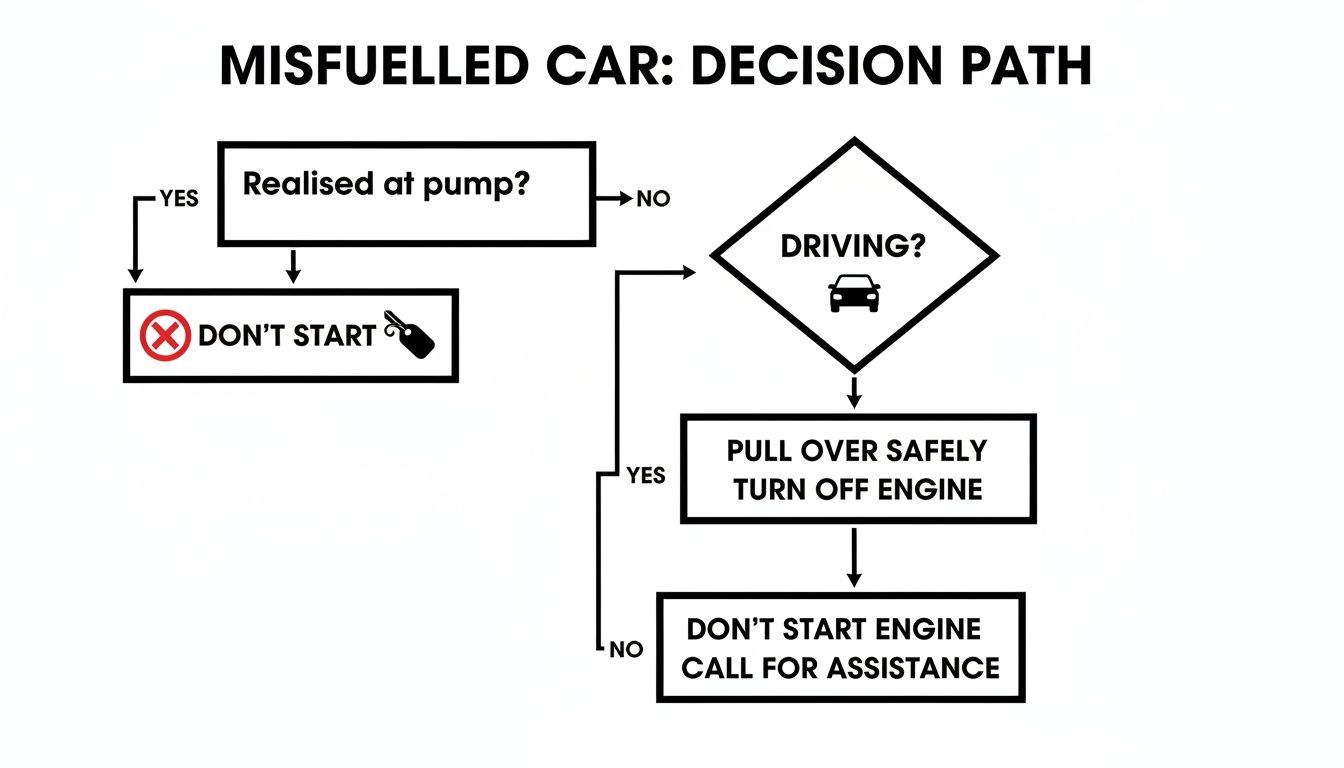
As the flowchart shows, the path to a quick, low-cost solution starts with one simple action: leaving the key well alone.
First Steps on the Forecourt
Right, you’ve taken a deep breath and resisted the urge to start the car. What now? Your next moves are simple. First, don't feel embarrassed—swallow your pride and let the petrol station staff know what's happened. They've seen this plenty of times and can help by coning off the pump to keep the area safe.
Next, get the car into neutral. With a bit of help (the staff might even lend a hand), you can push the vehicle to a safe parking space, away from the chaos of the pumps. This clears the lane for other drivers and gives you a calm spot to make a phone call and sort things out.
By keeping the engine off and moving the car to a safe area, you've successfully contained the problem. The diesel is still just sitting in the fuel tank. This is the absolute best-case scenario, making the fix far quicker and cheaper.
Immediate Do's and Don'ts After Misfuelling
When you're stood by the pump feeling a bit foolish, it can be hard to think straight. This quick-reference table breaks down exactly what to do—and what to avoid—in those first crucial moments.
Action | What to Do (The 'Do's') | What to Avoid (The 'Don'ts') | Reason Why |
|---|---|---|---|
Ignition | Leave the keys out of the ignition completely. | DO NOT turn the key, even to the 'on' or 'accessory' position. | Turning the key can prime the fuel pump, starting the circulation of the wrong fuel. |
Movement | Put the car in neutral and push it to a safe parking bay. | DO NOT try to "quickly drive it" to a parking spot. | Starting the engine, even for a few seconds, will cause significant damage. |
Communication | Inform the petrol station staff immediately. | DO NOT feel too embarrassed to ask for help. | They've seen it before and can help secure the area and assist you. |
Resolution | Call a professional misfuelling service for a fuel drain. | DO NOT attempt to siphon the fuel yourself. | Fuel is highly flammable, and DIY methods are dangerous and often incomplete. |
Following these simple steps turns a potential disaster into a manageable inconvenience, saving you a world of stress and a hefty repair bill.
Telltale Signs You Have Used the Wrong Fuel

Sometimes the penny doesn't drop right there at the pump. You might drive away completely oblivious, only for your car to start acting very strangely a few miles down the road. Recognising these symptoms for what they are—a cry for help from your engine—is absolutely crucial.
The first signs of putting diesel in a petrol car can be subtle, but they'll escalate quickly. Your car is trying to run on a fuel it simply can't process, and its performance will degrade rapidly. Knowing what to look and listen for can be the difference between a simple fix and a catastrophic engine failure.
Engine Sputtering and Loss of Power
The most common first sign is a rough, unhappy engine. You'll likely notice the car juddering or sputtering, particularly when you try to accelerate. It will feel sluggish and totally unresponsive, almost like it’s struggling to breathe.
This happens because the thick, oily diesel just can't be properly atomised by fuel injectors designed for a fine petrol mist. Instead of a clean, controlled explosion in the cylinder, you get poor, incomplete combustion. The result is a sudden and very noticeable loss of power, making it hard to maintain your speed.
Excessive Smoke from the Exhaust
A huge giveaway is the sight of thick, dense smoke billowing from your exhaust. This isn't the usual faint bit of vapour you might see on a cold morning; this is something else entirely.
The smoke is typically white or greyish. It’s caused by the unburnt diesel oil hitting the hot exhaust system and vaporising. Since the petrol engine can't burn the heavy diesel fuel properly, it just gets shunted through the cylinders and out the back, creating a very alarming and obvious plume of smoke.
Key Takeaway: If your car suddenly starts belching smoke and losing power just after you've filled up, it’s almost certainly a misfuelling issue. Pull over as soon as it’s safe and switch off the engine immediately.
Engine Cutting Out or Failing to Start
If you keep driving, things will only get worse. The engine will probably start to misfire badly before cutting out altogether, often leaving you stranded. At this point, it will likely refuse to start again.
The reason is simple: the diesel has now thoroughly contaminated the whole system.
Fouled Spark Plugs: An oily residue from the diesel coats the spark plugs, preventing them from creating the spark needed for ignition.
Clogged Fuel Filter: The fuel filter becomes saturated with the thick diesel, blocking the flow of any remaining petrol.
Blocked Injectors: The injectors get gummed up with diesel residue, meaning they can no longer spray fuel into the cylinders.
Once these key components are compromised, the engine just can't run. Even a small amount of diesel can be enough to cause a complete shutdown. You can explore a more detailed breakdown of these specific wrong fuel in car symptoms to better understand what’s happening under the bonnet.
A Distinct Knocking Noise
Another frightening symptom is a loud 'knocking' or 'pinking' sound coming from the engine bay. That noise is the sound of detonation—uncontrolled explosions happening inside your engine's cylinders. A petrol engine is precisely timed to ignite fuel with a spark at the perfect moment.
When diesel gets in the mix, it can auto-ignite under compression at completely the wrong time. This creates a violent shockwave that you hear as a metallic knock. This is incredibly damaging to pistons, bearings, and cylinder walls. If you hear this, stop the car immediately to prevent severe, and potentially irreversible, engine damage.
How Diesel Wrecks a Modern Petrol Engine
To really understand why putting diesel in a petrol car is such a critical mistake, you have to look past the spluttering engine and see what’s happening on a mechanical level. A modern petrol engine isn’t just a lump of metal; it’s a high-precision system, and every single part is designed to work in perfect harmony with a specific type of fuel. When you introduce a substance like diesel, you throw that entire delicate balance into chaos.
Diesel isn’t just a different fuel; it’s a completely different animal. Think of it like trying to get a Formula 1 car to run on thick, gooey treacle instead of high-octane petrol. Petrol is light, it’s volatile, and it vaporises in a heartbeat. Diesel, on the other hand, is a heavy, oily lubricant that actively resists being set on fire.
The moment this thick oil enters the fuel system, it stops being fuel and becomes a contaminant. It’s a thick, sticky liquid that clogs and coats everything it touches. The damage begins the instant the fuel pump whirs to life. This part is engineered to move a thin, watery liquid, not a viscous oil. It will immediately struggle, leading to massive strain and potential burnout as it tries to force diesel through lines and filters built for something far less dense.
The Fuel System Under Attack
The first line of defence, the fuel filter, is almost instantly overwhelmed. Its job is to catch tiny particles, but it stands no chance against the waxy paraffins in diesel. The filter clogs solid, starving the engine of any good fuel left and creating a blockage that can destroy the fuel pump from back-pressure.
From there, the diesel gets to work on the most intricate parts of your engine.
Fuel Injectors: These are probably the most vulnerable components of all. Modern injectors are engineering marvels, designed to spray a super-fine, cone-shaped mist of petrol. Diesel is far too thick to be atomised like this. Instead, it just gums up the tiny nozzles, ruining the spray pattern or blocking them completely.
Spark Plugs: A petrol engine needs a spark plug to ignite the fuel mixture. When unburnt, oily diesel coats the tip of a spark plug, it acts as an insulator. The plug can no longer create a spark, which leads to misfires and, pretty soon, an engine that won’t start at all.
The core problem comes down to basic chemistry and physics. Diesel needs immense pressure to combust (auto-ignition), while petrol needs a spark. Forcing a petrol engine to swallow diesel is asking it to do something it was never, ever designed for, triggering a domino effect of mechanical failures.
Long-Term and Catastrophic Damage
If the engine is run for any length of time with diesel in the tank, the damage can spread far beyond the fuel lines and injectors. The consequences get progressively more severe and a whole lot more expensive to fix, affecting parts that are critical to your car’s performance and emissions.
That unburnt, oily diesel doesn't just disappear; it gets shoved through the engine and into the exhaust system, where it really starts to cause havoc. For a deeper dive, you can explore the full range of issues affecting a diesel in petrol engine to see just how extensive the damage can be.
Two of the most expensive components at risk are the oxygen sensors and the catalytic converter.
Damage to Critical Components
Component | How Diesel Causes Damage | Potential Repair Cost |
|---|---|---|
Oxygen (O2) Sensors | These sensors sniff the exhaust gases to keep the engine running efficiently. Diesel soot and oil will coat the sensor, giving false readings to the car's computer (ECU), leading to terrible performance and awful fuel economy. | £150 - £300+ per sensor |
Catalytic Converter | This expensive emissions-control box uses precious metals to clean up harmful gases. Unburnt diesel will superheat and literally melt the delicate honeycomb structure inside, rendering it useless and causing a major exhaust blockage. | £400 - £1,500+ |
Finally, diesel’s lubricating properties—a huge benefit in a diesel engine—are destructive in a petrol one. It can wash away the vital film of engine oil that protects the cylinder walls and pistons. This causes metal-on-metal friction, scoring the surfaces and leading to potentially catastrophic internal engine failure. It’s the absolute worst-case scenario, and it’s why not starting the engine is the single most important piece of advice you will ever get.
Your Guide to a Professional Fuel Drain
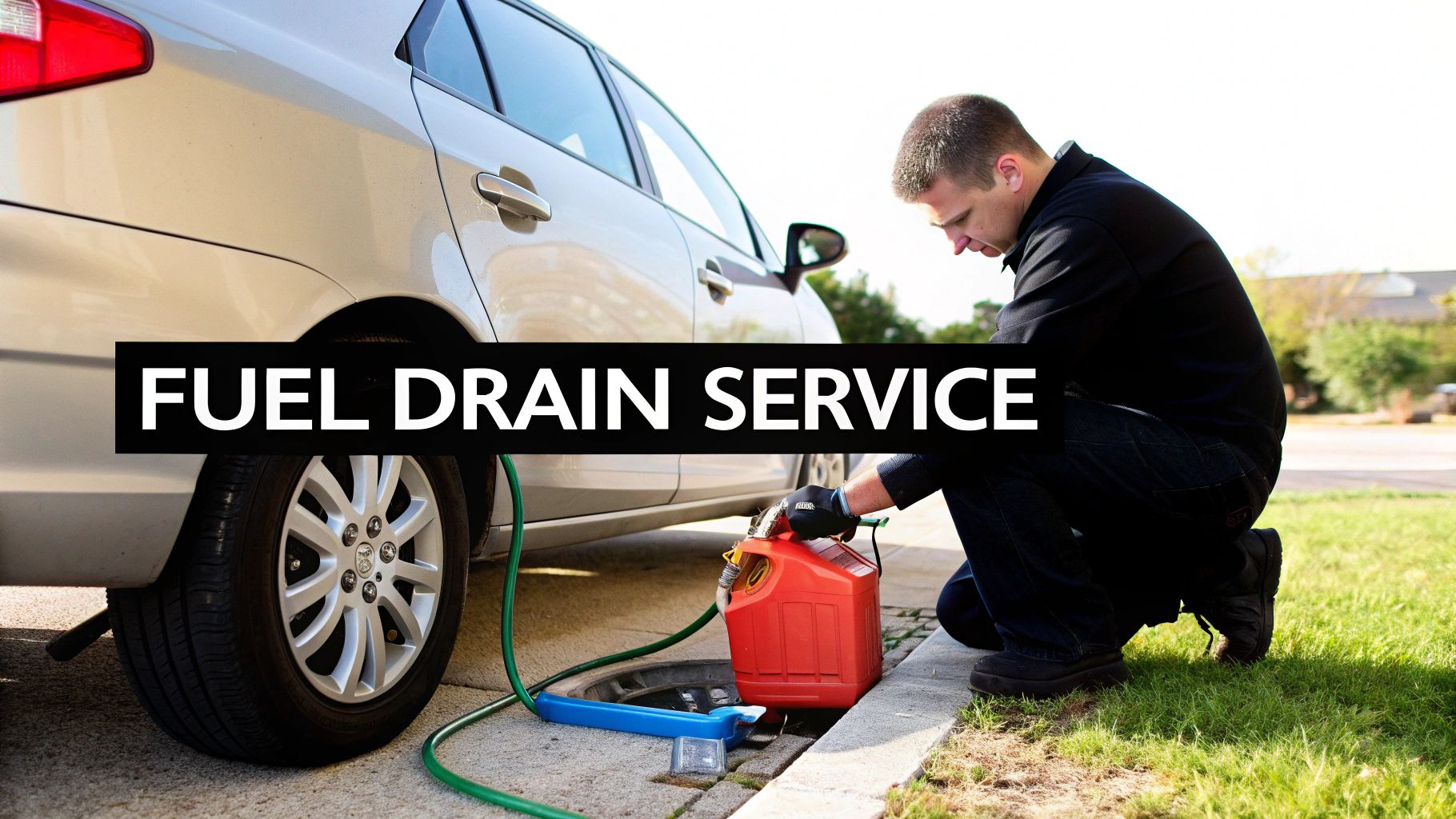
That sinking feeling when you realise you’ve put diesel in your petrol car can feel like a complete disaster. But the solution is often much simpler and quicker than you'd think. Calling a specialist mobile fuel drain service like ours is the single best thing you can do. It's a process we’ve got down to a fine art over thousands of call-outs, designed to be safe, fast, and get you back on your way with minimal drama.
Forget any thoughts of expensive recovery trucks or waiting days for a garage to squeeze you in. A mobile service brings the workshop right to you, whether you're stranded at a busy petrol station, parked on your driveway, or stuck on the side of the road. This on-the-spot fix turns a crisis into a mere inconvenience.
What Happens When the Technician Arrives
From the moment our technician pulls up, their focus is on safety and getting the job done right. Our vans are basically mobile workshops on wheels, fitted out with industry-leading, ATEX-approved pumping gear specifically designed for handling flammable fuels. This isn't a DIY job with a bit of hose; it's a professional procedure that sticks to strict safety and environmental rules.
First, they'll quickly assess the situation, confirming your car's details and roughly how much of the wrong fuel is in the tank. Then, they'll secure the area around your vehicle to create a safe working zone.
The main event, of course, is the fuel drain itself. A specialised hose is fed into your car's fuel tank, and the powerful pump starts to suck out the entire diesel-petrol mixture. You’d be surprised how quickly this happens – the equipment can empty a full tank in just a few minutes. Every single drop of contaminated fuel is transferred straight into a secure, sealed container inside our van.
The entire process is self-contained and controlled. There is no risk of spillage or fuel being left exposed on the ground. Our commitment is to leave the location exactly as we found it, with the problem cleanly and completely resolved.
More Than Just Draining the Tank
Just emptying the tank is only half the battle. To make sure your car runs perfectly and to prevent any lingering problems, the whole fuel system needs to be cleansed of that oily diesel residue. This is where a professional's experience really counts.
After the main drain, our technicians will systematically flush the system. This involves a few key steps:
Clearing Fuel Lines: Fresh, correct petrol is circulated through the fuel lines to push out any trapped diesel.
Flushing the Fuel Rail and Injectors: We make sure the components that deliver fuel to the engine are totally clean and free from residue.
Checking the Fuel Filter: The technician will inspect the fuel filter for signs of clogging and let you know if it needs replacing for the best performance.
Once the system is flushed clean, we add a good amount of the correct, fresh petrol to your tank. The final, crucial step is to start the engine. We let the car run for several minutes, keeping a close eye on its performance to ensure it’s running smoothly, just as it should. The job is only considered done when we are 100% satisfied that the car is performing perfectly.
Safe Disposal and Getting You Moving
A big part of the service that often gets overlooked is what happens to the contaminated fuel. That mix of diesel and petrol is classed as hazardous waste and can't just be poured down a drain. We take care of all that for you, taking the collected fuel to a licensed waste management facility for safe and environmentally friendly disposal.
The whole on-site procedure, from the moment we arrive to you driving away, typically takes between 60 and 90 minutes. It's a comprehensive service designed to provide a complete fix. For a deeper dive into what to expect, you can explore our essential guide to misfuel recovery services.
To make it even clearer why a specialist service is the smart choice, let's compare it to going through a main dealer or a general garage.
Comparing Misfuel Solutions: Professional Drain vs. Dealer Repair
Factor | Misfuelled Car Fix (Specialist Mobile Service) | Main Dealer or Garage Repair |
|---|---|---|
Location | We come to you: roadside, home, or petrol station. | You must arrange for your vehicle to be towed to their workshop. |
Speed | Typically on-site within an hour; job done in 60-90 minutes. | Can take several days, depending on their schedule and parts availability. |
Cost | Fixed, transparent pricing. Far more cost-effective. | Often significantly more expensive due to labour rates, towing, and potential for unnecessary parts replacement. |
Process | Specialist equipment for safe drain & system flush on the spot. | May involve stripping down parts of the fuel system, adding time and cost. |
Ultimately, the choice is clear. A professional mobile drain is the fastest, safest, and most cost-effective way to handle putting diesel in a petrol car. It skips the need for towing and avoids the higher costs and longer waits you'll almost certainly face with main dealers, getting you back on the road with complete confidence.
Simple Habits to Make Sure This Never Happens Again
After the stress, hassle, and cost of fixing a misfuelled car, you’ll want to make absolutely sure it’s a one-time mistake. The good news is, preventing it is pretty straightforward. It all comes down to building a few simple, conscious habits that make grabbing the right nozzle at the pump second nature.
This isn't about just vaguely "paying more attention." Life is full of distractions. What you need is a deliberate routine—a mental checklist you run through every single time you fill up, no matter how much of a hurry you're in. Making these small checks automatic is your best defence against another expensive error.
Create a Deliberate Fuelling Routine
The most effective way to beat this is to build a sequence of checks that becomes muscle memory. Your goal here is to snap yourself out of the autopilot mode that causes these slips in the first place. Before the nozzle even gets close to your car's filler neck, pause and consciously run through these steps.
First, just look at the colour of the nozzle. In the UK, it’s simple: petrol nozzles are green, and diesel nozzles are black. This is your most immediate visual clue. Make a habit of saying the colour and fuel in your head: "Green means petrol." It sounds silly, but it works.
Next, actually read the label on the pump, usually right on or near the trigger. It will clearly say "Unleaded" or "Diesel," often with the octane rating like 95. Match this to what your car needs. This simple two-step check—nozzle colour and pump label—slashes the risk of making the same mistake again.
By making a deliberate pause to check the nozzle colour and the pump label every single time, you create a powerful mental firewall. This simple, two-second habit is the most effective way to prevent a repeat misfuelling incident.
Use Physical Reminders and Guards
Sometimes, even with the best intentions, a momentary lapse can happen. That's where a few physical reminders come in handy, adding an extra layer of security when your mind is elsewhere.
A brilliantly simple trick is to put a small, clear sticker inside your fuel flap. A sticker that just says "PETROL ONLY" in bold letters gives you one last, unmissable reminder at the critical moment. You can pick these up online for a couple of quid, and they provide fantastic peace of mind.
If you want a more foolproof solution, you can even get a misfuelling prevention device. These are special replacement fuel caps or inserts that physically block the wider diesel nozzle from ever fitting into your petrol car’s filler neck. It’s a hardware fix that makes it impossible to grab the wrong pump.
Manage Your Environment
Finally, take control of what you can control. The forecourt is a busy, distracting place, but you can minimise your personal risk by managing your focus.
Ditch the Distractions: Put your phone away before you even get out of the car. Don’t try to have a conversation while you’re selecting the pump. Fuelling only takes a few minutes, so give it your undivided attention.
Don't Rush: Feeling hurried is a recipe for mistakes. Take an extra breath and just slow down. The few seconds you might save by rushing aren't worth the hours of hassle and hundreds of pounds a misfuel will cost you.
Beware of Unfamiliar Cars: Misfuelling is incredibly common when driving a hire car or a vehicle you're not used to. If it's not your regular car, make it your number one priority to double-check the fuel type before you even set off for the petrol station.
Your Top Questions Answered: Diesel in a Petrol Car
After the initial shock of putting diesel in a petrol car, your mind probably starts racing with questions. It’s a stressful spot to be in, and you need clear, straightforward answers. Having handled thousands of these exact situations, we’ve heard every question under the sun. Let’s get you some clarity on the most common ones we hear right there on the forecourt.
"I Only Put a Little Bit in. Can I Just Top It Up with Petrol?"
This is always the first question, and it comes from a place of hope – a hope that the problem can be easily diluted away.
For any modern car, the answer is an emphatic no. Even a small amount of diesel, say 5% of your tank's capacity, is more than enough to cause serious issues.
Think of it this way: diesel is a thick, oily fuel. Petrol is a thin, volatile one. A petrol engine is designed for a fine mist of fuel to be ignited by a spark. When you introduce oily diesel into that mix, it simply won't combust properly. Instead, that sludgy concoction will:
Coat your spark plugs in an oily film, stopping them from firing.
Start clogging up your fuel filter.
Risk poisoning expensive, sensitive parts like oxygen sensors and your catalytic converter.
An old banger from the 80s might have coughed and spluttered its way through a tiny bit of contamination, but today’s high-precision fuel injection systems have zero tolerance for it. The potential cost of engine damage far outweighs any savings you think you're making by avoiding a drain.
Attempting to "dilute" the diesel is a gamble you are almost certain to lose. The risk of causing thousands of pounds worth of damage to injectors, sensors, and your catalytic converter makes it a false economy. Always, always opt for a professional drain.
"Will My Breakdown Service Cover a Fuel Drain?"
This is another common source of confusion. People assume their breakdown cover will sort it out, but you need to check the small print very carefully.
Most standard breakdown policies are there to cover mechanical failures – a snapped fan belt, a dead battery, that sort of thing. Misfuelling is almost always classified as "driver error," which puts it outside the scope of basic cover. They’ll likely offer to tow you to a garage, but you'll be on the hook for the full repair bill once you get there.
Some premium policies or specific "misfuel cover" add-ons will pay for the cost of a drain. But even then, you need to check the policy excess. In some cases, the excess you have to pay could be more than the cost of calling a dedicated mobile service like ours directly.
In short, don't assume you're covered. Calling a specialist directly is often the fastest, most direct, and cheapest solution, cutting out the need for towing and long waits at a garage.
"How Long Does the Fuel Drain Actually Take?"
Drivers are often amazed at just how quickly this kind of disaster can be completely resolved. A professional mobile fuel drain is a slick, on-the-spot procedure designed to get you moving with minimal fuss.
From the moment our technician arrives at your car, the whole job is usually done and dusted in about 60 to 90 minutes. That’s not just for the drain itself; it covers the entire process to make sure your car is 100% clear of contamination.
Here’s what that involves:
Draining the Tank: Safely pumping out the entire contaminated mixture.
Flushing the System: Pushing fresh petrol through the fuel lines, pump, and injectors to clean out all that oily residue.
Adding Fresh Fuel: Putting in enough fresh, correct petrol to get you safely on your way.
Running the Engine: Starting the car and running it for a few minutes to ensure everything is operating smoothly.
Once our technician gives you the all-clear, you can drive away immediately. There's no waiting around. The whole service is geared towards getting you back on your journey as quickly and safely as possible.
"Oh No! I Drove the Car Before I Realised. What Now?"
This is a more serious situation, but it's usually fixable without catastrophic damage – as long as you act fast. If you've driven the car, the bad fuel has circulated right through the engine.
The most important thing is to stop the car as soon as you notice the symptoms. If it starts sputtering, chucking out smoke, or losing power, pull over safely and turn the engine off. Then call for professional help.
The fuel drain process is a bit more involved because a more thorough flush of all the engine components is needed, but it’s still very effective. A specialist has the right tools and know-how to clean the entire system and get the engine running properly again. The longer you drive, the higher the risk of doing permanent damage, especially to the catalytic converter. Stop immediately and make the call.
If you've put diesel in a petrol car, don't panic and definitely don't start the engine. For a fast, professional, and cost-effective solution, contact Misfuelled Car Fix. Our 24/7 mobile service will come directly to you and get you safely back on the road in no time. Find out more at https://www.misfuelledcarfix.co.uk.
Article created using Outrank